
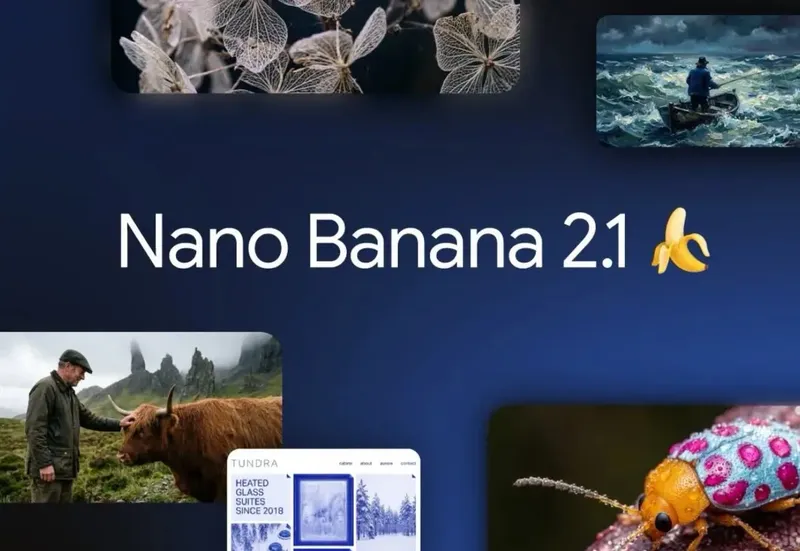
IT之家 News on October 7: Google today officially released Nano Banana 2.1, an upgraded version of the company's AI image generation and editing model. Google emphasized that the new Nano Banana 2.1 achieves improvements across the board, with particularly notable progress in visual design, mask-based image editing, and subject consistency.
Earlier this year, Google launched Nano Banana 2, also known as Gemini 3.1 Flash Image. Nano Banana 2 combines the high-speed characteristics of Google's Flash series of models with image output quality on par with Nano Banana Pro. Google also brought down to this lower-tier model several features that previously belonged to the Pro version, including a real-world knowledge base, optimized text rendering, and improved consistency for characters and objects.
IT之家 noted that Nano Banana 2.1, building on its existing capabilities, mainly makes improvements in three major directions:
Visual design: Nano Banana 2.1 can generate visual assets with better composition and higher completeness.
Mask editing: Users can more precisely select and modify localized regions of an existing image without regenerating the entire picture.
Subject consistency: When performing edits or batch-generating multiple related images, the model can better preserve the appearance and features of the image subject.
The improved subject consistency is highly practical for Gemini users, ensuring that the same person or object maintains a consistent appearance across multiple generation results. Google's Nano Banana 2.1 is now being rolled out gradually, covering the Gemini app, Google Search's AI Mode, Google AI Studio, Google Flow, Stitch, Google Ads, and the Gemini enterprise platform.
For developers, Nano Banana 2.1 is now officially available, with the model ID gemini‑nano‑banana‑2.1; the model supports text, image, audio, and video input, and can output images at 1K, 2K, and 4K resolutions.
At present, OpenAI's ChatGPT Images 2.5 remains the world's leading image generation and editing model. When a user keeps fine-tuning an image, it is better at preserving the results of previous edits, does not alter unedited regions, and does not degrade the original image quality through repeated iterations. Following closely behind this OpenAI product is Microsoft AI's MAI‑Image‑2.6 model, which was released in August this year.