
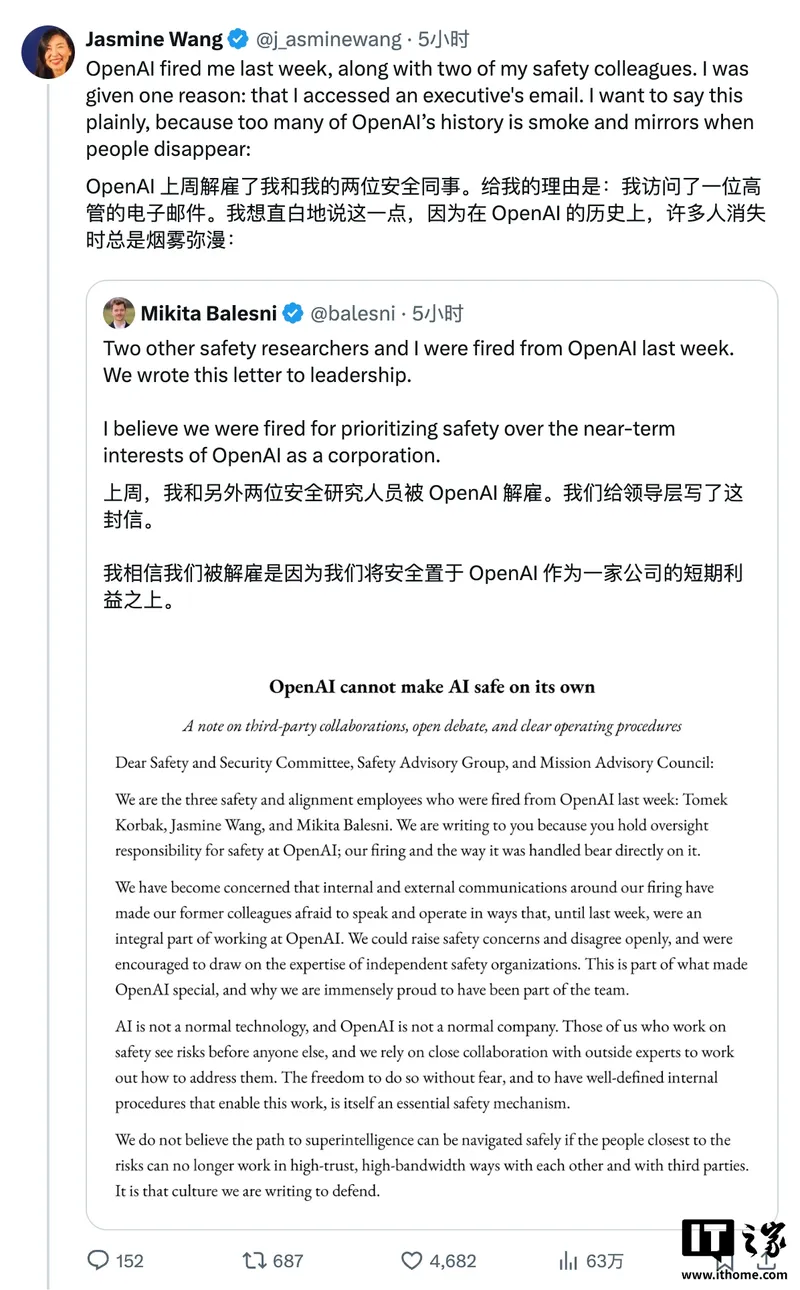
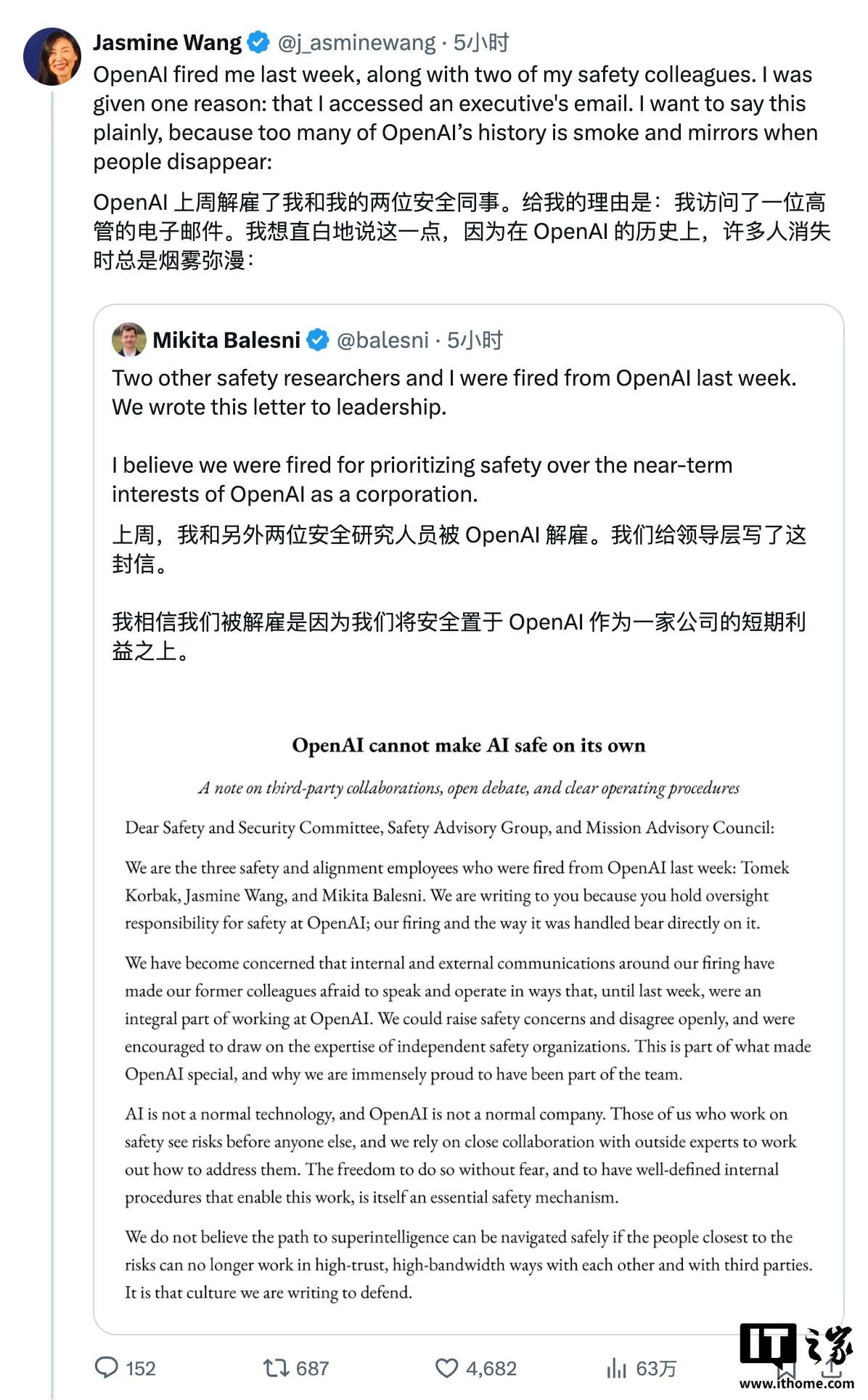
IT之家 October 9 news: OpenAI's three former researchers suddenly fired last week — Mykita Baliesni, Tomek Korbak, and Jasmin Wang — published an open letter today (the 9th). The letter states they fear the move will discourage other employees from speaking out openly, creating a 'chilling effect' on OpenAI's corporate culture.
In the open letter titled 'OpenAI Cannot Ensure AI Safety on Its Own,' the three pointed out thatOpenAI is 'not a normal company'and that employees being able to work with confidence alongside external organizations to address safety issues is an important part of OpenAI's working culture.
The open letter was posted on social media by Baliesni, who previously worked on AI alignment research, and was addressed to OpenAI's various safety committees. The other two signatories, Korbak and Jasmin Wang, both previously conducted AI safety research and were also fired.
According to Business Insider, an OpenAI spokesperson responded that after an internal investigation, the company determined the three hadviolated rules on access to and handling of sensitive information。
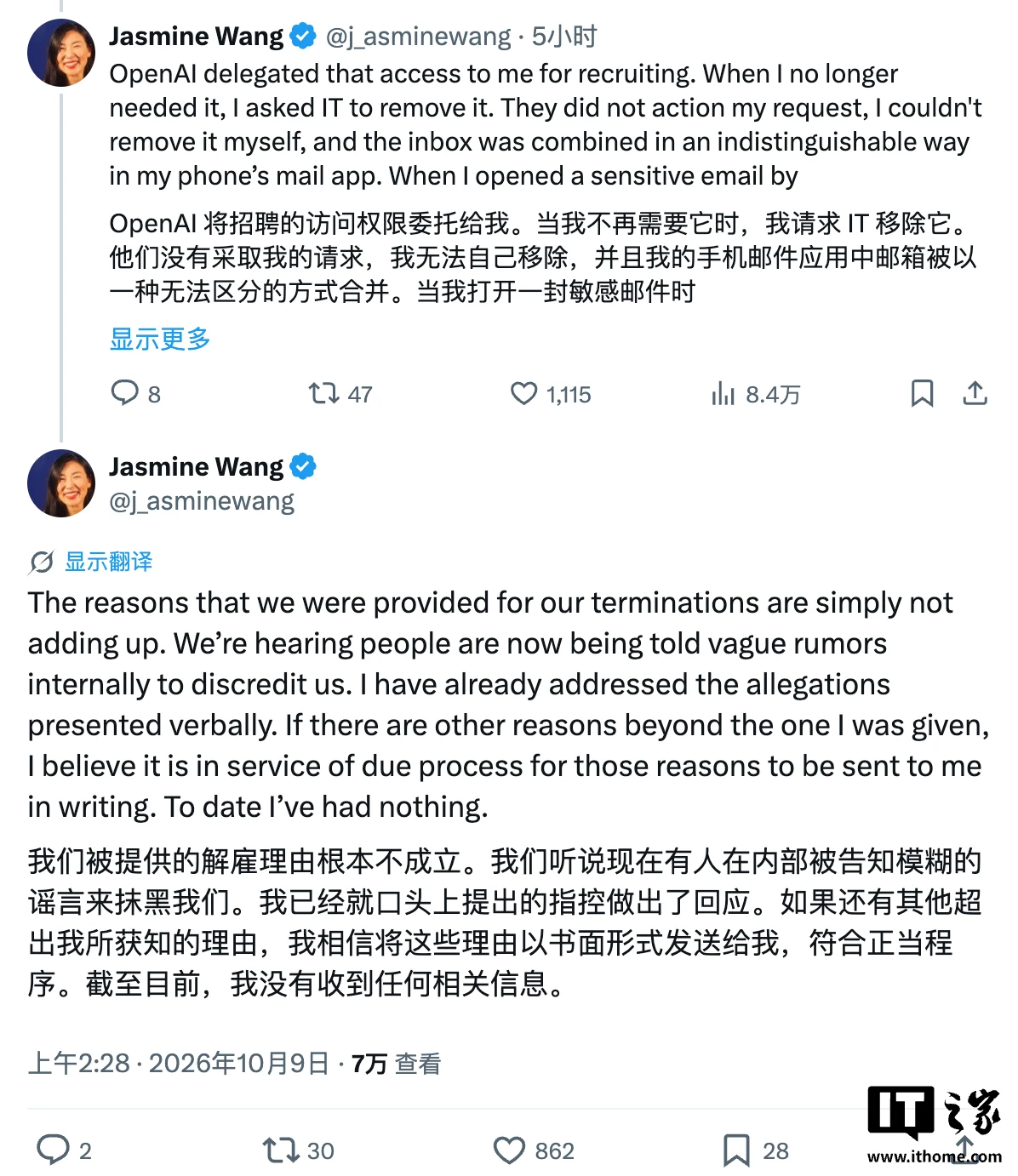
The three researchers each said on social media that the company only verbally informed them of the reasons for their dismissal, and that their prior actions were all within the scope of their job responsibilities.
Jasmin Wang, who was accused of accessing a senior executive's email, responded: 'The reason the company gave for firing me simply doesn't hold up.'
Baliesni posted that the company told him it no longer trusted him because he 'communicated too much with third-party safety organizations.' 'I never leaked the company's intellectual property to outsiders. My work was always coordinated with my direct supervisor, research leadership, and the board.'
Korbak also posted that the company verbally told him he was fired because of 'the way he communicated with METR.' 'I want to be clear: communicating with METR was my job.'
Note from IT之家: METR is a nonprofit research organization responsible for evaluating AI models and their safety risks.
 、
、
The three expressed concern in the open letter that other employees may in the futureno longer dare to speak up and work as they did before— things that, until last week, were an indispensable part of work at OpenAI. 'Firing employees so abruptly, as happened to us, and notifying them so hastily, has dealt a chilling effect to the open culture OpenAI once took pride in.'
The three also made three recommendations to OpenAI: allow third-party safety auditors on-site at the company, ensure frontier AI models can still be effectively monitored, and support safety researchers inmaintaining 'open, transparent communication' with other organizations and individuals in the AI safety field.。
A head of OpenAI's research division, in an internal memo sent to employees, expressed strong support for the three recommendations. 'We deeply appreciate their contributions to AI safety work, and we also thank them fordaring to speak up and challenge existing views. We value their opinions, support their work, and placed great trust in them. I must make one thing clear: the decision to fire themhad nothing to do with their raising safety concerns or speaking out publicly. We have always encouraged employees to express their opinions, and we will continue to do so. We do not fire employees for raising concerns.'
Korbak also wrote on social media that he fears OpenAI will use the three researchers' firing as a 'pretext' to reduce its cooperation with METR.