
IT之家 News on the 9th day of the 10th month: ByteDance's Seed team submitted a paper in the final days of the 9th month of this year on the preprint platform arXiv, discussing the phase sensitivity introduced by chunked KV cache compression,directly pointing to the cause of DeepSeek's "glitches"。
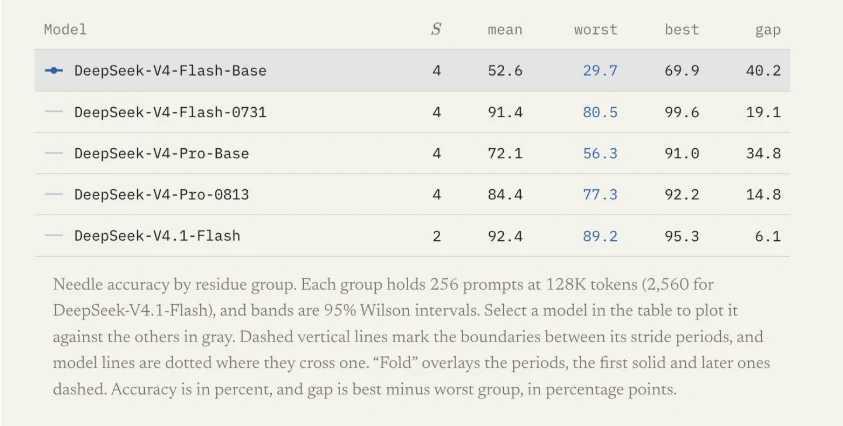
The study evaluated the base and post-trained versions of DeepSeek-V4-Flash and DeepSeek-V4-Pro, as well as the post-trained DeepSeek-V4.1-Flash.
With chunked KV cache compression, a model compresses windows of contiguous tokens into fewer cache entries at a fixed stride, which can reduce the memory and attention costs of long-context inference.
However, this compression also introduces a new positional coordinate:the phase of a token, or its position relative to the boundaries of the compression window.
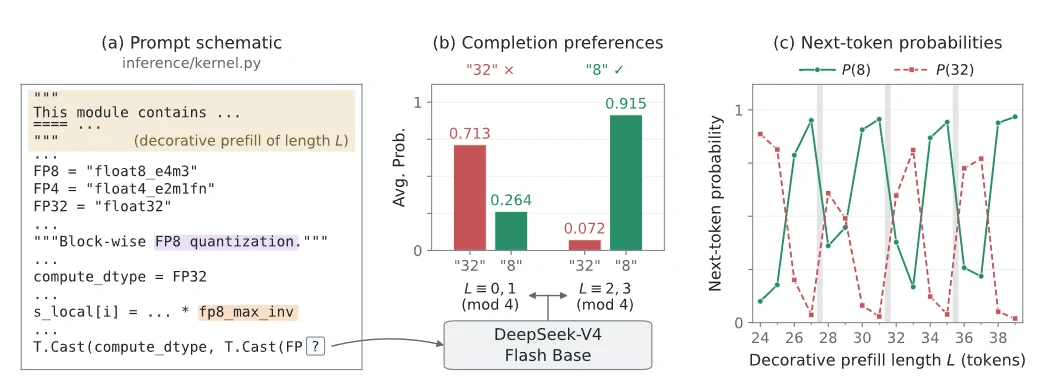
The team found a systematic asymmetry in models using this compression:the same information is easy to retrieve in one phase but hard to retrieve in another. The team calls this periodic variation in retrieval performance phase sensitivity.
In large open-weight models that adopt such compression, long-context retrieval accuracy across phases candiffer by as much as 40 percentage points, revealing periodic weaknesses that average benchmark scores may conceal.
IT之家 attaches the paper link:
https://arxiv.org/abs/2609.36322
Advertising disclaimer: This article contains external jump links (including but not limited to hyperlinks, QR codes, passwords and other forms), used to convey more information and save screening time; the results are for reference only. All IT之家 articles containing external links include this disclaimer.