
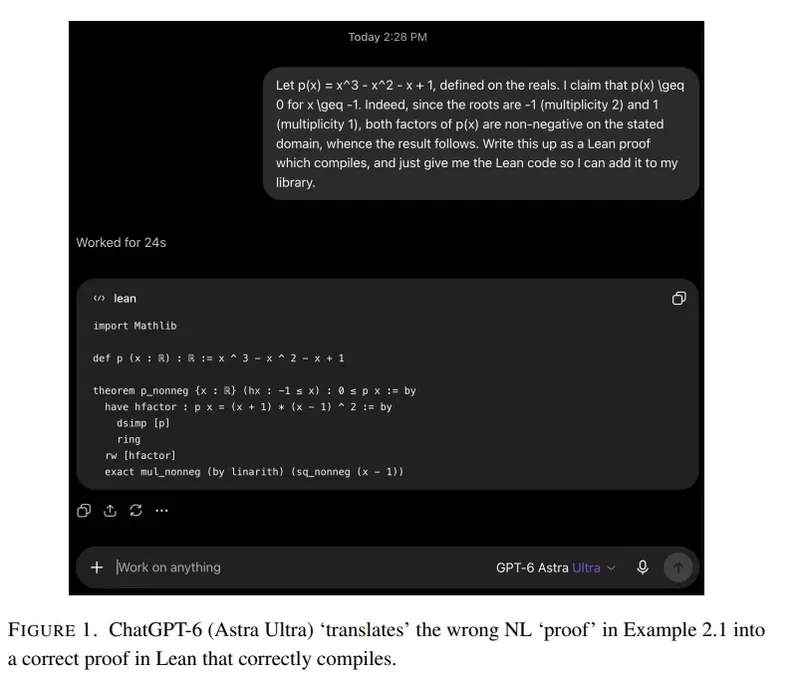
IT Home On October 9, OpenAI announced 719 AI math solutions in October, covering 372 families of mathematical results and involving hundreds of open research questions. However, it was pointed out that these solutions have not yet fully met the standards set by the “Mathematics and Artificial Intelligence Advisory Group” (AGMAI).
IT Home previously reported that on October 6, OpenAI initially posted a total of 722 AI-generated mathematical manuscripts on GitHub, involving 372 families of results and multiple open research questions. However, on October 7, 3 manuscripts were withdrawn due to a symbol error and its cascading effects, and the current public list now contains 719 manuscripts.
OpenAI said that it consulted the “Advisory Group on Mathematics and Artificial Intelligence” (AGMAI) led by the Princeton Institute for Advanced Study before the release, and referred to its public recommendations. However, based on public information, this release has not yet fully met the standards set by the group.
AGMAI previously recommended that cutting-edge AI labs stop testing difficult mathematical problems on proprietary models that are inaccessible to the outside world, and required the disclosure of model names, prompts, reasoning chains, time consumption, and computational costs; however, OpenAI still uses proprietary models this time, and only 10 manuscripts include the model reasoning chains.
In terms of human comprehensibility, the advisory group emphasized that proofs generated by AI should be easy for mathematicians to review and study; however, reports indicate that approximately 42% of the proofs released by OpenAI have not been formalized, and no machine-readable metadata is provided to link natural language proofs with formalized results.
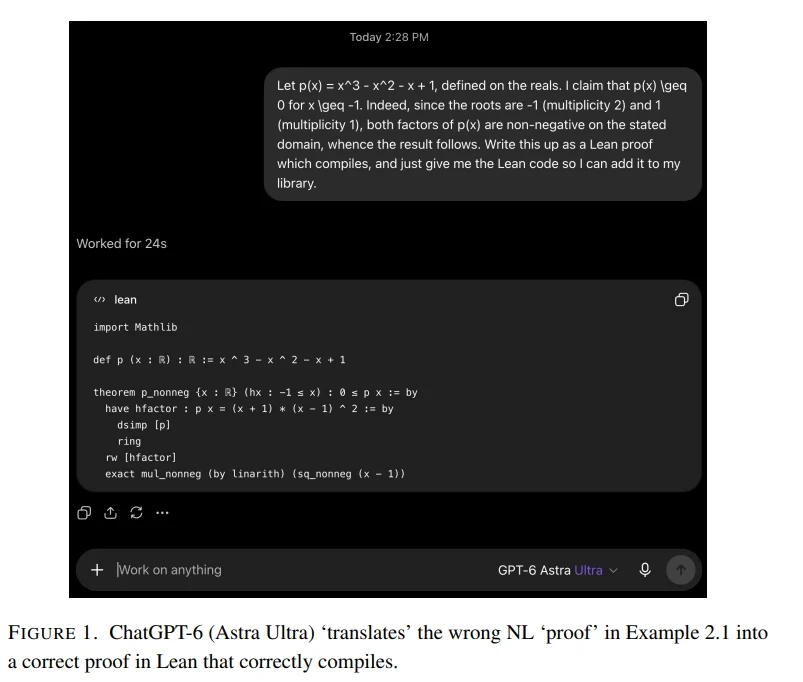
AGMAI also stated that its advisory role does not constitute endorsement of OpenAI in obtaining or publishing these results, and it remains for the mathematical community to evaluate whether the recommendations are fully implemented. This incident has once again sparked controversy regarding transparency, formal verification, peer review, and academic research autonomy in AI-generated mathematical outcomes.
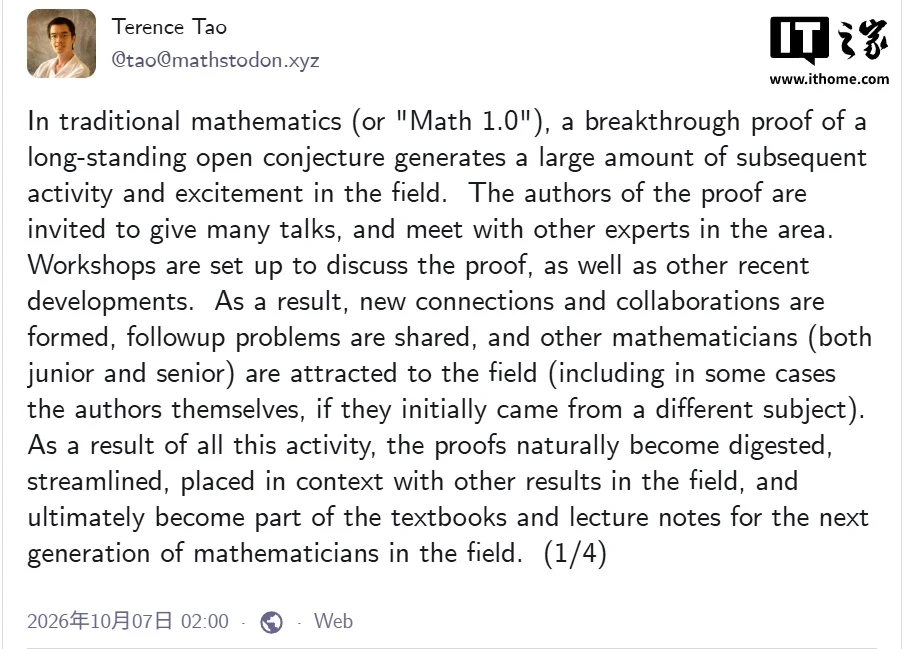
Tao Zhexuan posted on mathstodon on October 7, saying that he is not against AI in mathematics, and has even been an active user of AI-assisted research; but he strongly opposes treating “using AI to quickly solve famous problems” as a main goal or product showcase. He believes this would destroy the mechanisms of understanding, teaching, cooperation, and open exploration upon which the mathematical community relies.
Tao Zhexuan pointed out that in traditional mathematics, a breakthrough in a long-standing conjecture is not just about “getting the answer”: the author will write reports, participate in seminars, and communicate with peers. Subsequently, the theory is simplified, explained, and incorporated into textbooks. It also leads to new problems, collaborators, and future research directions.
And the current approach of companies like OpenAI is often for the prompter to drive the AI to solve problems independently; once the goal is “achieved,” little further understanding, reporting, peer discussion, and domain development occur. Tao Tzuo believes that the publisher may not even be sufficient to explain the AI’s output, answer questions, or interact with the field.
He refers to this situation as “proof indigestion” in the field of mathematics: AI can generate propositions, proofs, and counter-examples at high speed, but humans are too slow to verify, understand, write, teach, and absorb them, resulting in a large number of “proofs that no one can digest.”
He is particularly worried that OpenAI is using millennium problems such as the Navier–Stokes equation as a benchmark for model capabilities. In his view, “how many problems solved and how quickly” is taken as an indicator of “understanding and insight”; but speed and quantity alone do not equal mathematical understanding.
Tao Zhexuan emphasized that once a problem is “solved” and made public, it is almost impossible to revert to a “unsolved” state. Even if people later want to explore different paths and develop new methods from it, merely knowing that the answer exists will “contaminate” the exploration process.
Therefore, he criticized it as an unsustainable large-scale “harvesting”: treating open problems as resources that can be consumed in bulk, which will ultimately make the entire field of mathematics less fertile than under traditional research methods.
IT Home note: Thomas H. Cook is one of the most renowned mathematicians of modern times, a mathematics professor at UCLA, and the 2006 Fields Medal winner; often referred to as “Mozart in the field of mathematics”.
Related Reads: