
Yunzhong, from Aofe Temple
Quantum Bit | Public Account QbitAI
The agent is entering enterprises, but there are still many challenges from demonstration effects to production applications:
Complex task chains are long, and multiple agents find it difficult to cooperate efficiently; business experience is hard to accumulate, and each execution may require repeated trial and error; computing power investment continues to increase, but operational efficiency may not improve accordingly.
In addition, data permissions, security isolation, and abnormal recovery also directly affect whether an enterprise can use it with confidence.
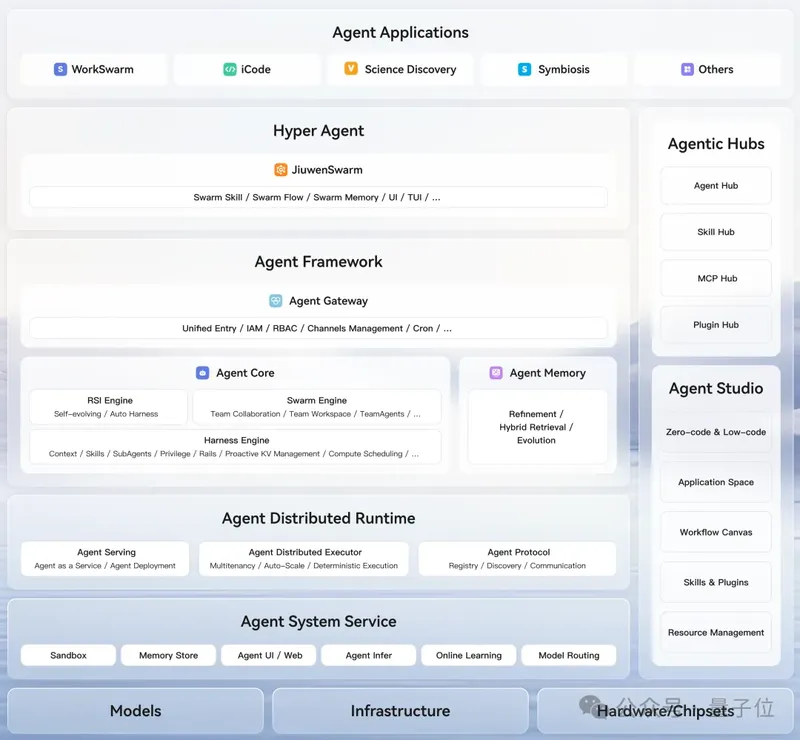
These issues need to be addressed through the system capabilities involved in development, operation, and management. For the large-scale implementation of enterprise intelligent agents,openJiuwen, an open-source AI Agent platform built by teams from Huawei 2012 Laboratory, Huawei Cloud, Computing, Terminals, and Computing Power Pioneers, along with universities and enterprises, has been released and made open source for enterprise-level AgentOSIt integrates multi-agent collaboration, self-evolution, compute affinity, and enterprise-level security and reliability capabilities into a unified base, and connects upper-level intelligent application systems with underlying models and compute resources through a plugin-based architecture and an open ecosystem.
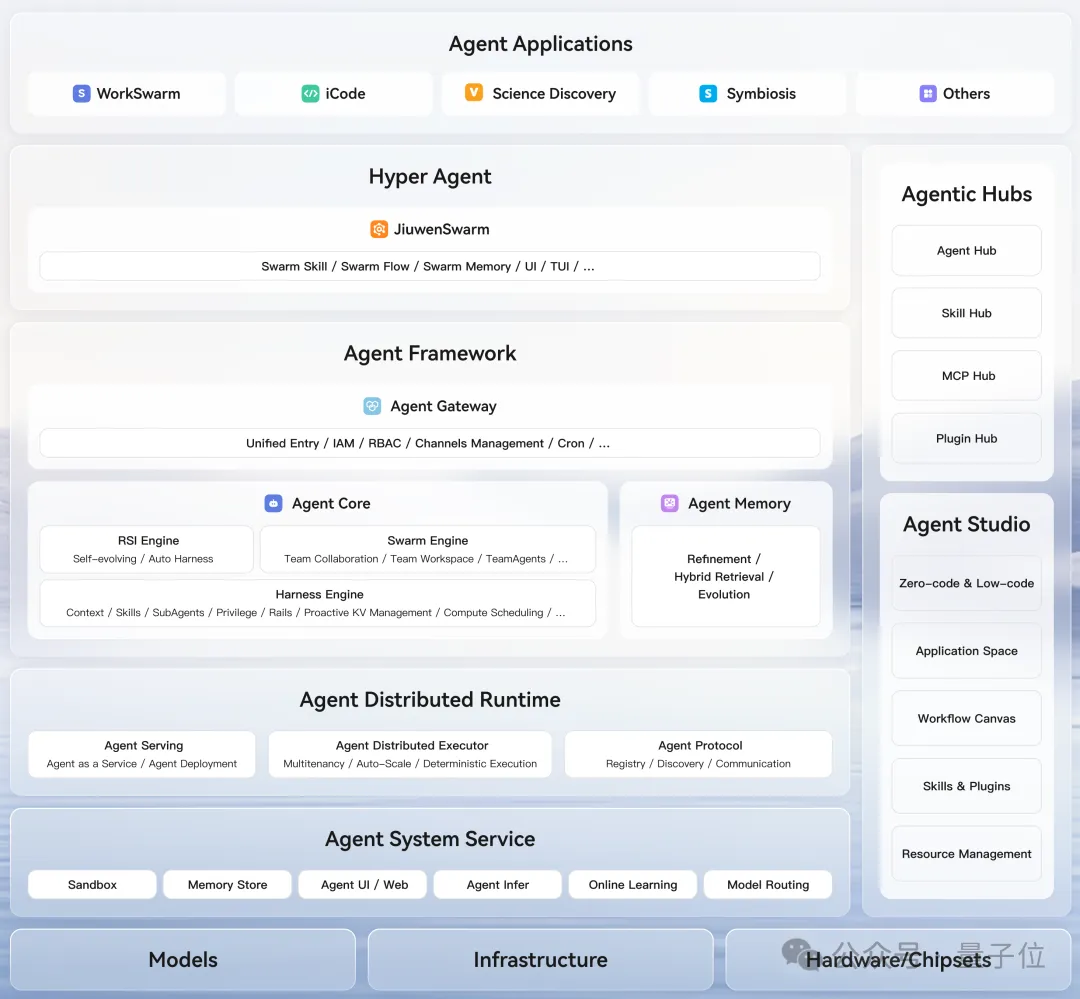 △Jiuwen AgentOS overall architecture diagram
Native multi-agent system, enabling orderly collaboration for complex tasks. Through swarm coordination and workflow orchestration, AgentOS supports task decomposition, role assignment, and parallel execution. It organizes different stages such as research, analysis, and writing, and allows humans to participate in judgment at key stages, making the collaboration process of the intelligent team more controllable.
Self-evolving native, allowing task experience to continue accumulating. Based on execution trajectories, user feedback, and memory mechanisms, AgentOS enables agents to optimize their skills and collaboration methods, turning effective experience into reusable capabilities, reducing repetitive trial-and-error, and adapting to ever-changing business requirements.
Computing affinity and enterprise-level operating foundation, enabling the agent to work more efficiently and stably. Through soft and hard coordination, resource scheduling, and inference optimization, AgentOS improves the utilization of computing power; through multi-tenant isolation, security sandboxes, permission management, and security safeguards, data access and tool calls are restricted, and mechanisms such as fault recovery support high-reliability continuous operation of tasks.
Plugin-based AgentOS architecture and an open northbound ecosystem, enabling capabilities to be combined as needed and industry experience to be reused continuously. AgentOS transforms capabilities such as model invocation, tool invocation, and memory management into plugins, supporting on-demand loading and custom extensions. In the northbound ecosystem for applications and developers, five types of assets—skills, connectors, plugins, experts, and expert groups—can be flexibly combined, and are published, obtained, and shared through the Agentic Hub. Partners can reuse mature capabilities, as well as deposit industry methods, system connections, and team collaboration experiences into their own assets, reducing redundant development and accelerating the implementation of industry AI agents and integrated machine solutions.
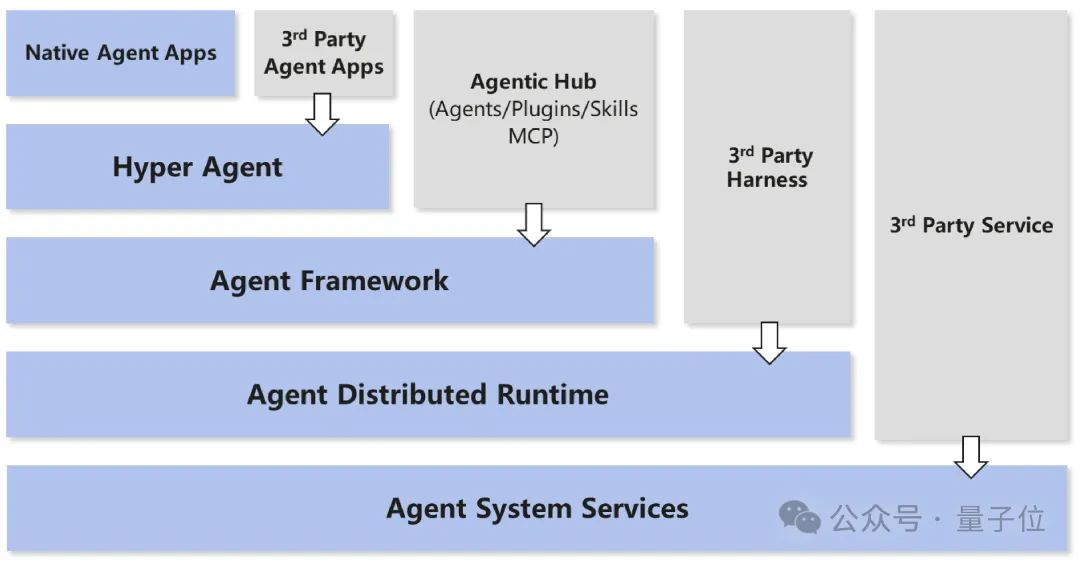 △Plugin-based AgentOS architecture and Agentic Hub north-facing ecosystem
These technical capabilities are also being transformed into more convenient enterprise delivery solutions through integrated machines. At the Huawei Connect 2026 (HC2026) conference, Huawei launched an open-source Agent acceleration platform and solution based on Jiuwen AgentOS for integrated machines, leveraging a series of hardware components to collaborate with partners in creating industry-specific intelligent machine systems.
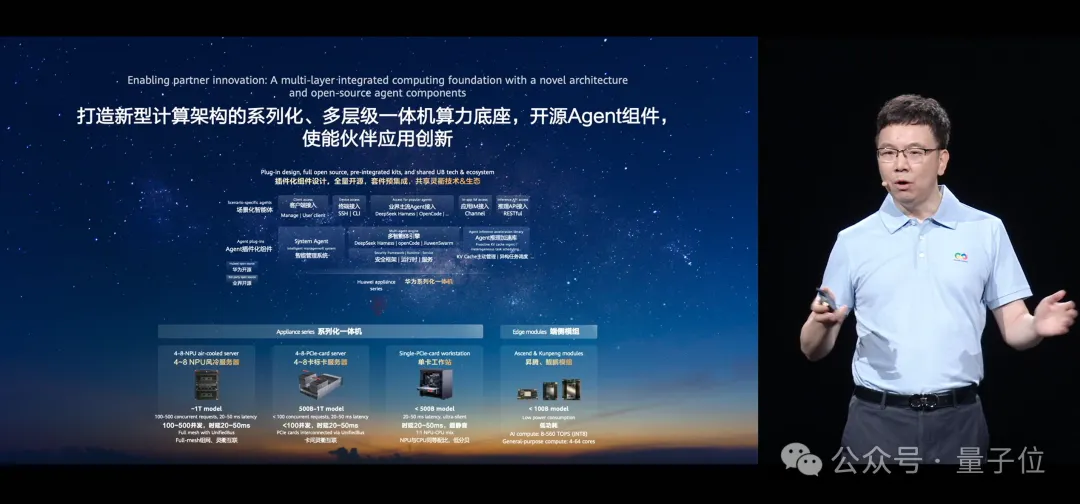 △ Huawei Connect 2026 Unveils a Unified Machine Open Source Agent Acceleration Platform and Solution
Jiuwen AgentOS is a high-reliability/high-secure agent running platform that provides a solid foundation for agent operation. Through a unified agent gateway, a distributed running framework, and a built-in WorkSwarm office/programming workstation, the work of building and adapting everything individually by enterprises is reduced, allowing common capabilities to be used out of the box. The platform includes SystemAgent built in, which supports one-click configuration and management of the integrated machine. According to the conference release information, the platform can achieve hour-level end-to-end private deployment for enterprises, helping companies get access to agents more quickly.
Designed for industry customization, partners can connect to enterprise existing business systems, local knowledge bases, and industry models through open plugins and interfaces, and integrate their professional experience into AgentOS. For example, by configuring intelligent agents that collaborate with each other around internal enterprise data retrieval, analysis, and report generation, the agents can become more closely aligned with actual business operations. As needs evolve, additional skills and applications can be added further.
Jiuwen AgentOS provides partners with a reusable technical foundation, and enables enterprises to obtain an intelligent agent application environment that is easier to deploy, manage, and continuously expand, accelerating the transformation of computing power into business productivity.
Project URLs:
https://atomgit.com/openJiuwen/agentos-enterprise
https://github.com/openJiuwen-ai/agentos-enterprise
*This article is published with the permission of Qbit. The views belong solely to the original author.*