

IT之家 On October 9, Huawei officially released theHarmonyOSthe September (9) Experience Report on the HUAWEI Fan Club, announcing the new changes brought after multiple version upgrades to HarmonyOS PCs in September (9) this year, including the all-new Immersive Light Sense, Gallery AI photo editing, Xiaoyi Task mode, dynamic wallpapers, Huawei Remote Sharing, super-space storage / memory technology, 3D image wallpapers and more.

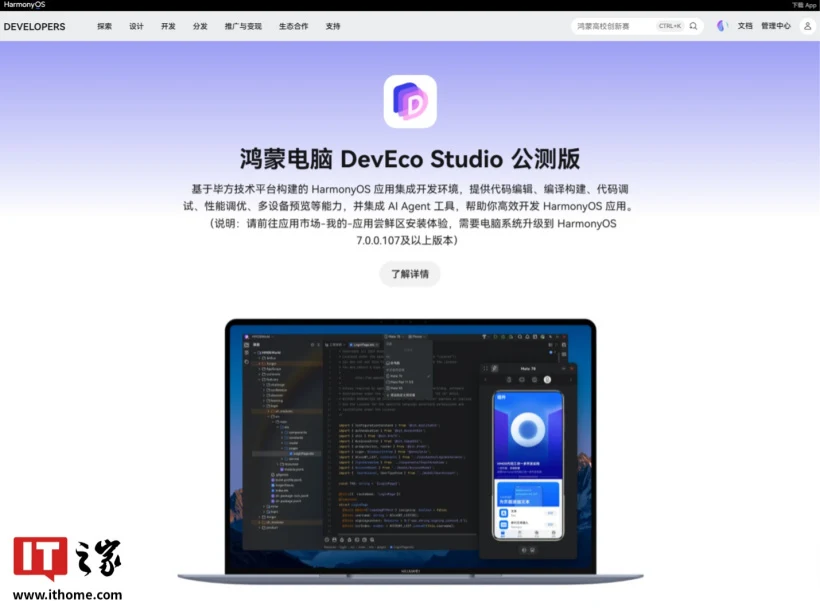
Referring to IT之家's report yesterday,DevEco Studio has also officially launched on HarmonyOS PC and started public beta testing, while the one-stop HarmonyOS app AI development tool DevEco Code and the AI development capability kit DevEco CLI simultaneously ushered in their first public beta for HarmonyOS PC.
According to Huawei's official introduction, this public beta of the DevEco "trio" responds to developers' demands for HarmonyOS computer development tools and AI-assisted R&D, and can improve full-chain efficiency from development and debugging to listing. DevEco Studio supports integrated development and multi-device debugging, DevEco Code provides a one-stop Agentic development experience, and DevEco CLI opens HarmonyOS development capabilities to more Agent workflows.
Further reading
According to IT之家's previous report, at the HarmonyOS Computer New Product Technology Communication Conference held by Huawei on July 29, 2026, Jia Yongli, President of Huawei Terminal Cloud Service Xiaoyi Business Department, introduced the new Xiaoyi Tasks, which can achieve the transformation "from being able to speak to being able to act", supports a multi-agent collaborative architecture, has 2300+ skills across 4 major categories, and can plan autonomously and combine on demand.
Xiaoyi Tasks also support customized emails, browser control and other functions, and can provide capabilities such as analyzing tasks, generating spreadsheets, local search, summary confirmation, desktop file parsing and information retrieval; officially, its on-device WebAgent task success rate is on par with humans.
Regarding the DevEco Code in this public beta, it has built-in GLM5.3 and GLM5.1 models, improves app compilation pass rates and task completion rates through Harness technology, supports users configuring third-party models, and offers three modes—Plan, Build and Goal—covering the entire development process. DevEco CLI provides capability kits for various AI Agents, covering multiple stages from project initialization to debugging log capture, and can quickly streamline the HarmonyOS app development process via the command line.
According to the Huawei developer official website, the HarmonyOS computer version of DevEco Studio released its first public beta version on October 8, 2026. The public beta requires supported models such as HUAWEI MateBook Pro and HUAWEI MateBook Fold 非凡大师, a system version of HarmonyOS 7.0.0.107 or above, memory of 16GB or above, and disk space of 100GB or above.
The Immersive Light Sense mentioned in the article is a set of interface visual capabilities of HarmonyOS that can apply floating tabs and immersive light effects to title bars and bottom navigation, enhancing the visual effect of app core interfaces through materials, interaction and adaptive design.
In addition, the HarmonyOS computer product matrix continues to expand. According to a preview by Zhu Dongdong, President of Huawei Terminal Tablet and PC Product Line, the first HarmonyOS desktop computer, the HUAWEI Qingyun HM650 series, is planned to launch in October 2026, equipped with Huawei's self-developed Kirin X90 chip, mainly targeting commercial office scenarios such as government and enterprises, finance and energy.