
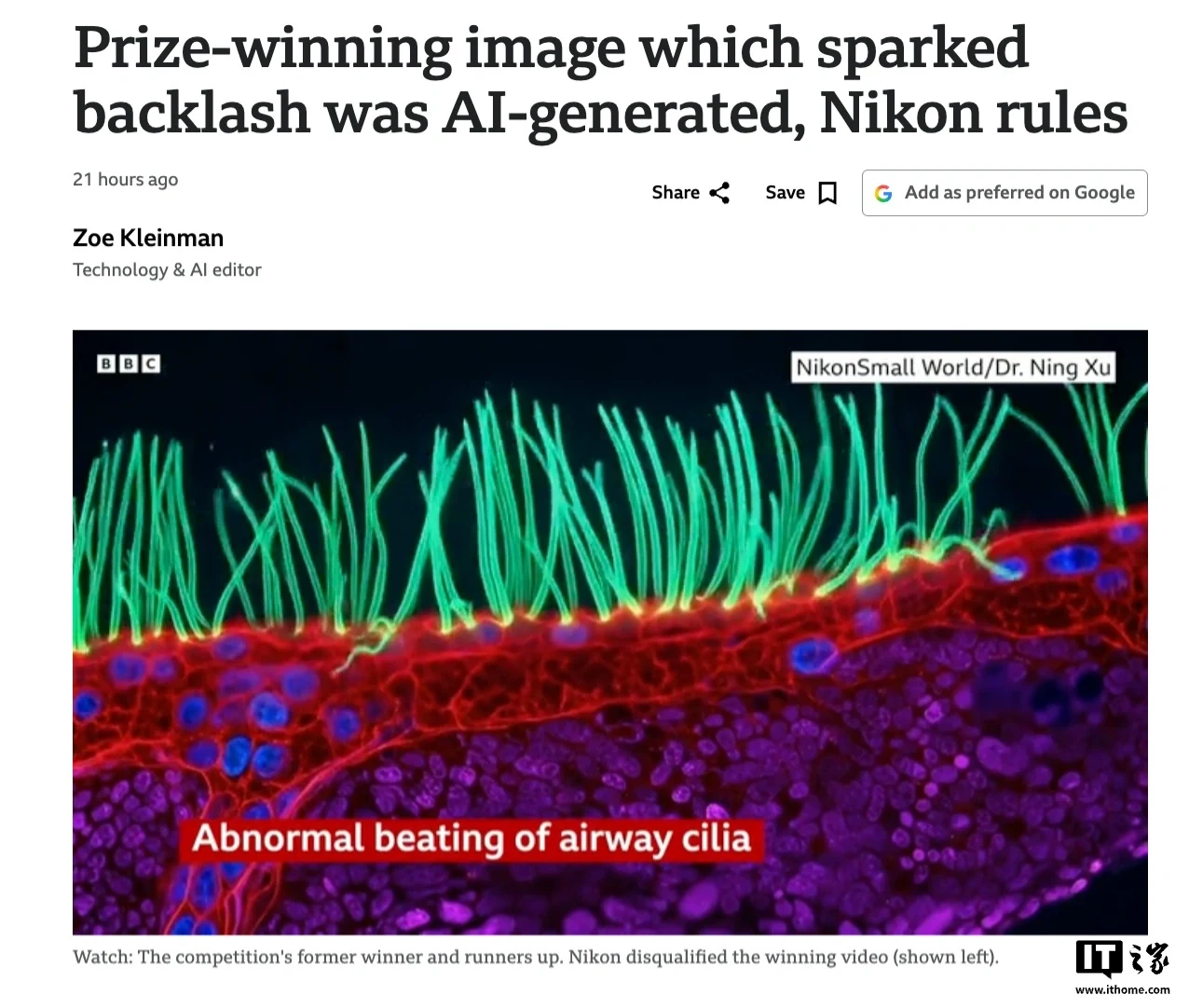
IT Home On October 10, according to a BBC report, Nikon announced that a piece won the first prize in the 2026 Small World in Motion Microvideo Competition was disqualified due to “not meeting the relevant regulations regarding generative AI” in the competition. According to the updated rankings, Vietnamese participant Nguyen Nam Nhat’s work has now risen to first place.
According to IT Home, the original award-winning video was submitted by Dr. Ning Xu from Tsinghua University in China. The video claims to use super-resolution microscopy technology and shows the abnormal movement of cilia in the respiratory tract of a child with Primary Ciliary Dyskinesia (PCD).
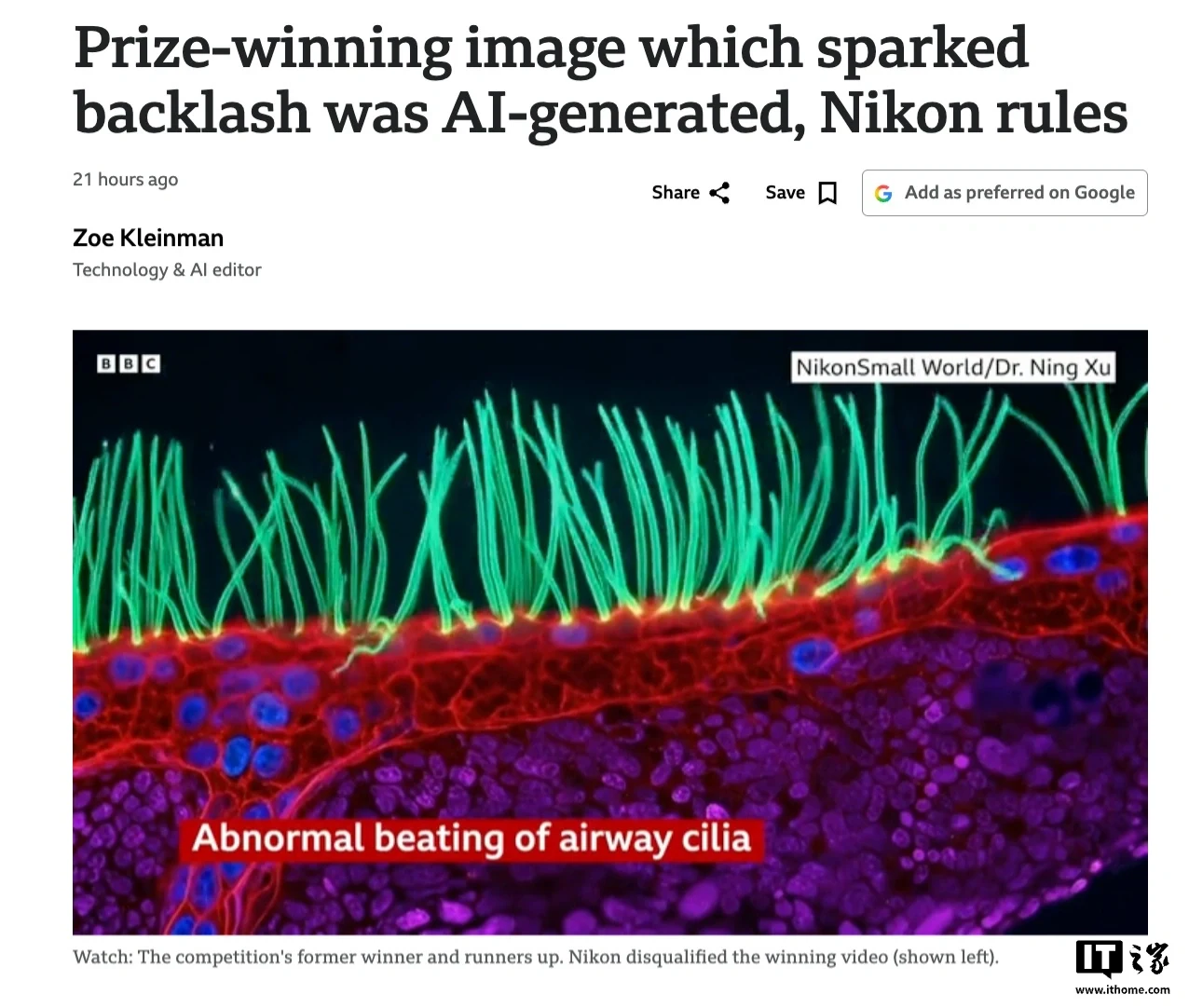
However, experts in the fields of microscopic imaging and cilia research later raised doubts on social platforms, claiming that the structures in the video do not match the real PCD samples. Some purple structures in the video appear suddenly or disappear, while some green cilia seem to appear out of nowhere. The sizes of these structures also do not correspond to known biological structures.
In response to the doubts, Dr. Xu Ning admitted that AI technology was used during the video production process. He explained that AI was employed to distinguish and visualize features in the original grayscale micrographs, and he believed this approach was in line with the competition rules. However, he denied using AI to generate the experimental videos, the cilia structures, or the movement of the cilia. After a re-examination, Nikon determined that Xu Ning’s work did not comply with the rules regarding generative AI in the competition, and decided to revoke his champion status.
As Dr. Xu Ning’s entry was disqualified, Ruan Nanri, who originally ranked second from Vietnam, now becomes the champion of the 2026 Nikon Small World in Motion. His work documented the interaction between a tiny nematode and the single-celled organism Dileptus in the microscopic world, and the rankings of other shortlisted entries are also extended accordingly.