
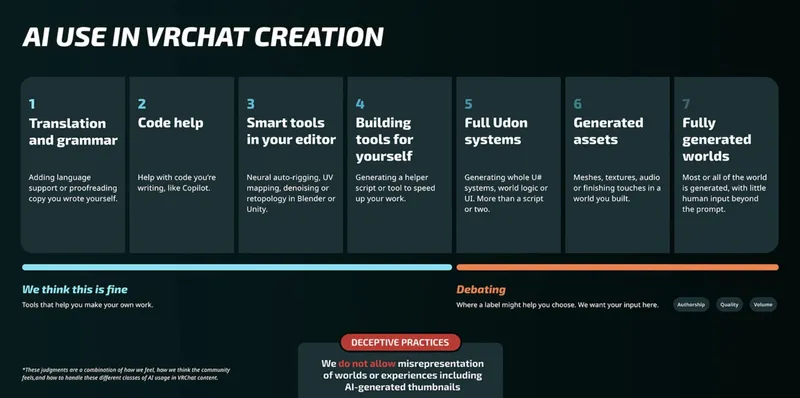
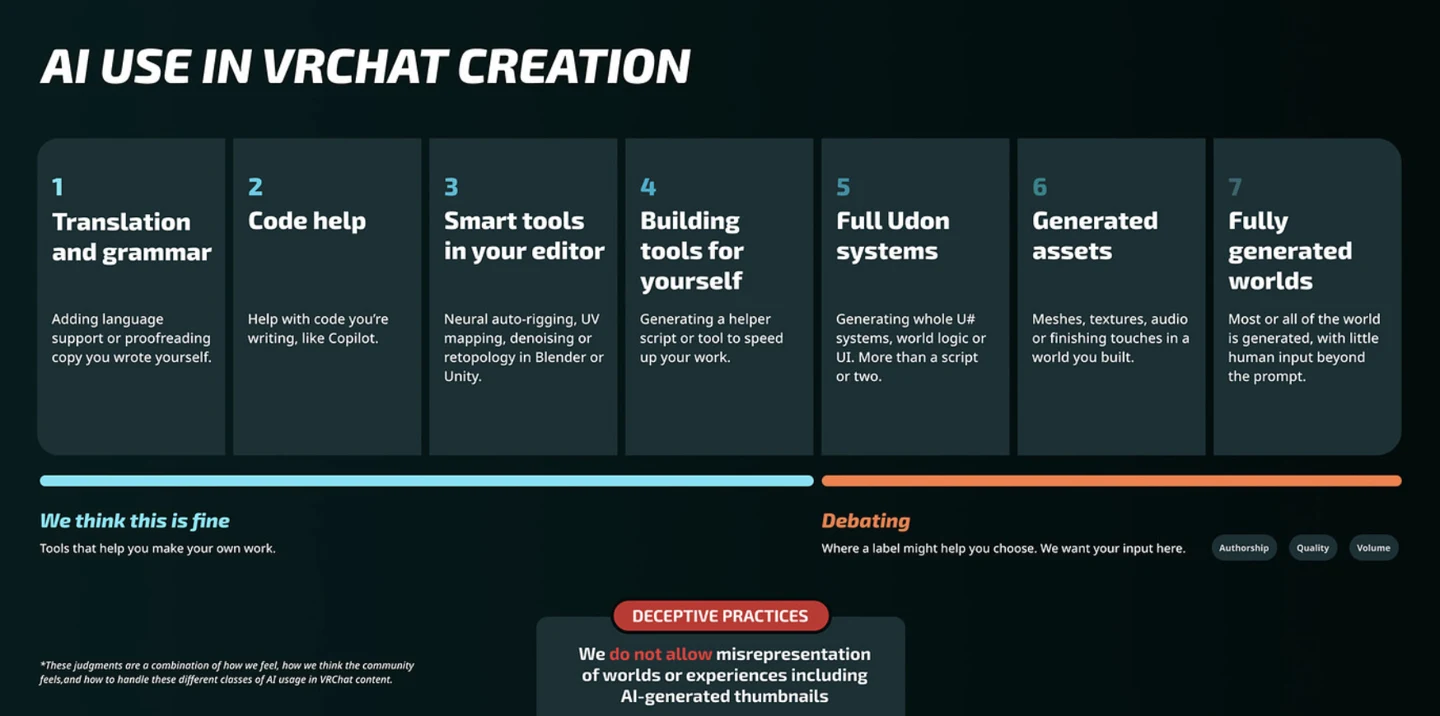
IT Home On October 11, VRChat Inc., the developer of VRChat, announced its guidelines for AI-generated content on October 7, along with a updated creator guide. The official policy explicitly prohibits the use of AI-generated misleading maps / character thumbnails to prevent creators from using thumbnails that do not match the actual content, thereby attracting players’ clicks.
《VRChat》 indicates that the platform has always regarded “free expression,” “human unlimited creativity,” and “the connection between people” as its core values. Although AI technology has improved the efficiency of developers, it has also produced a large amount of low-quality content. In fact, before the widespread use of AI, there were already a number of low-quality maps/characters on the platform. The emergence of AI further reduced the barriers to mass production and publishing of content, allowing a large number of inferior works to flow into the platform, and high-quality content is now more likely to be overwhelmed.
《VRChat》 also revealed that there are differences in the internal team’s views on AI. Some employees use AI to automate work processes or fill gaps in their knowledge, while others have deeper concerns about AI. Recently, an incident occurred on the VRChat website: AI placeholder art materials used for page layout were mistakenly placed in the officially launched web pages, resulting in a decline in the platform’s reputation.
Regarding the “AI tag” statement that players are concerned about, VRChat believes that although such statements can help players quickly identify which items use AI, there is still no clear consensus within the internal team. Therefore, VRChat is open to introducing the AI tag system, but has not promised that it will definitely be implemented.
In addition to the AI policy, VRChat plans to introduce a more convenient content feedback mechanism within the game in the future, allowing users to directly express their likes or dislikes for certain content. This will help the official team filter out low-quality content and gradually improve the recommendation system.