
IT Home reported on October 13 that tech media outlet Tom’s Hardware published a blog post today (October 13) stating that after TypeSafe released the Jev model, it has ignited the “decision AI model” sector. As Microsoft, OpenAI, Cloudflare, and Perplexity join the competition, Jev also faces issues of “plagiarism.”
According to a blog post cited by IT Home, After TypeSafe released Jev, a batch of similar decision-making models emerged rapidly in the AI industry. Microsoft launched Microsoft Decision, OpenAI introduced the Decisions API, and Fastino released Glide; Cloudflare’s Clef and Perplexity Decider use open weights, allowing users to run them on their own hardware.
These models do not generate text token by token, nor do they maintain conversation history or long context. They directly return probability results and can process problems in parallel, thus being faster and less costly; TypeSafe previously claimed that Jev is 193 times faster than standard LLMs and costs as little as one in 445.
Behind the popularity of the decision-making model, Jev has also sparked originality debates. Nandakishor Mukkunnoth, founder of ConvAI Innovations, said that his paper on SalesRLAgent published on March 30, 2025, introduced a probability estimation model and made the model weights and dataset available publicly.
Mukkunnoth stated that SalesRLAgent is designed for specific sales scenarios, which is why it has not received the same attention as a general decision-making engine. TypeSafe, on the other hand, released Jev as a full托管 product, including servers, API, documentation, developer tools, and a pricing system.
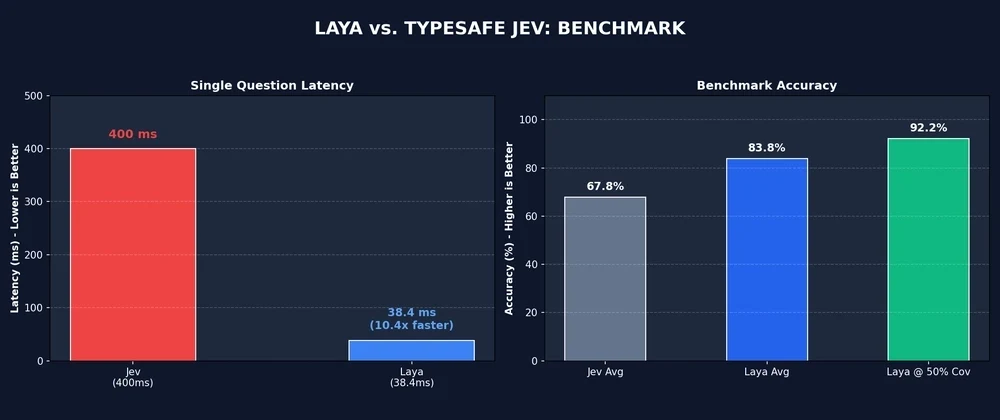
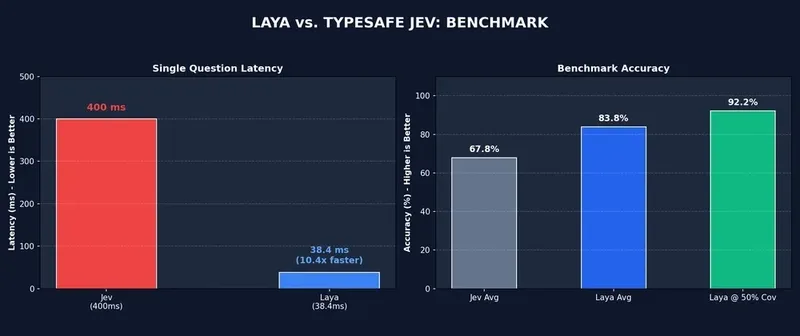
Mukkunnoth then released the open-source model Laya on the same day as the release on Jev. Laya supports Jev-style models and interfaces, can be deployed on users' own hardware, and supports multiple languages. It is based on a encoder-only model from the BERT family.