
By Yunzhong, reporting from Aifeisi Temple
Quantum Bit | Official account QbitAI
Robots can already run, jump, and do somersaults, but when it comes to picking up an egg or tightening a nut, things are not so simple.
Vision can tell a robot where an object is, but it can hardly accurately tell it how much force is being used, whether there is any slipping, and how to adjust next, after contact has occurred. This is whytactile sensingis becoming a new technology direction fiercely contested in the robotics industry.
Recently, a Shenzhen company founded by a 98-born PhD has chosen a rather different route:instead of starting from algorithms or traditional sensor structures, it uses a photonic crystal material that changes color under pressure to redesign the robot's tactile sensors。
This company is called Shita Robotics.
On October 13, Shenzhen Shita Robotics Technology Co., Ltd. (hereinafter referred to as "Shita") completed its angel round of financing. Investors in this round include Huawei's Hubble Investment, funds under Shenzhen Capital Group's Shenzhen High-tech Investment, and Gaoxuan Investment, with Duowei Capital serving as the exclusive financial advisor.
Shita's founder and CEO Zhang Wei was born in 1998. His doctoral studies were jointly conducted by Southern University of Science and Technology and City University of Hong Kong, with research spanning optical materials and robotics. The company's team has anaverage age of about 23, with core members coming from the Intelligent Liquid Crystal Optics Laboratory of Southern University of Science and Technology, covering fields such as materials, device circuits, and algorithms.
Youth is the most visible label of this team, but what has won the favor of industrial capital is a technological innovation from materials science.
Shita is combining flexible photonic crystals with photosensitive devices to develop a flexible electronic skin solution with a thickness of less than 1 mm and a sensing density exceeding 10,000 points/cm².
Compared with traditional tactile sensors, this electronic skin aims to maintain high-density sensing while further addressing the sensor's thickness, flexibility, and large-area integration issues.
Beyond electronic skin, Shita has also established a research and development system spanning hardware to algorithms, built around tactile sensors, data acquisition equipment, and tactile control models.
A 98-born PhD starts a company: why redo touch starting from materials?
Zhang Wei was not initially a typical robotics entrepreneur. His research background comes from optical materials.
During his doctoral studies jointly conducted by Southern University of Science and Technology and City University of Hong Kong, he worked with liquid crystal elastomers, flexible optical devices, and how to use the microscopic structures inside materials to achieve different optical functions.
Later, Zhang Wei began to consider whether these material technologies could be used to solve practical problems in robot manipulation.
One starting point was seeing the Unitree robots on the Spring Festival Gala stage. At this stage, robots have already demonstrated strong athletic capabilities, but there is still a long way to go from running, jumping, and tumbling to actually getting work done.
Zhang Wei noticed that when humans perform many fine manipulations, they do not need to keep staring at their hands. Picking up a cup, adjusting grip strength, tightening a bottle cap—the fingers constantly adjust their movements based on contact feedback.
But robots often lack this ability. "What we care about is whether touch can enable robots to complete operations that they used to do poorly, or even could not do at all." In his view, for robots to enter complex manipulation scenarios, touch is an unavoidable link.
The problem is that existing tactile sensors are still far from ideal. Technical routes such as piezoresistive, capacitive, magnetic tactile, and visuotactile sensing have been developed for many years, each with its applicable scenarios, but achieving thinness, high density, and low cost simultaneously within the limited space of robot fingers and palms still presents considerable engineering difficulties.
Take visuotactile sensing as an example. Such sensors typically observe the deformation of the contact surface through a camera, and algorithms then compute contact states and force information. Its advantage is that it can obtain rich contact information, but the camera, optical structure, and imaging distance also impose limitations on further thinning of the sensor. For fingertips, this problem might still be solved by optimizing the structure. But if touch is expected to cover the entire palm, or even other parts of the robot's body, the thickness and volume of traditional modules become an even greater burden.
In Shita's view, an ideal tactile sensor needs to balance three metrics:high sensing density, low cost, and thinness。
So they chose to seek answers from the materials themselves. Its core technology is a class of flexible photonic crystal materials, represented by cholesteric liquid crystal elastomers (CLCE).
This material has a very interesting feature: its color is not produced by dyes, but generated by a periodic helical structure formed by the liquid crystal molecules inside. When the material is compressed or deformed, the period of the internal helical structure changes accordingly, which in turn causes changes in the reflected spectrum and color.
In other words, the material itself can convert invisible mechanical deformation into an optical signal that can be read.For example, after a photonic crystal with a structure of six to seven hundred nanometers is stacked in ten layers, a one-micron change can shift the wavelength from 600 nanometers to 500 nanometers—directly changing from red to green.
This means that, through the material's optical response, otherwise tiny deformation changes are manifested as obvious color differences.
This property provides the foundation for sensitive perception in thin and light structures. Moreover, the periodic structure of the photonic crystal can be formed by the spontaneous arrangement of molecules and then fixed by an elastic polymer network, giving the material both softness, deformability, and optical responsiveness, while also making large-area fabrication and lower manufacturing costs possible.
For Shita, the real technical work was not discovering that photonic crystals change color, but ratherhow to turn this material into a tactile sensor that can be read stably, manufactured repeatedly, and ultimately integrated into robots。
Shita's mass-produced sensors passed 1 million tests with an error rate consistently below 5%
Removing the camera, making a truly soft electronic skin
Photonic crystal materials that can sense pressure—that is only the first step.
The next question is a more practical one: how to turn it into a product that robots can actually use?
Shita's next-generation electronic skin solution combines mechanochromic flexible photonic crystals, a transparent interlayer, a flexible TFT photosensor array, and a backlight layer. Among these, the photonic crystals are responsible for sensing contact and deformation, while the flexible photosensor array reads the optical signals.
Unlike traditional vision-based tactile sensors, which need to reserve imaging space for a camera, this design integrates the optical reading components into a thin-film structure, making it possible to further reduce the sensor's thickness.
The material handles sensing, and the photosensor array handles reading. By changing how these two parts are combined, Shita hopes to turn high-density tactile sensors into a truly soft, thin electronic skin.Its photonic crystal electronic skin can be less than 1 millimeter thick, with a sensing density exceeding 10,000 points/cm².
These two metrics correspond to two key questions for electronic skin.
One iswhether it can fit in. The space on robot fingers and palms is inherently limited; if the sensor is too thick, it will affect the design of the body structure and may even restrict finger movement.
The other iswhether it can sense finely enough. When a robot grasps an object, contact often does not occur at a single point but is distributed across multiple areas. Higher spatial resolution helps record the contact details of these areas.
Flexibility further expands the range of applications for electronic skin. The human hand is not flat—the fingers, knuckles, and palm all have complex curvatures. Traditional standalone modules have difficulty covering all contact positions, whereas a flexible film has the opportunity to spread along these surfaces.
This is also an important direction for the next phase of Shita's electronic skin:extending touch from the fingertips to a larger area of the hand's surface, and further exploring tactile coverage across the whole palm and even other parts of the robot's body.
Of course, a material being able to bend does not mean a complete electronic skin already has mature large-area deployment capability. The photosensor array, packaging structure, device consistency, and long-term durability all need to be addressed in subsequent engineering work.
But the application space of this technical route is not limited to robots. For example, products such as car seats, mattresses, and massage devices also have a need for flexible pressure sensing. The contact surfaces of these devices are often large and irregularly shaped. If the sensor can be thin and soft enough, with high sensing density, it has the opportunity to add pressure and contact-state sensing without significantly altering the original product form.
This is why Shita hopes to enter more application scenarios through its photonic crystal electronic skin.
From material innovation to product delivery, Shita moves toward tactile commercialization
Material innovation is Shita's technical starting point, but for a hardware startup, between a laboratory material and a deliverable product lies a large amount of engineering work.
How is material consistency guaranteed? How are sensors packaged? How can manufacturing costs be reduced? If a customer raises new requirements for dimensions and structure, can the design be adjusted quickly? These problems cannot be solved by a single paper alone.
For Shita, the 0-to-1 technical exploration went relatively smoothly, but going from 1 to 10, and then to 100, the real challenge lies inhow to turn technical advantages into a stable, manufacturable product that can be delivered consistently。
. At present, the Shita team has about 50 members, with an average age of about 23. This young team adopts a flat organizational structure and concentrates materials R&D, device design, manufacturing, and testing verification in the same location.
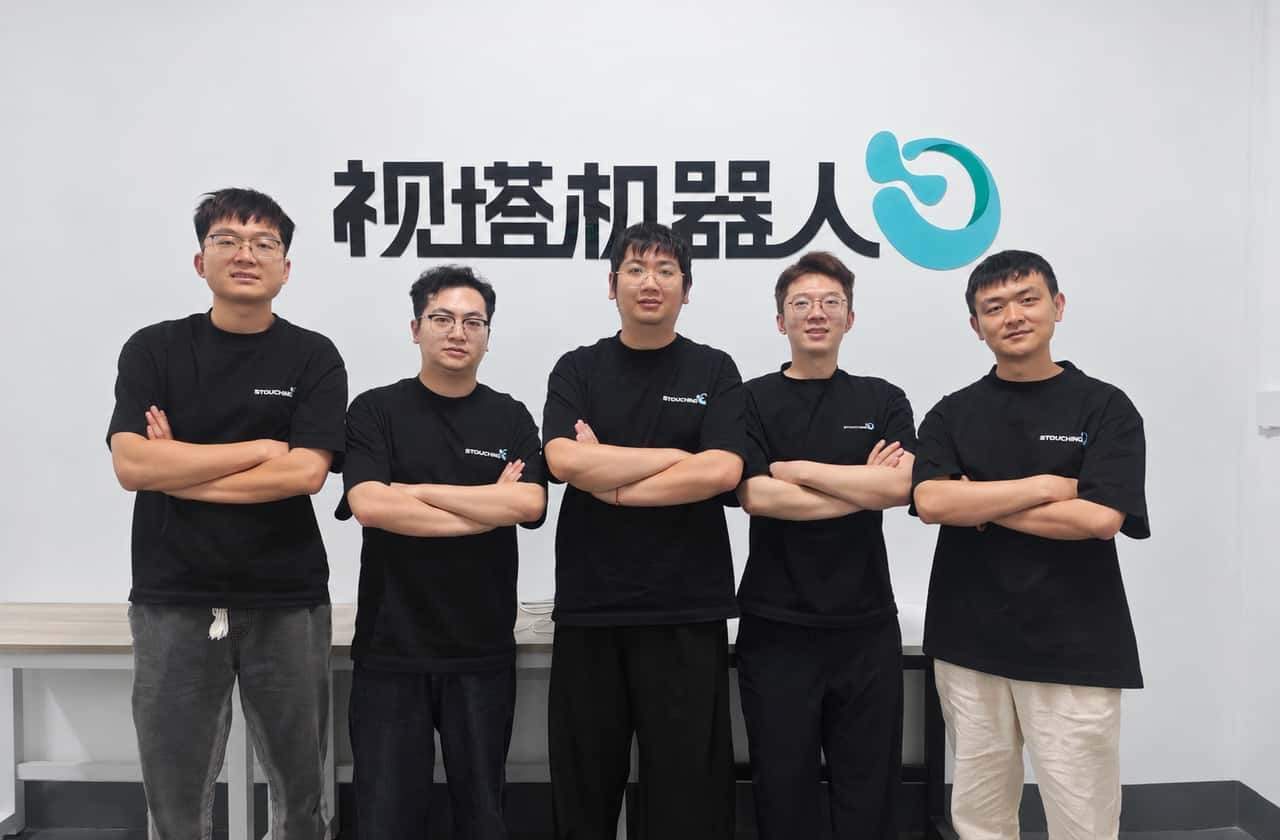
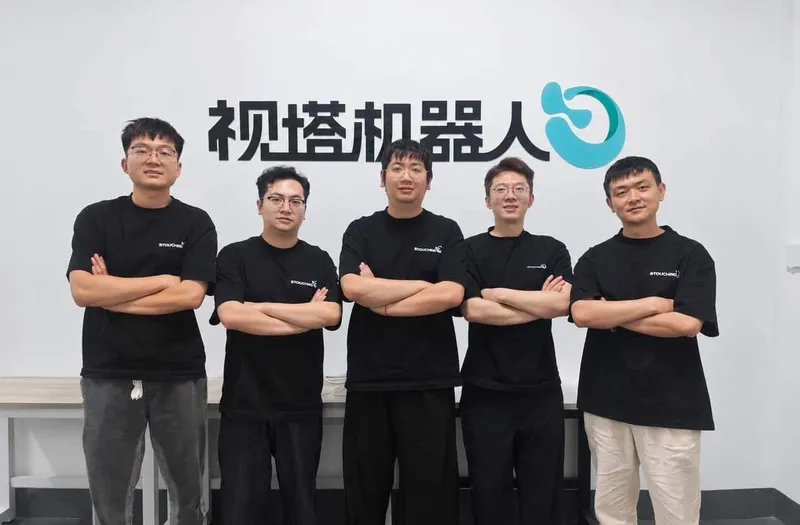
Shita's core team; third from the left is founder and CEO Zhang Wei
In an approximately 800-square-meter R&D and production space in Shenzhen, they have not only R&D office areas but also cleanrooms, 3D printing, CNC, laser processing, circuit SMT, and other equipment, as well as a test platform built by the team itself.
This model of tightly linking R&D and manufacturing allows engineers to complete design, fabrication, and testing in the same location and quickly adjust plans based on feedback. For tactile hardware that requires repeated optimization of materials, optical paths, structures, and circuits,shortening the verification cycleis an important step toward engineering the product.
In less than a year since its founding, Shita has gradually established an R&D and delivery system for tactile sensors and data acquisition devices, with customers covering university laboratories at home and abroad, leading model companies, and dexterous hand manufacturers.
During the commercialization process, VisionTower also found that different customers have markedly different requirements for haptics. Some focus on response speed, some pursue higher force measurement precision, some need to perceive texture, and others are first constrained by installation space.
This means that even though photonic crystals have unique advantages in thinness, lightness, and high-density sensing, it does not mean they can replace all haptic technology approaches.
Therefore,Vision塔, on one hand, continues to advance the research and development of flexible photonic crystal electronic skin; on the other hand, centering on customers' actual needs, it has laid out different tactile solutions including visuotactile, piezoresistive, and capacitive approaches, providing corresponding sensor products.。
Beyond hardware, Vision Tower is also extending into robot data and operation control.
In terms of data collection, the company has developed devices such as visual-tactile data collection grippers, the EGO data collection system, and data collection backpacks, supplementing robot model training with information such as contact states and force changes.
But what robots need is not just more tactile data, but the ability to adjust their movements in real time based on contact feedback.
To this end, Vision Tower is developing its own proprietary tactile control model—the "external haptic cerebellum". Its design philosophy is to work in coordination with higher-level robot models such as VLA: the higher-level model is responsible for understanding tasks and planning actions, while the tactile model makes local adjustments to force, position, and pose based on contact feedback.
In internal tests of typical tasks such as erasing the blackboard and inserting plugs, the introduction of haptic cerebellum feedback improved the robot task success rate by nearly 100% at most.
The joint R&D of sensors and models also enables Visual Tower (视塔) to optimize hardware design and data acquisition methods based on actual operational needs, gradually building up a technological accumulation from tactile perception to manipulation control.
However,the flexible photonic crystal electronic skinremains Shita's most core product direction at the current stage. Compared with a single fingertip sensor, electronic skin has the opportunity to cover a larger contact area, and it also places higher demands on materials preparation, device integration, and scalable manufacturing.
The addition of investors such as Huawei Hubble this time will provide funding support for Shita to further advance product R&D and commercialization.
From photonic crystal materials to independent tactile modules, and then to large-area flexible electronic skin that can conform to complex curved surfaces, Shita is attempting to change the form of tactile sensors, and is also exploring another way for robots to perceive the physical world.
Robots already possess increasingly strong visual understanding and motion planning capabilities, but to truly enter the physical world, they still need to learn how to touch, feel, and adjust.
Shita has chosen to start with a piece of soft electronic skin, bringing the way machines perceive the world a little closer to that of humans.
*This article is republished by QbitAI with authorization; the views are those of the original author alone.