
By Krei Xi, from Wafeisi
QbitAI | WeChat Official Account QbitAI
Infinigence AI, an AI-native infrastructure service provider, has completed its Series C financing round of 2.3 billion yuan. Adding in previous rounds, Infinigence AI has raised a cumulative total of 4.3 billion yuan, setting new records in the domestic AI-native infrastructure sector both for a single round and for cumulative fundraising.
Since its founding, Infinigence AI's investor lineup has brought together many well-known institutions, covering state-owned capital institutions, industrial investors, financial investment institutions, and other categories. Among them, state-owned capital institutions include Hangzhou Gaoxin Jintou, the Social Security Zhongguancun Fund (managed by Legend Capital), Zhuhai Science and Technology Industry Group, Xiamen Guoxing Investment, Xuhui Capital, Futeng Capital, China Insurance Investment, and CDB Science and Technology Innovation; industrial investors include Dabanc Holding, Lenovo, Ubiquant Ventures, Tongge Ventures, Tencent, Baidu, and others; and financial investment institutions include Sequoia China, Hongtai Fund, Huiyuan Capital, Qiming Venture Partners, Fortune Capital, Shunwei Capital, Lishi Capital, and other well-known institutions. Infinigence AI has become one of the most sought-after star unicorns in the AI Infra sector.
This company does not train models and does not build applications; it works on the layer between models and chips — specifically, connecting models and chips to achieve ultimate efficiency and cost optimization between multiple model algorithms and multiple chip hardware platforms.
The goal of this approach is to efficiently aggregate and coordinate heterogeneous, fragmented, cross-domain computing resources, squeezing low-cost, high-quality, production-ready Tokens out of every kilowatt-hour of electricity and every second of chip operation, and pushing Tokens into real business scenarios.
Overseas, the market has already put a price tag on this business. The three companies doing the same business have all seen their valuations rocket over the past year.
Fireworks AI rose from 4 billion to 17.5 billion US dollars, a 337% increase; Baseten rose 160%; Together AI rose 151%.
Behind these three companies stands the very same investor we know all too well.
NVIDIA.
NVIDIA, which has made a fortune selling shovels at the very top of the GPU industry chain, is personally placing bets on downstream AI Infra, terrified of missing the boat ticket for the era of explosive AI Infra demand.
When even the shovel sellers are getting anxious, it shows the potential of this market is already so large that the upstream can no longer sit still.
What NVIDIA is betting on, Infinigence AI's investors clearly want to bet on as well. This 2.3 billion yuan injection is precisely a bet on this market.
The computing power gap is a bottomless pit
To understand the context of this financing round, you first need to look at a fact.
You might think that as chips get stronger and production capacity rises, the AI computing power gap will close — but in reality, computing power has never been enough, because no matter how much chip production expands, it cannot keep up with the growth in demand.
Therefore, Dylan Patel, founder of the independent research and analysis firm SemiAnalysis, has judged that the computing power shortage will persist.
And the explosion of Agents has magnified this gap by an order of magnitude.
When an Agent runs a single task, it involves dozens of chained inference requests, with Token consumption utterly incomparable to the single-turn conversations of the past.
Capital, with its keen sense of smell, quickly swooped in with money.
The three overseas AI infrastructure companies mentioned at the beginning already illustrate the trend very well: the entire AI Infra sector is being repriced.
Harry Stebbings, founder of 20VC, discussing his investment in Fireworks AI, said it was 'settled in 15 minutes, one of the easiest decisions of my ten-year investing career.'
15 minutes — a person who has managed a fund for ten years invested in an AI Infra company in less time than a meal.
Catalyzed and accelerated by Agents, the computing power gap will not be filled; instead, it will only tear wider, and this business has no ceiling in sight.
On the same track, overseas companies valued at tens of billions of dollars have already emerged, while domestically, a new financing record for this track has just been set.
Moreover, Infinigence AI did not choose to build its own data centers; it took a different path.
Doing AI Infra without building data centers
There are really only two paths for doing AI Infra.
The more traditional approach is to build your own data centers, trading heavy assets for scale, but this very likely means expanding with debt.
The other path goes to the opposite extreme: not touching the data center at all, but gathering the computing power scattered in various places and using software orchestration to weave it into a network.
Wuxinyinqiong (Infinigence AI) chose the latter. It does not own physical data centers itself; its compute resources are scattered across computing centers in various locations, and its chips come from a "United Nations" of manufacturers.
Wuxinyinqiong's technical system has three keywords: heterogeneous multi-chip support, software-hardware co-optimization, and autonomous AI.
Starting with heterogeneous multi-chip support: Wuxinyinqiong's platform has already adapted 16 kinds of chips including NVIDIA, AMD, Huawei Ascend, Biren, Hygon, Moore Threads, MetaX, Enflame, and T-Head, serving 37000P of compute.
Even when a new chip arrives, the team needs only 2 working days to complete the adaptation, cutting the adaptation cost for domestic chips by more than 70%.
As the chip supply chain becomes ever more complex, the ability to switch freely between different chips, so that customers are not locked into a single chip, is quite hardcore. Not only does it avoid lock-in, Wuxinyinqiong also stays neutral: as an independent platform connecting models, chips, and customer needs, it organizes scattered model capabilities and heterogeneous compute, continuously optimizing the conversion efficiency from underlying resources to AI productivity.
Wuxinyinqiong was the first to achieve thousand-card-scale mixed training on heterogeneous chips, with compute utilization reaching 97.6%. To be more specific, Wuxinyinqiong used four kinds of domestic chips—Huawei Ascend, Iluvatar CoreX, MetaX, and Moore Threads—together with two kinds of imported chips, AMD and NVIDIA, to complete heterogeneous-chip mixed training of a 700亿-parameter large model. This was a first in the industry.
Cross-domain training is another hard benchmark.
Wuxinyinqiong, together with China Telecom, completed China's first large-model cross-domain mixed training spanning more than 4000 kilometers, connecting compute in Hami, Xinjiang and Shenzhen, Guangdong, and carried out joint training on a 300亿-parameter model, improving performance by 165%.
In addition, the team also achieved multi-data-center joint training across 4 GPU clusters of different generations and different models, as well as hybrid-cloud mixed training combining local private clusters and public cloud compute, with performance improvements of 41% and 68% respectively.
Of course, adaptation is only one step; in actual operation, speed is also an important metric.
After all, an Agent has no time to wait for a model to spit out words one character at a time.
This is the problem that software-hardware co-optimization is meant to solve.
Wuxinyinqiong made a full set of optimizations on the software stack, from automated parallel orchestration and search, and operator and computation-graph optimization, to computation-communication overlap and dynamic orchestration and scheduling, efficiently converting compute resources into high-quality model performance and Token serving capability.
The final result: on infrastructure optimized by Wuxinyinqiong, the training throughput of trillion-parameter MoE models is 41% to 75% higher than mainstream open-source frameworks.
On the inference side, through a series of technical innovations, Wuxinyinqiong reduced inference costs to one-tenth of the original within one year.
At WAIC 2026, the company also released the industry's first cross-cluster heterogeneous PD-disaggregated architecture, PDD (Prefill-RelayDecode-MainDecode), reducing first-Token latency by 51.5% and per-Token cost by 37.5%.
With the scaled application of PDD, inference costs still have room for a tenfold reduction in the future.
But in the Agent era there is another problem: models excel at different capabilities, so deciding which model to call for a specific task and how much compute to use becomes something that needs attention.
Wuxinyinqiong handed this judgment call to the system—what they call "autonomous AI".
Specifically, it introduces an adaptive coordination mechanism between large and small models: the system gives complex tasks to large models for planning and reasoning, while lightweight real-time responses are handed to small models, with the system dynamically switching based on task complexity, latency requirements, and Token cost.
On top of this mechanism, Wuxinyinqiong has also deployed a swarm of agent groups, currently comprising three subsets: a user-facing platform-steward agent system, a cluster-facing operations-and-maintenance agent system, and a chip-facing operator-generation agent system. Agent capabilities drive the entire AI Infra to form a closed loop of autonomous iteration and self-optimization, making the infrastructure stronger with use.
Looking at these capabilities together, what Wuxinyinqiong does is easy to understand.
Rooted in infrastructure, they aggregate energy and chips below and support models and applications above, not only maximally improving the scale and efficiency of converting underlying resources into AI productivity, but also possessing the most distinctive AI-native capability of the Agentic AI era—using an infrastructure agent swarm to empower resource scaling and more efficient Token production, and supporting the continuous evolution of Agentic AI, with business foresight.
Compute, models, and industries: running three layers of business at once
Having tallied the technical side, let's look at commercialization.
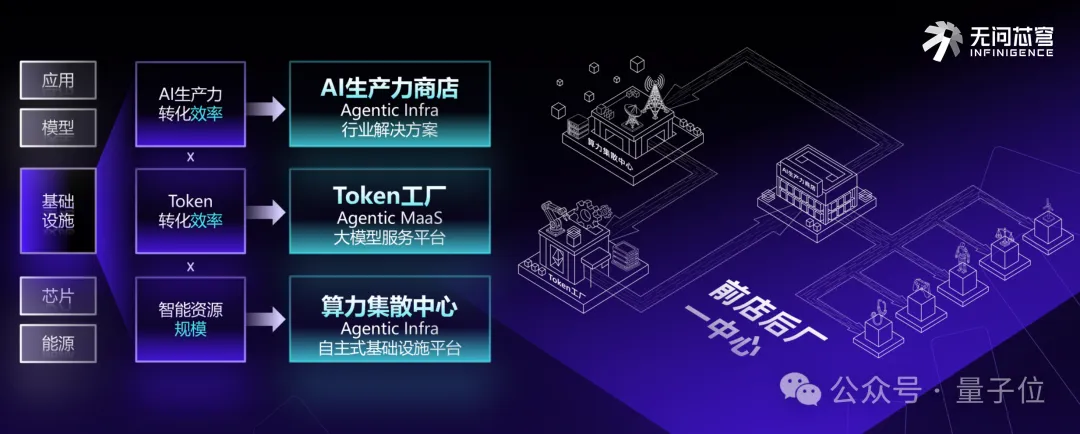
Wuxinyinqiong has proposed the strategic layout of "front store, back factory, one center", specifically splitting its business into three layers.
The bottom layer is the Compute Distribution Center (Agentic Infra autonomous infrastructure platform), whose job is to uniformly aggregate, elastically schedule, and distribute on demand scattered, heterogeneous compute resources, building a sufficient, stable, and scalable compute foundation for the model and application layers; customers need not worry about underlying hardware differences—once connected, it just works.
The middle layer is the Token Factory (Agentic MaaS large-model service platform), serving the scaled, high-quality production of Tokens with extreme efficiency. The platform has already established close cooperation with leading large-model companies such as Zhipu and Moonshot AI, with over a hundred large models online; customers don't need to deploy anything themselves—just pick a model and it's ready to use out of the box.
The top layer is the AI Productivity Store (industry solutions), providing enterprises with Agentic Infra industry solutions. For the same industry scenario, different model scales and different hardware configurations may correspond to completely different Token costs. Wuxinyinqiong takes agent scenario-adaptive technology as its core technical path for improving AI productivity conversion efficiency, and has launched Agentic Infra industry solutions covering entertainment and gaming, healthcare, legal services, energy and electric power, and other fields, further converting Tokens into executable, deliverable industry productivity.
After Agent applications exploded, the daily average Token usage on Wuxinyinqiong's large-model service platform grew more than 40-fold in half a year, with more than 95% of inference tasks coming from Agents.
Among Wuxinyinqiong's three layers of business, the Compute Distribution Center builds a sufficient, stable, and scalable compute foundation for the model and application layers; the Token Factory, through a series of original technical innovations, greatly improves large-model inference efficiency and reduces inference costs; and the AI Productivity Store efficiently converts Tokens into high-quality AI productivity recognized by industry.
As early as 2025, Wuxinyinqiong was the first in the industry to propose the paradigm shift of Agentic Infra. Today, the industrial value of Agentic Infra in supporting the large-scale operation and continuous evolution of agents is being continuously validated. When the wind truly arrives, it will already be standing at the center of it.
2.3 billion yuan thrown in — what's the bet on?
The technology works, demand has been validated, and the next question is scale.
In this C round, Infinigence AI raised 2.3 billion yuan. Adding in previous rounds, cumulative funding has reached 4.3 billion yuan, with both the single-round and cumulative amounts setting new records in the domestic AI infrastructure space.
This capital is precisely the key energy driving Infinigence AI toward scaled expansion.
In addition, according to Bloomberg, citing people familiar with the matter, Infinigence AI has secretly filed an IPO application with the Hong Kong Stock Exchange in recent months.
After raising a cumulative 4.3 billion yuan, this AI-native infrastructure provider has sounded the IPO horn.
Investors willing to pay this price at this point in time are looking at three things: the team, the position, and the timing.
First, the team. Infinigence AI is a typical Tsinghua-affiliated company. Its initiator Wang Yu is a tenured professor in Tsinghua's Department of Electronic Engineering, was the department head, and an IEEE Fellow; CEO Xia Lixue, chief scientist Dai Guohao, and CTO Li Boxun all graduated from Tsinghua's Department of Electronic Engineering.
From Zhipu to Moonshot AI, the Tsinghua camp has already produced a batch of leading AI companies, and Infinigence AI's DNA is on that same line.
This team has been researching hardware acceleration for deep learning and heterogeneous system optimization since their PhD days, and combining deep industry experience, they possess both top-tier hardware and software R&D and engineering capabilities.
Next, the position.
Infinigence AI sits at the hub of the industry chain, connecting downward to energy and chips, supporting upward the models and applications, and facing real workloads from thousands of industries. Every additional customer raises the complexity of scheduling and scenario adaptation.
Finally, timing. Over the past two years, the competition has been about whose model is stronger, but the gap between models is narrowing.
When everyone can train roughly similar models, competition shifts to the next layer — those who can run similar models faster, cheaper, and more reliably are the ones who truly make money.
Moreover, players who got running first have accumulated data and experience; latecomers trying to catch up by throwing money at it will find it very hard.
In this respect, Infinigence AI has continuously honed and accumulated extensive optimization experience in real business scenarios, and has launched Agentic Infra industry solutions covering entertainment and gaming, healthcare, legal services, energy and power, and other fields. Massive business experience in turn feeds back into rapid technological iteration, driving simultaneous leaps in platform performance and reliability, forming a positive cycle of commercialization.
On the AI Infra track, Infinigence AI, founded three years ago, has been exploring around computing resources, Token production, and industry agent applications. Starting from actual industry needs, its practice of solving problems such as computing utilization, service costs, and application conversion through independent technological innovation has brought it to today, with both its single-round and cumulative funding amounts setting new records for the track.
The scale war in AI infrastructure has only just begun, and Infinigence AI is already standing at the very front.