

IT Home reported on October 13 that Phoenix Network International released a video today. The organization joined hands with the China Science Exploration Association to visit Ailao Mountain, and also brought along the first “robotology research team member”.
The video shows that the robot dog guides people and extends the observation perspective, moving the observation position of the Western black-crowned gibbon forward by about 20 meters. It also captured the crystal orchid, known as the “Underworld flower,” under the forest canopy.

According to Yunshuichi Technology, the program “Scientific Exploration of China”, in collaboration with the Chinese Science Adventure Association, has invited the Yunshuichi Technology Lynx M20S wheeled robot to participate in scientific expeditions.
As the first “robot research team member” on Ailao Mountain, the mountain cat robot dog penetrates into the primeval forest, undertaking tasks such as exploring dangerous areas, biological observations, image recording, and material transportation. It helps to reduce research risks and, due to its low disturbance characteristics, supports the monitoring of biodiversity and rare species. This marks the first field research application of embodied intelligent robots in Ailao Mountain in China.
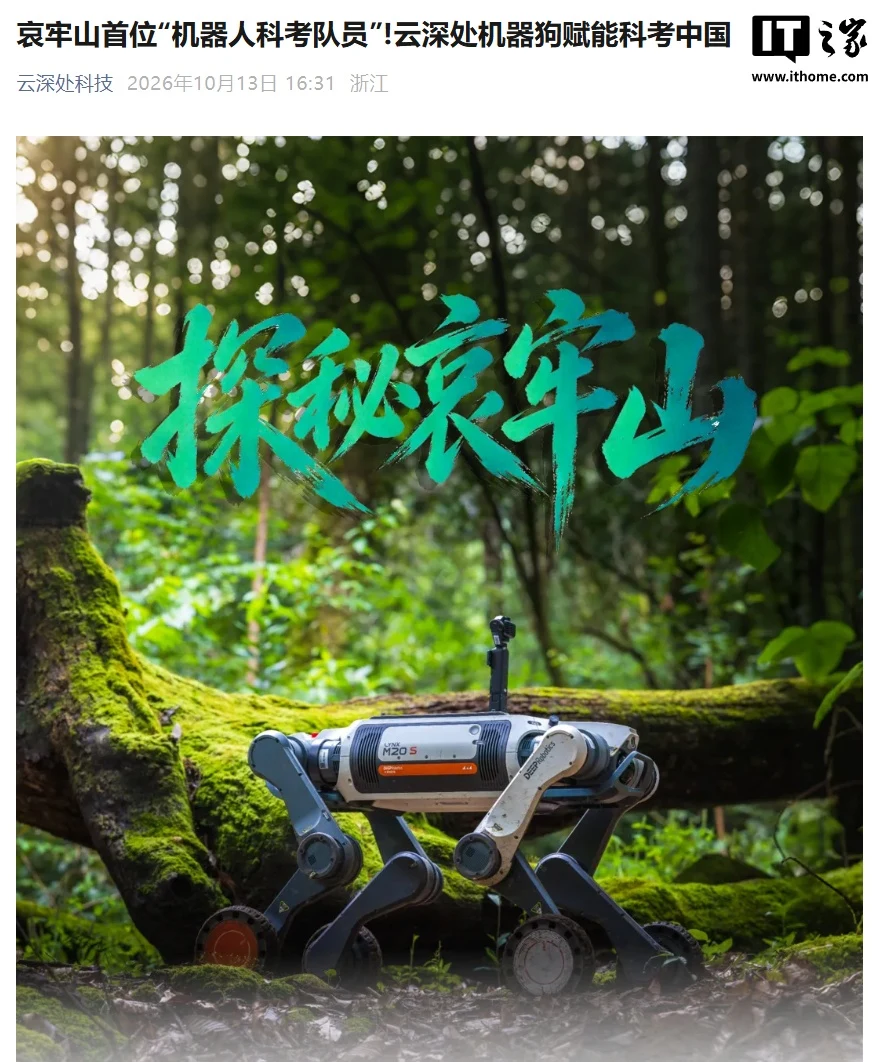
According to IT Home’s introduction, the Cloud Deep Lynx M20S is equipped with a wide-angle camera that transmits panoramic images in real time. Researchers can use these images to identify hidden obstacles and analyze road conditions, enabling a safe operation mode where they can explore one section and advance further on it, thereby solving the core problem of limited visibility in the raw dense forest.
Cloud Deep Mountain Cat M20S wheeled foot robot supports an IP67 protection level, operates in a wide temperature range of -30℃~55℃, capable of handling the extreme temperature fluctuations of Ailao Mountain; the wheeled foot configuration can be switched seamlessly. Thanks to its large joint range of motion, it can quickly navigate through forests and muddy areas using rollers, and also climb over fallen trees and rocky beaches using foot joints. It can reach deep into the hard-to-reach parts of the mountains.
The complex environment of Ailao Mountain nurtures rich biological resources and serves as a habitat for rare animals such as the western black-crowned gibbon. The western black-crowned gibbon often moves in the canopy layer and is highly sensitive to human interference. Scientific researchers approaching them easily startle them, so a low-interference observation method is urgently needed. The mountain cat robot dog in the cloud depths has noise below 55 decibels; it can blend into the forest environment and is small and hidden in size. Equipped with high-definition devices, it supports multi-angle filming to record the natural behaviors of the gibbon. Thanks to the low-disturbance nature of the robot, the observation points have been advanced about 20 meters forward, allowing for images that were previously difficult to capture.
At the same time, robot dogs can also compensate for the limitations of ground-based observations. Many rare lower-level plants are hidden by vegetation and difficult to detect. With its low-angle perspective, the robot dog avoids the vegetation cover and explores the hidden plants in the humus layer. During this investigation in Ailao Mountain, it successfully captured images of the saprophytic plant Crystal Lily, which only appears on the ground for about 40 days a year and is rare in field images, obtaining valuable first-hand imaging data.
Ad notice: The text contains external link references (including but not limited to hyperlinks, QR codes, passwords, etc.) designed to provide more information, save selection time, and the results are for reference only. Articles on IT Home that include external links comply with this notice.