

Anthropic says it cut Claude reasoning token theft by up to 99% in fight against industrial-scale distillation
 Manuel Uth
Oct 13, 2026
Manuel Uth
Oct 13, 2026
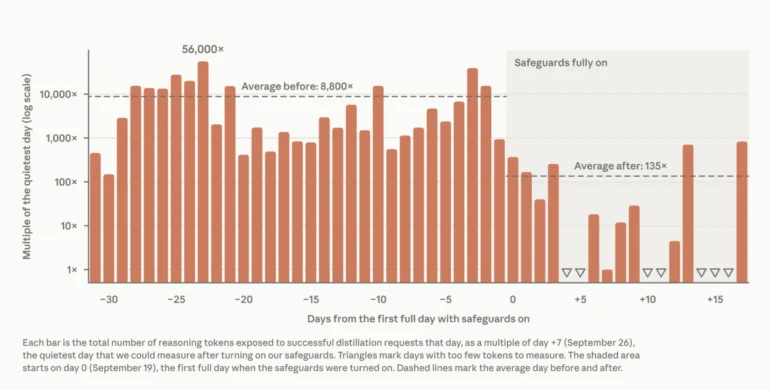
Anthropic is battling large-scale distillation attacks on its Claude models. In these attacks, companies systematically copy an AI model's capabilities to train their own, smaller models. Anthropic says its new defenses have cut the volume of extracted reasoning tokens, the model's internal chain-of-thought steps, by 90 to 99 percent. Attackers use networks of hundreds of thousands of fake accounts to pull it off.
Anthropic names Chinese companies Zhipu and Moonshot as participants. Zhipu allegedly siphoned cyber capabilities from leading US models for its GLM-5.3 model, while Moonshot secretly routed queries through Claude. The stolen capabilities could end up in foreign military and surveillance systems.
Anthropic now restricts access to Claude's internal reasoning steps, runs a classifier that detects extraction attempts, and automatically bans flagged accounts. Tens of thousands have already been banned. Anthropic is calling on other AI developers to adopt similar protections, although the company admits that legitimate users are getting caught up in the process too.Ad
AI News Without the Hype – Curated by Humans
Subscribe to THE DECODER for ad-free reading, a weekly AI newsletter, our exclusive "AI Radar" frontier report six times a year, full archive access, and access to our comment section.
Source: Anthropic / Distillation Defenses