
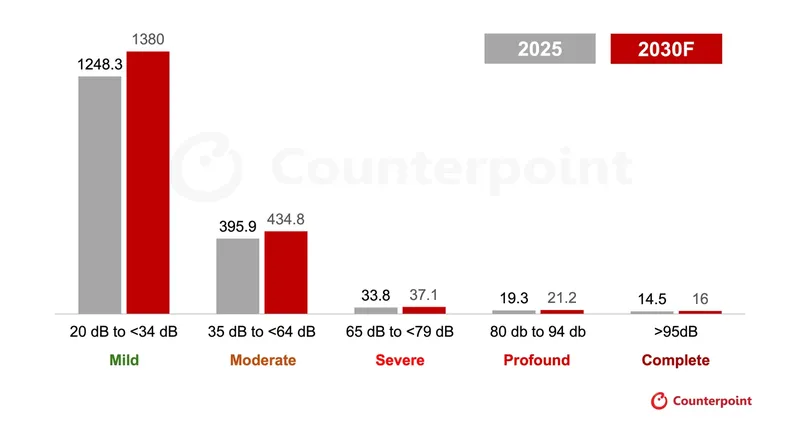
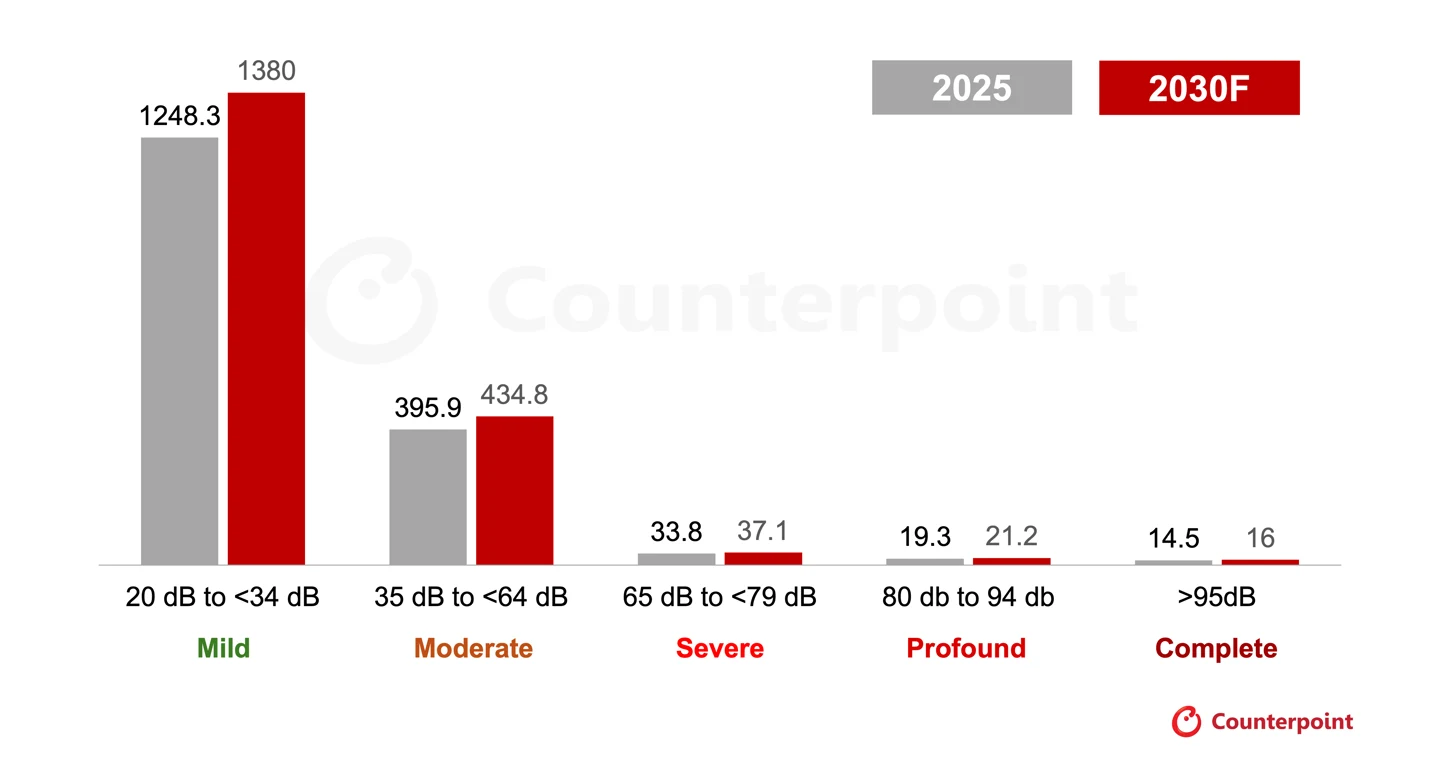
IT Home On October 14, a report by Counterpoint titled “Global Edge AI Wearable Devices Forecast” indicates that by 2030, global prescription hearing aids sales are expected to exceed 31 million units, with a compound annual growth rate of 4% from 2025 to 2030. As AI becomes more widely used in the hearing aid industry, it is estimated that nearly 50% of hearing aid products will feature edge AI capabilities by 2030.
Over the years, hearing aids have continued to improve in terms of size, connectivity, and battery life, but a core challenge remains: users have difficulty hearing conversations in noisy environments. Traditional hearing aids rely mainly on digital signal processing (DSP): the microphone captures ambient sound, the processor analyzes features such as frequency and volume, and then a pre-set algorithm determines which sounds to amplify or reduce. This approach works well for stable noises like air conditioning and engines, but real-world scenarios are often more complex. For example, in a crowded restaurant, there are multiple conversations, music, and the sounds of utensils colliding simultaneously. It is very difficult for a rule-based system to determine what sound the user really wants to hear.
AI brings a completely different solution: AI models do not rely on preset rules, and can learn to distinguish the patterns of human voices from other sounds. A deep neural network (DNN) trained on millions of sets of human voice and background noise samples can recognize the speaker’s voice in real time and suppress irrelevant noise.
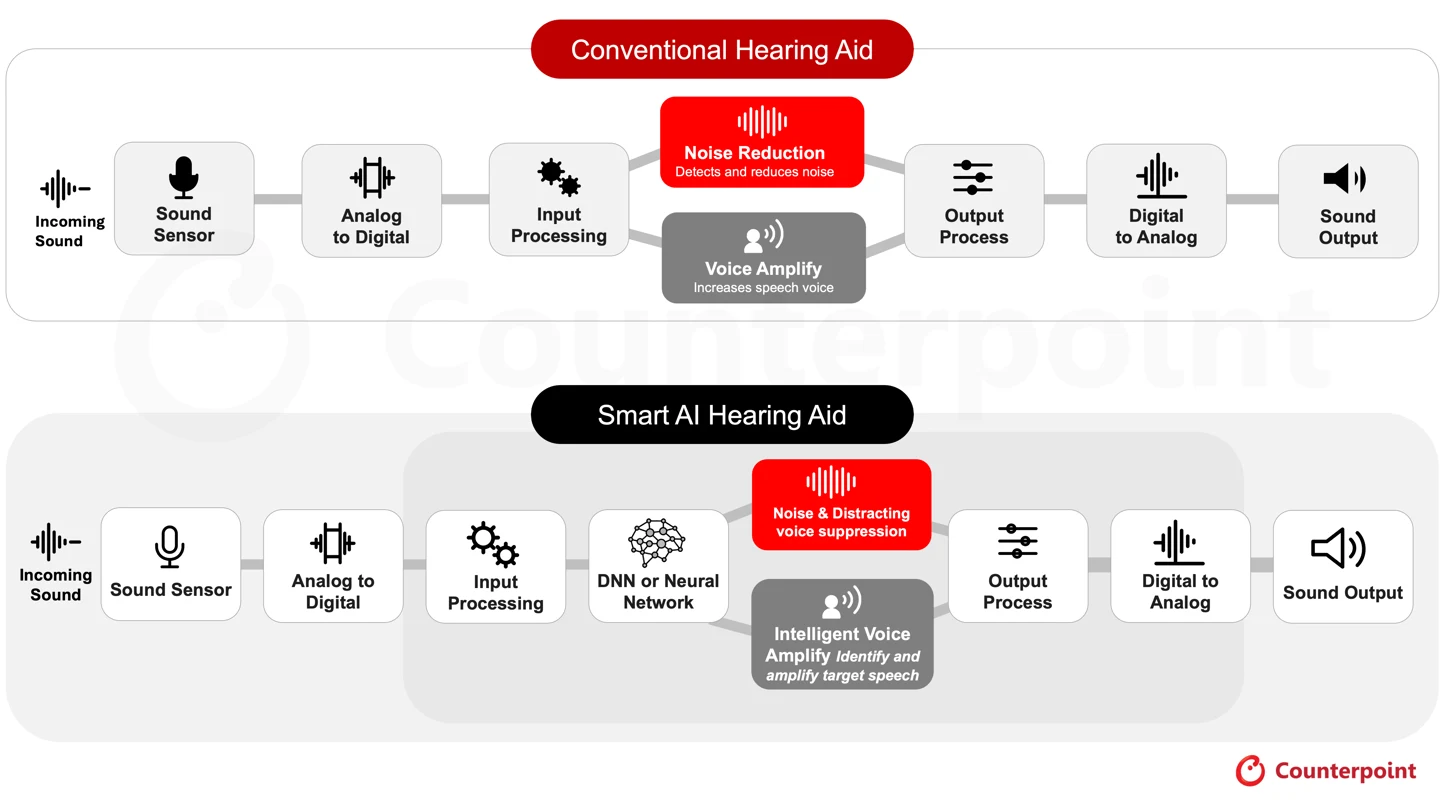
AI can improve the speech recognition capabilities of hearing aids in real environments by separating human voices from noise, highlighting the target speaker first, enhancing spatial perception, and adapting continuously to environmental changes for optimization. AI is particularly good at distinguishing subtle and confusing sounds such as “s”, “f”, “t”, “sh”, and “th”. It can also help users distinguish numbers like 15 and 50, or 17 and 70 (Note from IT Home: in English, fifteen and fifty sound similar). By preserving these detailed phonetic features, AI not only increases volume but also improves real‑world speech understanding in scenarios such as restaurants, meetings, and crowded streets.
In clinical “noise-based speech recognition” tests, listeners with normal hearing typically require a signal-to-noise ratio (SNR) of about 2 dB to correctly identify 50% of the keywords; for listeners with mild to moderate sensorineural hearing loss, this requirement rises to about 8 dB. AI can thus provide a quantifiable improvement in the SNR. According to Phonak tests, with the microphone fixed and traditional settings used, the signal-to-noise ratio can be increased by 6.4 dB compared to an omnidirectional microphone. With AI noise reduction technology, the improvement reaches 9 dB under default settings and 10.2 dB under maximum settings, which is sufficient for smooth communication in a restaurant environment.
AI can also make hearing aids more automated and personalized: machine learning can adapt sound processing according to user preferences and listening scenarios, reducing manual adjustments and the cognitive load required for following conversations. As a result, listening fatigue is reduced, the need for repeated queries is minimized, and users’ confidence in daily communication is enhanced. However, these improvements come at a cost: continuously running neural networks consumes battery power and takes up device space. Therefore, the most advanced AI hearing aids currently available often offer only a limited number of models.
Hearing aids have extremely high requirements for processing latency: the entire process from sound collection to processing and transmission to the ear must be kept within 10 milliseconds or less to ensure a natural experience. This creates a fundamental difference between hearing aids and most AI devices — smart phones can upload data to the cloud, wait for AI results, and then process it, but hearing aids cannot tolerate the latency involved in the cloud-to-cloud transfer. Even a slight delay can cause audio and visual mismatches or make the user’s own voice sound unnatural.
Therefore, real-time speech processing requires AI to operate locally on the hearing aid, rather than on the user’s phone or cloud, which is precisely the core value of edge AI: the sound is analyzed and processed locally, near the microphone and receiver.
The challenge lies in the fact that hearing aids have extremely small battery capacities, limited computing capabilities, and strict size constraints. To incorporate AI capabilities into such devices, it is necessary to highly optimize both the AI model and the processor, so as to minimize power consumption while achieving speech separation and noise reduction. Continuous operation of the neural network significantly reduces battery life: for example, the Peugeot 2025 Audéo Infinio Ultra Sphere has a normal battery life of 56 hours, but if the AI function is kept active continuously, the battery life drops sharply to 10 hours. This clearly shows the cost of running AI locally.
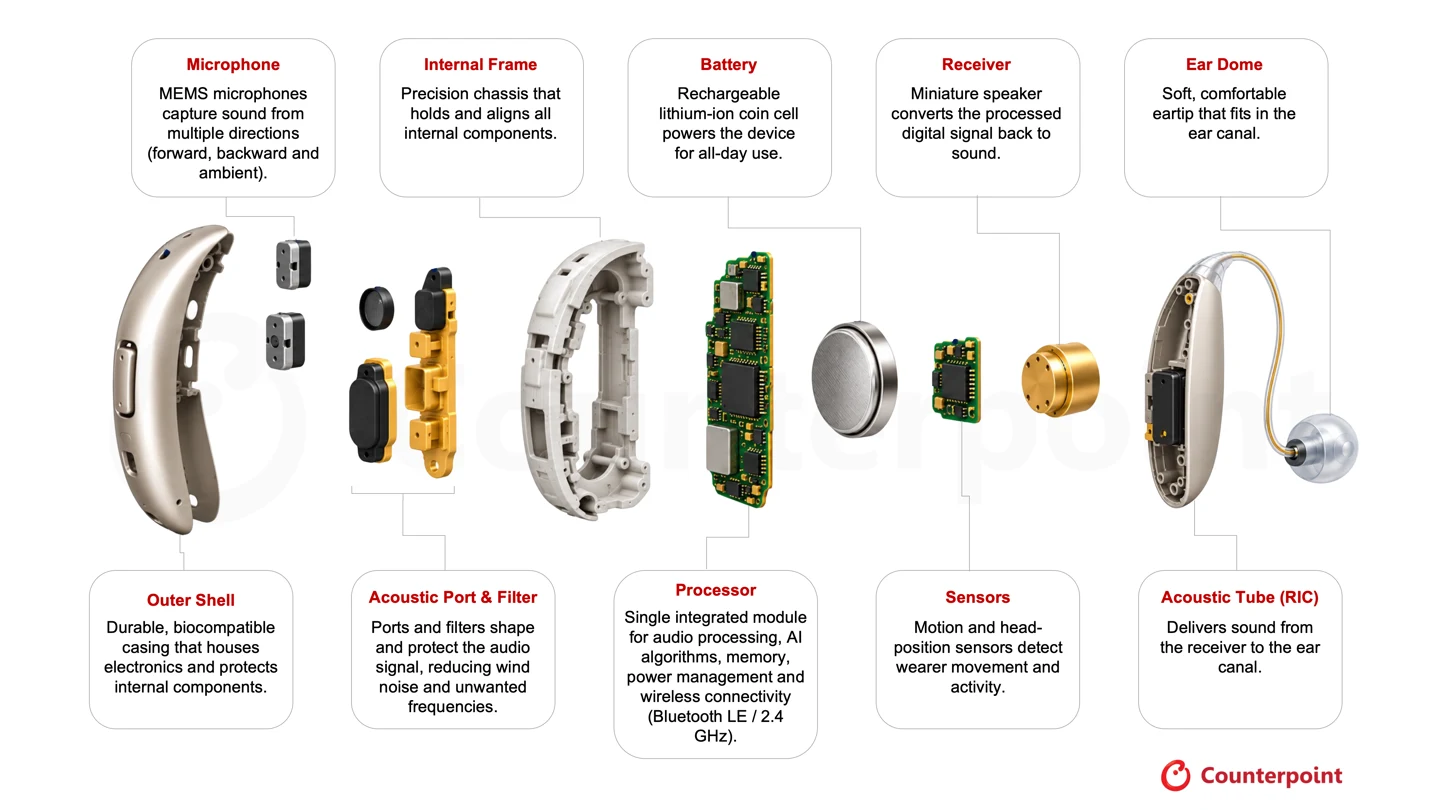
Integrated on-device AI makes hearing aids “smart,” but efficient integration is the challenge in research and development: Every little bit of improved speech clarity comes at a cost in battery life and size, and the data from Piil products clearly demonstrates this cost. The core competitiveness of next-generation hearing aids lies in enabling AI to operate quietly in the background, so as to provide clearer human voices, lower listening load, and a more personalized hearing experience, without consuming too much power or increasing the device’s size. The industry has already started this technological competition.