
Yunzhong, from Feiaosi
QbitAI | Official account QbitAI
Having an agent write weekly reports and analyze plans is already part of many people's daily routine. But every time they start, users still have to dig up materials and explain the background, and the agent has to go through multiple steps such as searching, reading, and organizing before it can truly begin the task.With a different task, the whole process has to start over.Repeatedly processing these existing materials wastes time and increases token consumption. The more materials there are and the longer the steps take, the easier it is to miss information or introduce deviations, affecting the accuracy of task completion.
To solve these problems,WorkSwarm for the first time natively supports the Personal Knowledge Space。
The "Personal Knowledge Space" is based on multiple material sources configured by the user, automatically collects content, and through rule-based processing, hybrid rule-and-LLM processing, or agent processing, organizes the materials intopersonal knowledge with a directory, with connections, and with sourceswhich is then provided to agents via progressive disclosure.
WorkSwarm organizes personal materials into long-term reusable personal knowledge, achieving"collect once, reuse repeatedly"making it easier for agents to find and make good use of relevant information, improving task completion accuracy, while shortening task preparation time and reducing token consumption.
openJiuwen Personal Knowledge Space: automatically collects personalized multi-source knowledge, used by office agents on demand
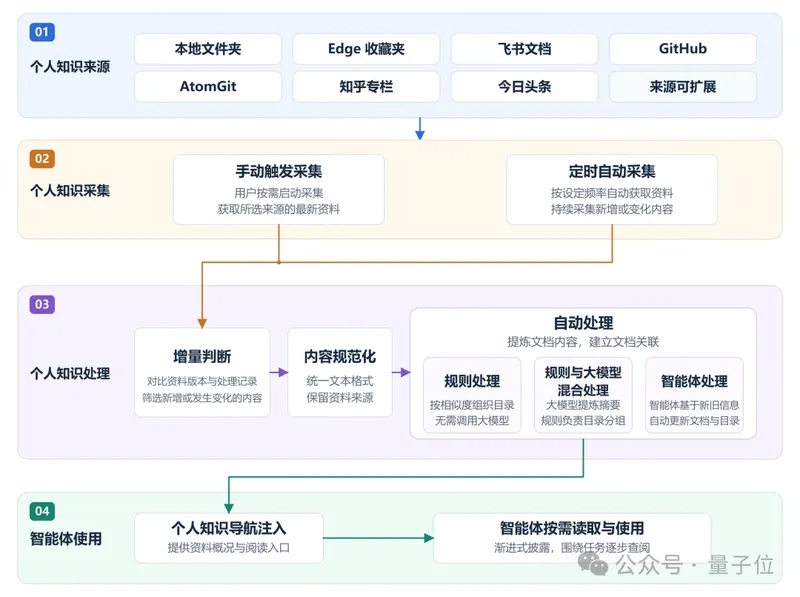
The Personal Knowledge Space revolves around four layers—sources, collection, processing, and use—turning the personal materials users accumulate daily into sustainably reusable task background knowledge.
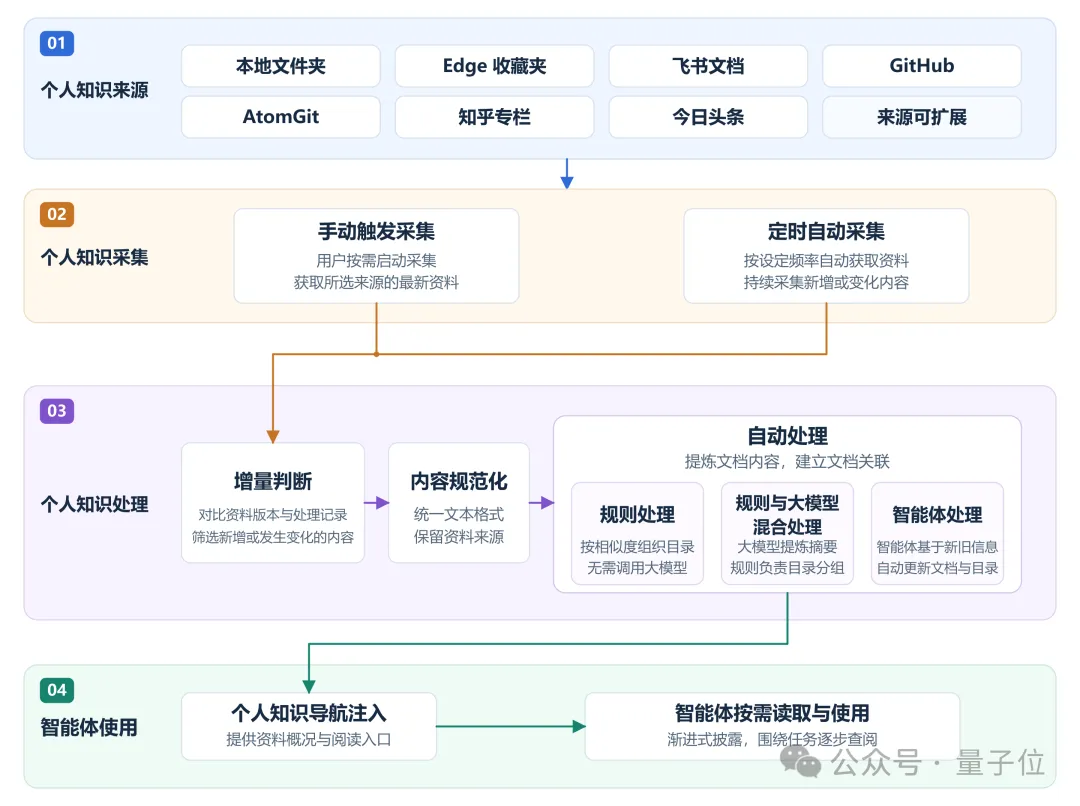 △ The four-layer workflow of the Personal Knowledge Space, showing multi-source material configuration, manual and scheduled collection, three processing methods, and on-demand use by agents
The user first selects the personal knowledge sources and collection scope, and the system fetches content on demand or on a schedule. The collected materials go through format normalization and incremental detection to identify new content and changes to be processed in this round; then, according to configuration, rule-based, hybrid rule-and-LLM, or agent processing is chosen to organize them into topic directories and Markdown pages, while maintaining document associations and sources. After the directory structure and source citations pass checking, the organized results are made available for the user to review.
When the user enables task usage, the system provides the personal knowledge overview and reading entry points to the agent, which gradually reads the relevant pages around the current question, letting existing knowledge become the background for completing the task.
Personal Knowledge Space configuration and collection: freely choose personal knowledge sources, with manual/scheduled incremental collection supported
After enabling the Personal Knowledge Space on the "Knowledge" page in "Settings", users can add sources such aslocal folders, Edge favorites, Zhihu columns, Toutiao, Feishu Docs, GitHub, and AtomGitDifferent sources can be configured separately, and users decide for themselves which personal materials enter the Personal Knowledge Space.
Once configuration is complete, users canmanually initiate collectionto proactively update their Personal Knowledge Space, or set upscheduled automatic collectionto continuously fetch content at a set frequency. The system identifies new or changed materials by combining source identifiers, versions, and collection progress, and processes the new or changed materials in conjunction with existing personal knowledge.
The source management page displays collection progress and recent status; users can adjust the update frequency, view the results of the current round, or stop a collection in progress.
Enable the Personal Knowledge Space on the "Knowledge" page in "Settings", then go to "Source Management" on the "Knowledge" page. The video uses Toutiao as an example, adding an author homepage link, manually starting collection, and viewing the source's running status.
Personal knowledge processing: offers three organization methods, turning scattered materials into reusable knowledge
Web pages, documents, and code each have different structures, and content on the same topic may be scattered across multiple sources. The personal knowledge space first unifies the format of materials, then distills the content, organizing it into directories and pages by topic. This makes it easy for the agent to first get an overview and then progressively read related content, while preserving links and provenance of the original documents.
After new material is collected, the system supplements and updates it in combination with existing personal knowledge, allowing knowledge to continuously accumulate within the same set of plain-text files.
On the "Knowledge" page in "Settings", users can choose one of the following three processing methods based on the characteristics of the materials and their organization needs:
- Rule-based processing: uses BM25 term weighting and content similarity to group related pages by topic, and maintains links between directories and pages, without invoking generative models.
- Hybrid rule and large model processing: first, the large model extracts the title, summary, and keywords of new material; then rules complete topic grouping and directory organization; finally, the large model generates directory titles and introductions for easier understanding and reference.
- Agent processing: the agent analyzes the relationship between new material and existing personal knowledge, prioritizing updates to or merging with existing topic pages, adding new documents when necessary, and synchronously maintaining directory descriptions and cross-references between documents.
When using the latter two methods, users can configure the model used to organize materials. After organization is complete, the system checks the directory structure and source citations; content that passes the checks becomes available for users to browse and for agents to use.
Users can also find related content through the file tree, graph, or search, open documents to read the full text, and trace back to the original materials via the "Sources" annotations.
After collection is complete, content related to "jev" has been collected. Users can search for jev on the "Knowledge" page, read the organized text on the right side, and also view related nodes and their connections through the graph.
On-demand use: progressive disclosure lets the agent start working with existing knowledge
Once materials are organized into personal knowledge, users can connect the agent to the personal knowledge space via the "+" menu in the task input area. After receiving user input, the agent first obtains an overview of the personal knowledge space and its reading entry points to understand the scope of existing knowledge, then, based on the current task, progressively consults directories and document links to gather the needed background.
This progressive disclosure approach is similar to starting a new job by first reading the table of contents and project introduction, then flipping through related documents, letting each task read existing knowledge on demand.
Collection and task use can be controlled separately. Users can let the system continuously collect and organize materials, and enable agent use when needed. After task use is turned off, materials can still continue to be collected, and users can directly browse and search existing documents.
Users decide which materials enter the personal knowledge space, and when agents may use them. When launching a task, users only need to focus on the problem to be solved this time; the existing knowledge accumulation provides background for the agent to understand and complete the task.
After enabling the personal knowledge space, type "介绍一下jev" and send it. WorkSwarm then consults the Jev documents in the personal knowledge space and generates an introduction covering core mechanisms, practical cases, and more.
Effect comparison: improved task pass rate, reduced task time and token consumption
With the personal knowledge space enabled, the agent can first understand the scope of existing materials, then locate and read relevant documents, reducing the repeated searching and organizing of raw materials during tasks.
The team first ran 2 comparison tests to observe the impact of this change on task completion quality, time, and token consumption.
The comparison shows that with the personal knowledge space, WorkSwarm can draw on client profiles, project materials, and work plans to produce a concrete project summary and next-step arrangements; without the relevant personal knowledge,the agentsearched multiple times without obtaining the project background, and could only provide a generic meeting preparation framework while asking the user to supply materials.
The comparison shows that with the personal knowledge space enabled, WorkSwarm can complete tasks faster by leveraging knowledge accumulated from sources such as the user's browser bookmarks and Zhihu columns.
In addition, the openJiuwen team built a test set of 25 questions, based on materials from seven types of sources: local papers, browser bookmarks, Feishu documents, GitHub, AtomGit, Zhihu, and Toutiao, covering scenarios such as single-source retrieval, cross-source synthesis, reuse with changed questions, missing facts, and irrelevant tasks, with acceptance criteria preset for each question. Test results show that with the personal knowledge space enabled:
- the task pass rate increased by 32%. The personal knowledge space makes it easier for the agent to locate the needed materials and answer by combining personalized information from different sources, reducing cases of failing tasks because materials could not be found or information was missed.
- total task time decreased by 76.2%. Materials are collected and organized in advance, so relevant documents can be consulted directly during tasks, reducing the steps of searching, reading, and organizing raw materials on the fly.
- total token consumption during the task phase decreased by 84.1%. Organized knowledge can be reused across different tasks; the agent reads relevant content on demand around the task, reducing token consumption from repeatedly organizing raw materials and passing in irrelevant content.
This experiment used an agent-based processing approach; although the preprocessing phase also consumes tokens, this cost can be controlled by choosing a lower-priced model suited to material organization, and is gradually amortized as the organized results are reused across multiple tasks.
Conclusion
The openJiuwen personal knowledge space organizes scattered personal materials into sustainably reusable knowledge. Users choose the sources themselves, and the system continuously collects and updates, making materials both convenient to consult and readable by agents on demand, providing background for different tasks.
In the future, the openJiuwen personal knowledge space plans to combine user activity traces to identify work goals and knowledge gaps, and proactively supplement materials, making knowledge accumulation closer to actual needs and making office agents understand you better with each use.
The personal knowledge space turns the materials you accumulate into the starting point for your next Agent collaboration.
The personal knowledge space is now live in WorkSwarm. Interested users can go to the official website for one-click download and try it now:
WorkSwarm official website: https://openjiuwen.com/workswarm
GitHub: https://github.com/openJiuwen-ai/jiuwenswarm
AtomGit: https://atomgit.com/openJiuwen/
*This article is republished by QbitAI with authorization; the views belong solely to the original author.