
By henry, from QbitAI
QbitAI | Official Account QbitAI
If you ask me, Google is a seasonal climate model company — when the weather cools down, the flagship ripens.
Just now, Gemini 4 Argon has officially begun rolling out to developers, enterprises, and paid subscribers worldwide.
According to Google's positioning, this generation mainly strengthens coding, professional knowledge work, and sustained execution of complex tasks, while also pushing its previously strong capabilities in visual understanding, spatial reasoning, and tool calling further to the frontier.
In the officially showcased demo, it's clear that this time Gemini 4 Argon is most confident about multimodality.
Enter a text prompt simulating a kite, and the generated result takes off instantly.
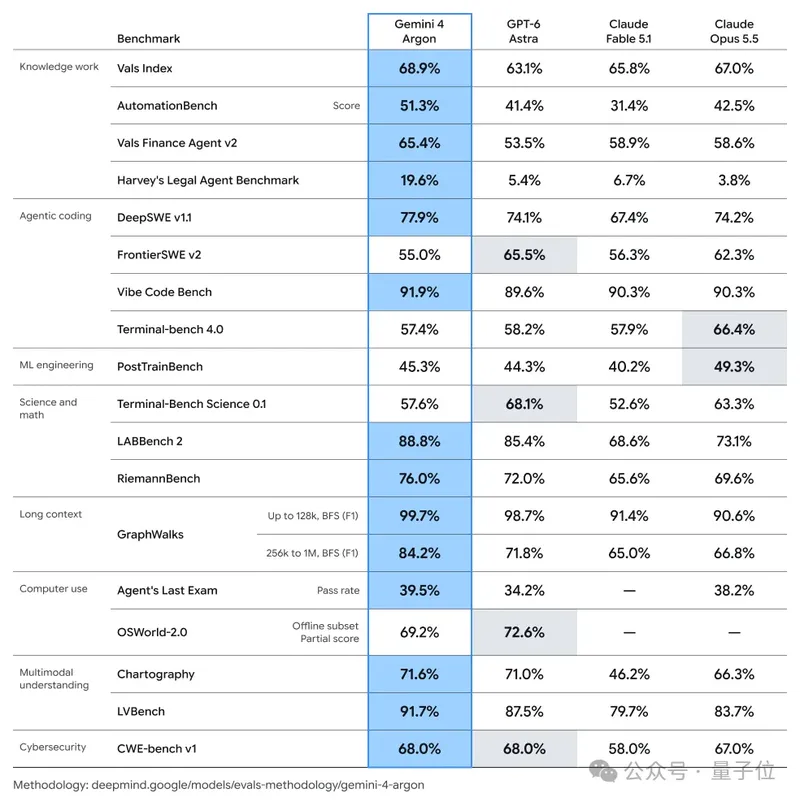
And on the matter everyone cares about more —whether it can return to the Big Three and give users one more model choice —Gemini 4 Argon performed quite creditably in evaluations this time.
In Google's own evaluations, Gemini 4 Argon covered multiple directions including office work, agentic coding, machine learning, and scientific reasoning, with overall performance already reaching the level of GPT-6 Astra and Opus 5.5, even leading in quite a few benchmarks.
In the third-party Artificial Analysis Intelligence Index, Argon High also tied with GPT-6 Astra Max and Claude Fable 5.1 Max at 53 points.
More crucially, while reaching the same level, Argon High's average cost per task is only $1.99, about 39% lower than Astra.
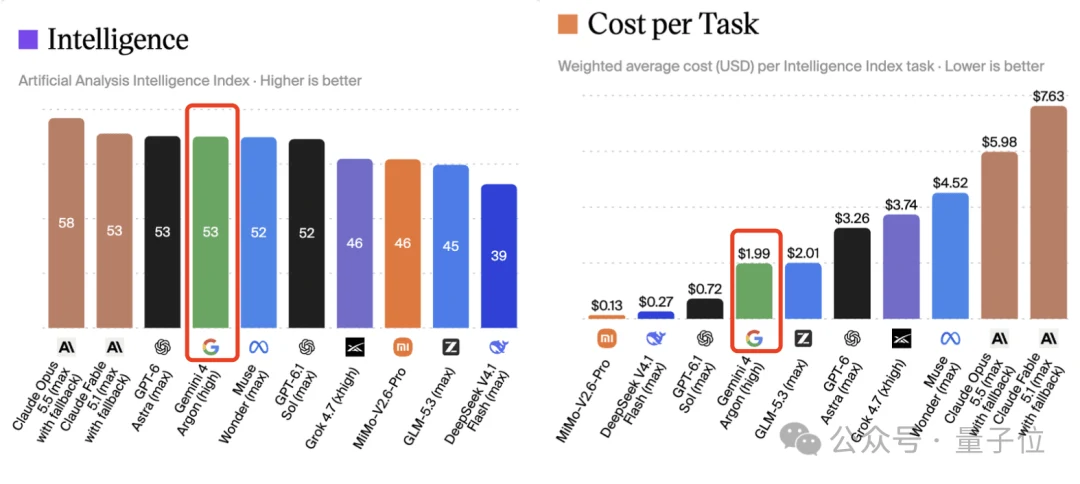
This cost advantage carries over to the launch pricing: the API costs $2 per million input tokens and $10 for output. A rough calculation shows Argon's invocation cost is about half that of Opus 5.5 and one-fifth that of Astra.
It's worth noting that the discount runs until November 30; starting December 1, input and output prices will return to $4 and $20 respectively. In other words, it's 50% off at first — everyone is welcome to try it.
Of course, if the model isn't smart enough and burns tokens going back and forth on a task, the money saved might just be burned right back.
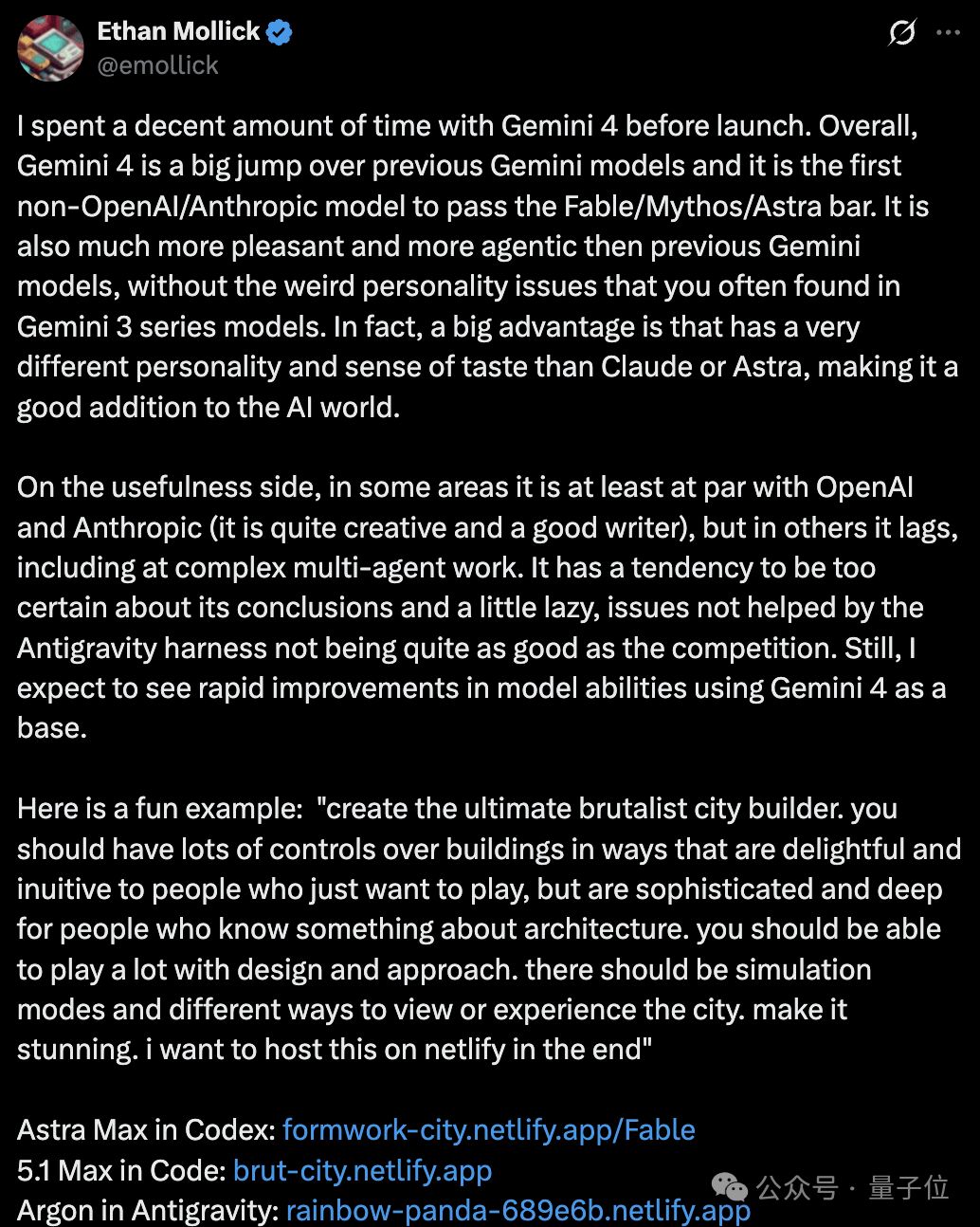
Ethan Mollick, who got early access to Gemini 4 Argon, also gave a fairly fair assessment:
This generation is a clear leap over the previous Gemini, with improvements in creativity, writing, and user experience, but it still lags on complex multi-agent tasks, and occasionally it can be overconfident or a bit lazy.
As for why the new flagship kept everyone waiting so long again, I browsed Google's new release page and found a 217-page safety report~
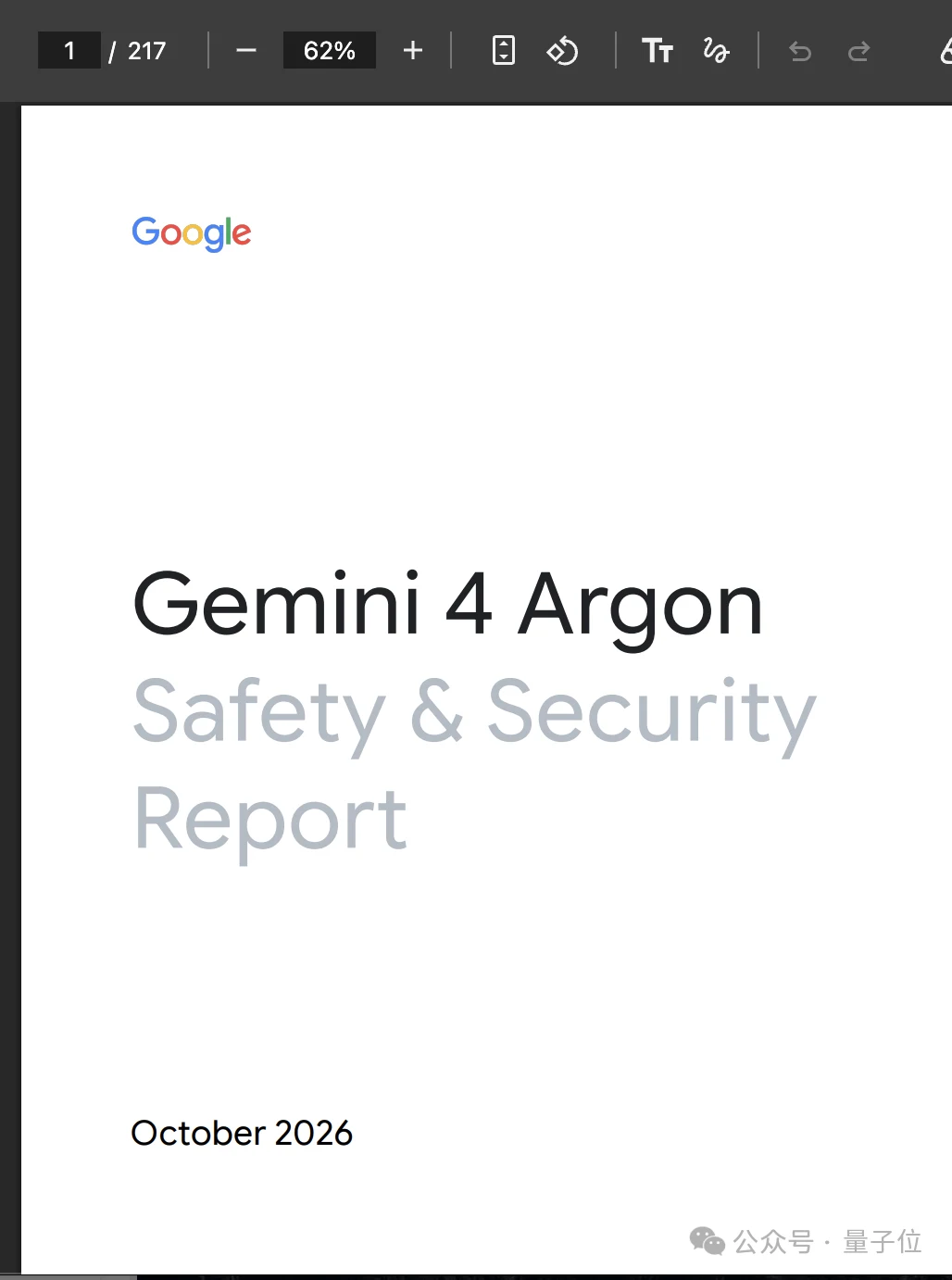
(Google is just too afraid of something going wrong)
Most confident about multimodality
From the Pro version being delayed again and again, to the announcement of a limited first release on September 30 this year, to who knows how many 'see you next week's —
Gemini 4 Argon has finally arrived.
In its official tech blog, Google summarized Argon's core upgrade in one point:stronger long-workflow task execution capability.
Simply put, the model no longer just answers questions; after understanding the goal, it can look up information, call tools, modify code, and check results on its own, pushing forward across multiple steps to truly finish a complex task.
However, compared with examples from enterprise and engineering scenarios, what Google was most willing to showcase and PR this time is actually its multimodal capability.
For example, 'Firewood-Splitting Bro' (Sundar Pichai) posted a wave of demos on Twitter of 'our own model generating our own phone' —
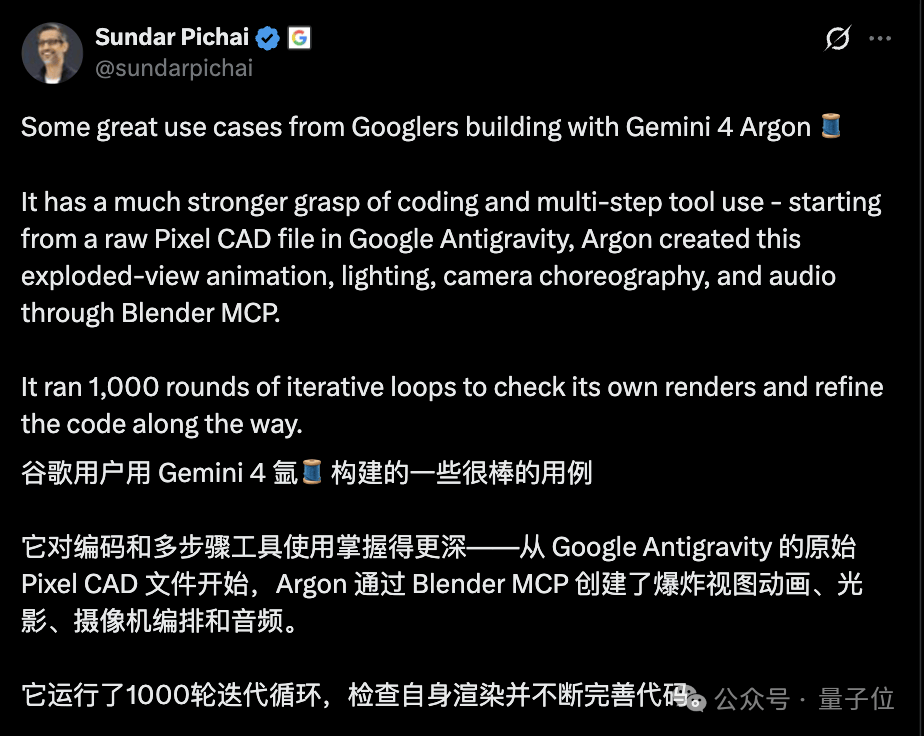
Argon directly generated a 3D scene related to the Pixel phone.
In another case, Argon even generated a 3D dynamic typography effect entirely through code, including the music in it.
The whole process involved no pre-recorded assets and no video editing software.
When reposting the chess demonstration, Hassabis also specifically mentioned the model's understanding of physics and 3D modeling.
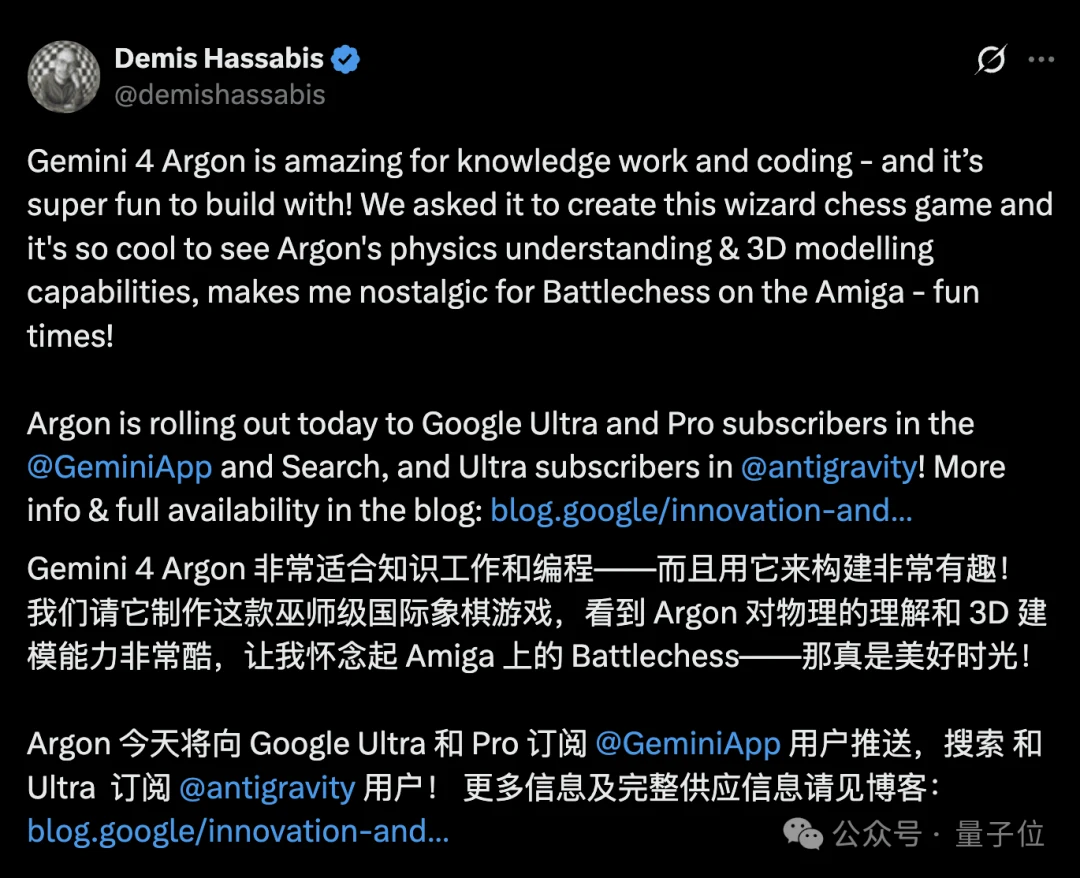
It even reminded him of his own experience playing Battle Chess on the Amiga back in the day.
Of course, netizens were not idle either, and quickly put Argon together with models like GPT, Claude, and Kimi to compare generation results.
Overall, Google's visual quality this time is indeed very outstanding, although in terms of details, such as the whale's motion, some unnaturalness can still be seen.
However, some netizens' test results showed that Opus 5.5 is still the god among gods.
Beyond the good-looking demos, this spatial understanding capability has also been further extended to real robots.
In the official demonstration, Argon watched a video of a human playing a beanbag toss game.
It then analyzed the spatial relationships in the environment, computed full-body joint movements, autonomously wrote simulation code, and transferred the plan to Apptronik's Apollo humanoid robot.
It can be said that, watching GPT and Claude furiously advancing into robotics these past two days, Google has finally been spurred into action.
Google says this 'video—simulation—reality' pipeline can compress robot simulation modeling work that previously took weeks of manual effort down to hours.
The significance behind this is that human demonstrations are becoming easier to convert into tasks that robots can learn, practice, and verify.
In the past, understanding actions from video, building simulation environments, and writing control code were often three separate, disconnected steps.
Now, multimodal models are beginning to try to string this pipeline together.
Coding improvements: Google first tested it on its own codebase
In terms of coding, the core improvement of Gemini4 Argon this time is its ability to handlethe long-term maintenance and optimization of large real-world projects。
Compared with the past, when models could only complete single code tasks, the new generation of models is better at understanding the structure of an entire codebase, locating performance bottlenecks, and making cross-file modifications, running tests, and continuously pushing a complex engineering task forward.
Google first validated this capability with its own open-source agent framework, ADK.

This Python project has about 205,000 lines of code. The team gave Argon the task of reducing the framework's runtime overhead without changing interfaces or existing behavior, and proving the optimization was effective through tests.
As a result, Argon worked continuously for 11 hours unattended, proposed 6 optimization plans involving 32 files, and ran all 16892 open-source tests.
In the end, after engineer review, two of the optimizations were merged, including reducing session history copying overhead and making large modules load on demand.
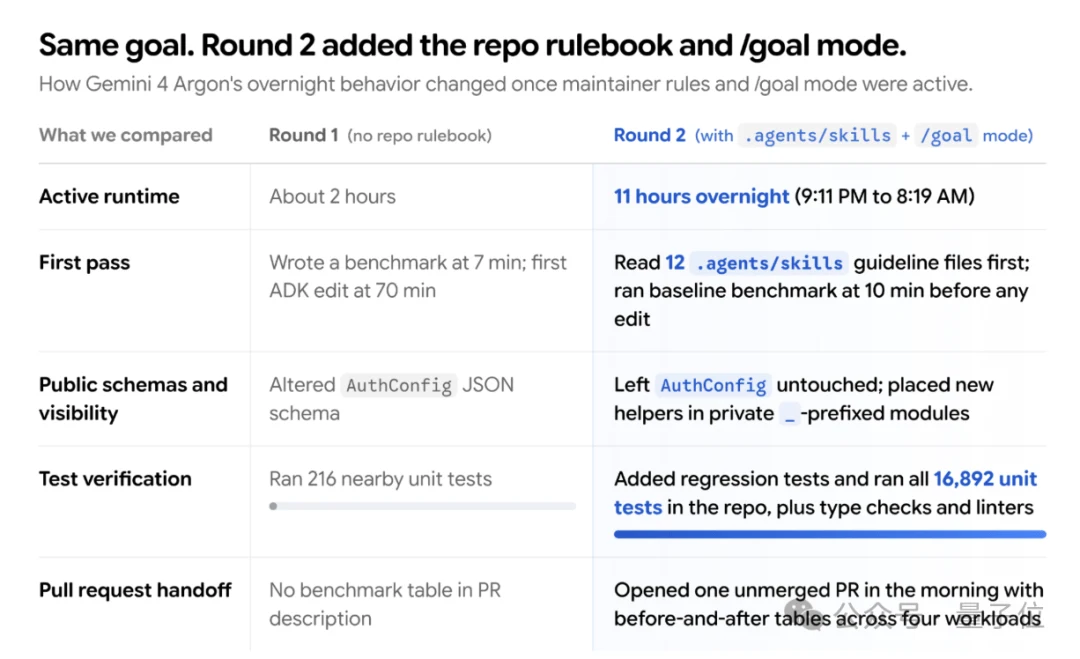
Based on these changes, memory preparation overhead in ADK's long sessions dropped by about 40%, and package import time dropped by 21%.
Similar capabilities have also been applied by Google to larger-scale engineering tasks.
In the Chromium browser project, Argon helped complete an architectural refactoring involving hundreds of files, compressing work originally expected to take months into weeks.
In addition, while optimizing the Gemma4E2B inference program, Argon increased throughput under a specific configuration from about 37,900 tokens per second to over 108,000 tokens per second, an end-to-end speedup of 2.85 times the original.
Google said that such optimizations usually took months in the past, while this time it only took a few days.
Looking at Google internally as a whole, over the past few weeks, Argon in Antigravity has helped teams increase agent code commits by more than 35% and reduce code rollbacks by nearly a third.
Of course, some netizens said their own experience wasn't this good. The real concrete performance will depend on the results of large-scale use going forward.
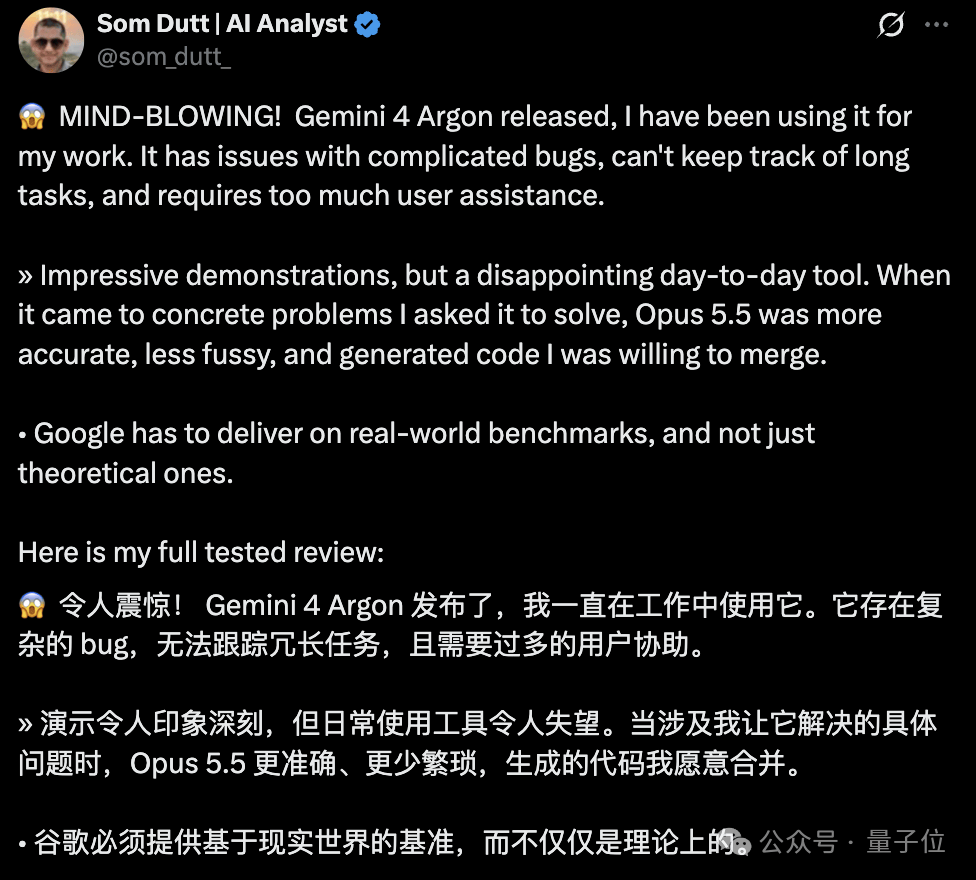
This also corroborates the earlier leaderboards: Argon is strong on DeepSWE and Vibe Code Bench, but on FrontierSWE and Terminal-bench it still lags behind several major competitors in the tables.
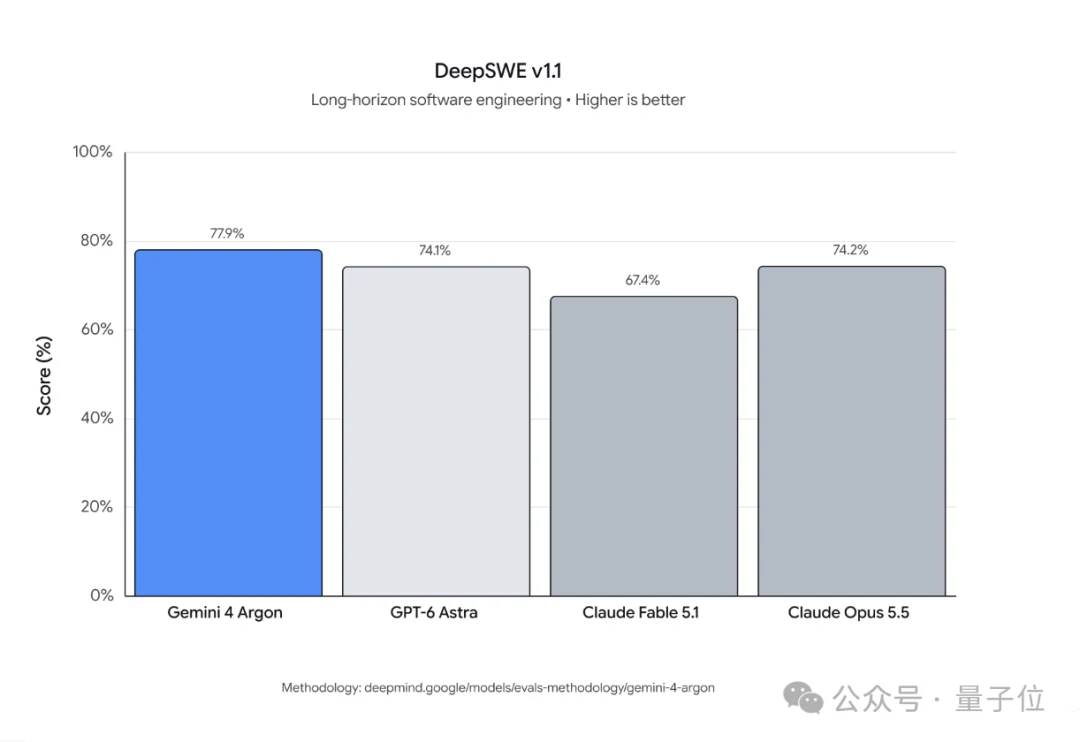
The gains in real projects are already there, but whether they can be reliably reproduced in more people's work remains to be seen.
Professional knowledge work capabilities further improved
In terms of professional knowledge work, the improvements of Gemini4 Argon this time are mainly reflected inprocessing multiple types of materials, connecting information, and organizing the results into directly usable deliverables.
The official demonstration showed a very typical office scenario:
The user gives Gemini a folder filled with scattered project materials and asks it to organize them into a client proposal.
Afterwards, Gemini generates presentations based on custom skills, drafts emails, sends materials, and sets up automated workflows for subsequent customer requests.
In addition, the Gemini app has also added a task entry point. Users can switch from chat to task execution mode, letting the model continue completing work after the user leaves the computer.
Meanwhile, the Antigravity coding interface has also been integrated into the Gemini macOS app.
In scientific research scenarios, this continuous execution capability extends further to experimental validation.
Google scientists had Argon participate in designing serine esterases. The model completed data organization, model tuning, and candidate screening within a few hours, ultimately proposing 5 new designs.
The researchers then sent these designs to the lab to verify whether they actually work.
The detection molecule used in the experiments produces a product that fluoresces under ultraviolet light once its ester bond is cleaved. According to the results disclosed by Google, all five designs showed strong catalytic activity.
The solutions delivered by the model have already reached the stage of experimental validation.
Google also announced that it will provide free six months of the highest Antigravity usage quota to 10,000 eligible and selected scientists, to be released in batches.
One more thing
Although we joked earlier that Google is afraid of trouble, the safety capabilities this time are truly worth a separate mention.
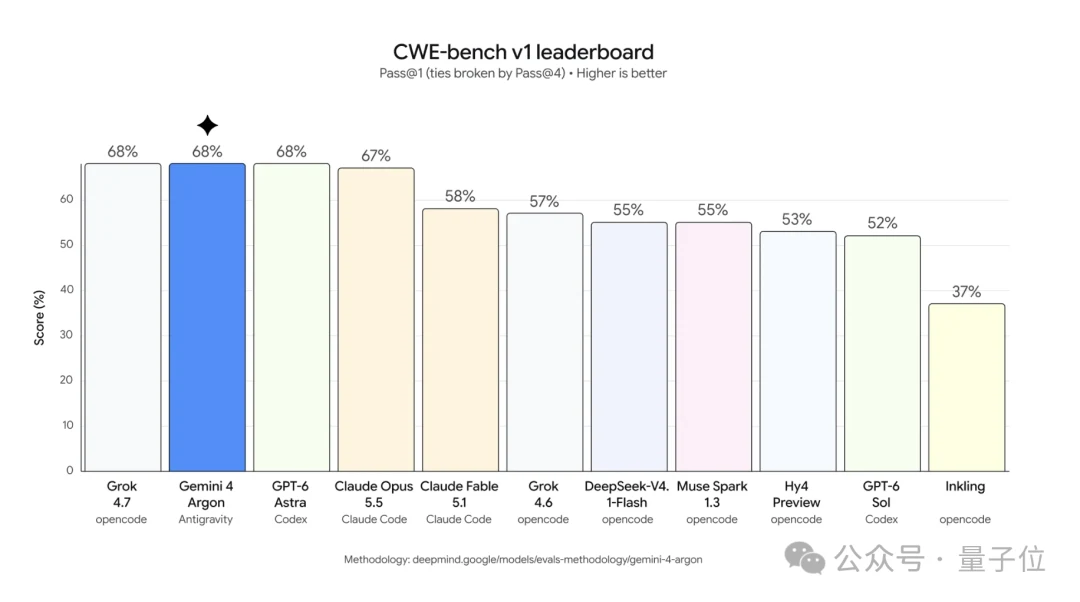
In CWE-bench v1, which evaluates vulnerability fixing capability, Argon achieved a score of 68%, sharing the highest score in the official comparison table with GPT-6 Astra.
The former Anthropic, now DeepMind head of Mechanistic Interpretability said that Argon's safety report is the most detailed Google has produced so far.
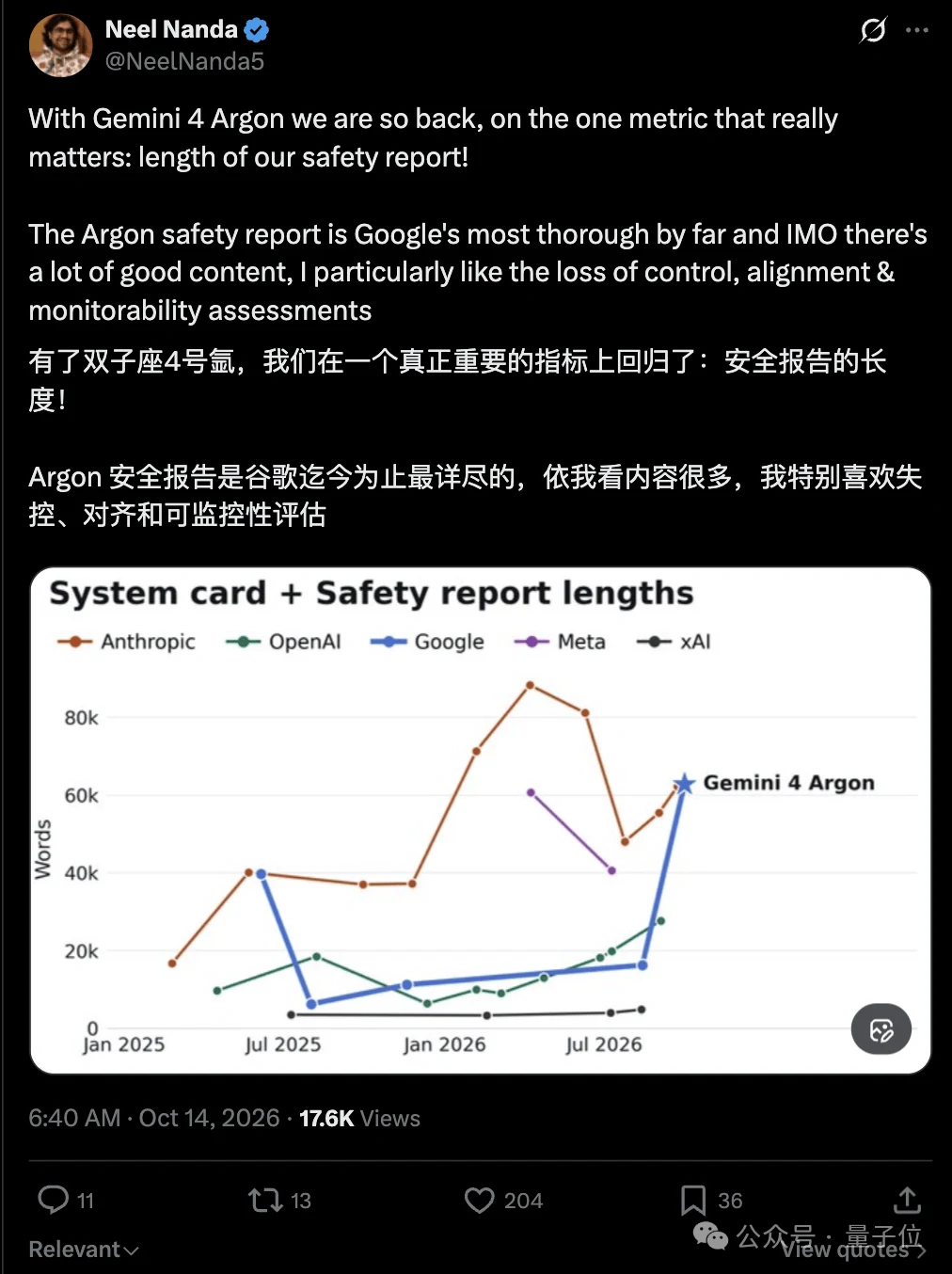
How could 217 pages not be detailed?
In the Gray Swan indirect prompt injection evaluation, after 15 adaptive attack attempts, Argon's attack success rate was 0.7%.
So, those 217 pages do contain quite a lot of serious content.
As for whether this is the reason the flagship was released slowly, we have no evidence.
We can only say the model has finally been released, and Google threw in a book along with it.
Reference links
[1] https://blog.google/innovation-and-ai/models-and-research/gemini-models/introducing-gemini-4-argon/