
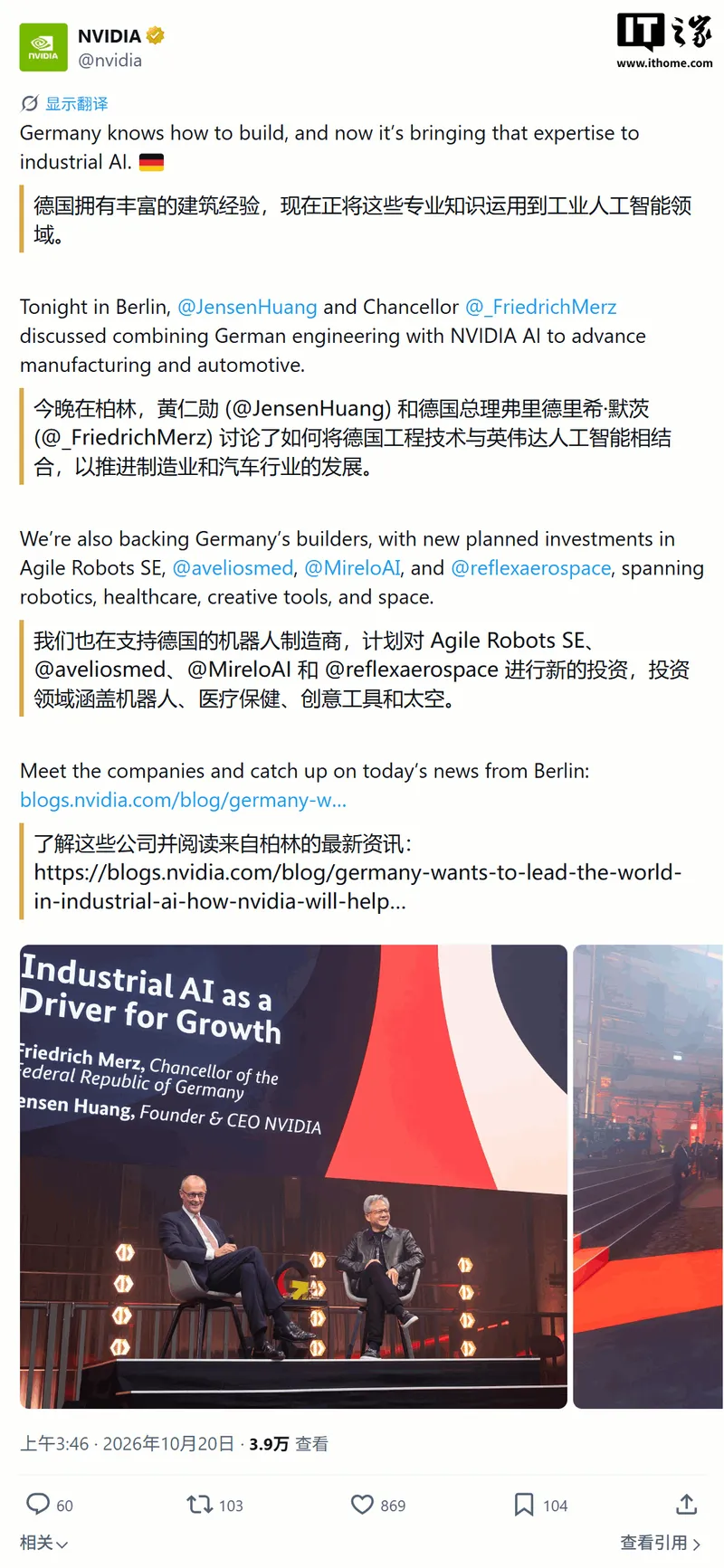
IT之家 news, October 20 — During a conversation with German Chancellor Friedrich Merz in Berlin, NVIDIA CEO Jensen Huang said that AI is not just a chat tool.It will enter scenarios such as factories, robots, and hospitals, enhancing existing professional capabilities and industry experience.
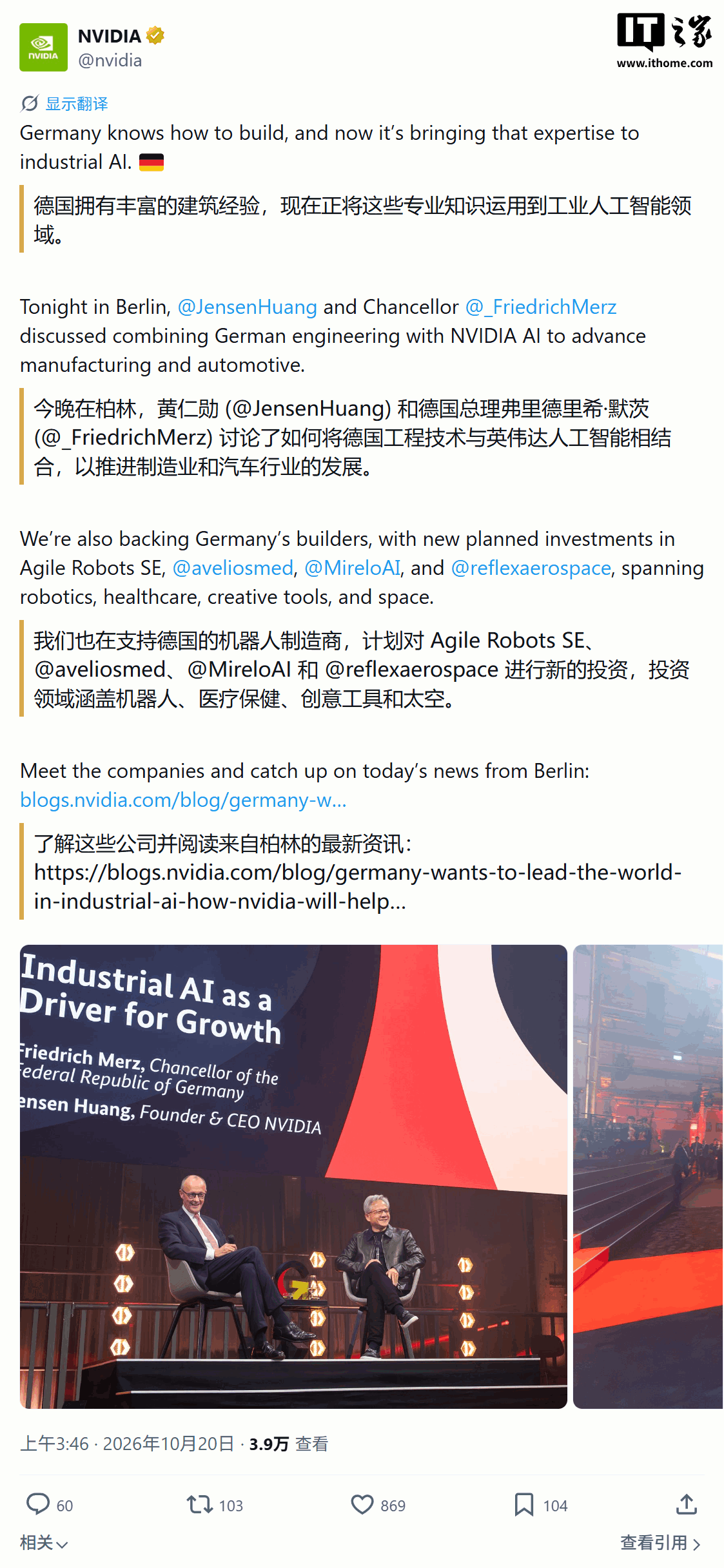
During this conversation, Huang and Merz discussed how to combine Germany's manufacturing strengths with AI and promote the adoption of AI in the automotive, machinery manufacturing, and small and medium-sized enterprise sectors. The German federal government also signed a joint statement of intent with NVIDIA to jointly advance advanced models for physical AI, enabling AI to be applied further to real-world industrial scenarios.
Huang said thatthe engineering, manufacturing, and scientific knowledge accumulated by German companies is an important advantage, and AI will enhance these capabilities. He described AI as a "new tool" and encouraged companies to use the technology to amplify their own expertise. Merz called on small and medium-sized enterprises to let AI utilize existing data, turning accumulated industry experience into competitiveness.
On the investment front, NVIDIA announced plans to invest in four German startups, covering robotics, hospital information systems, video dubbing, and satellite manufacturing. Among them, Avelios Medical develops hospital information systems that integrate AI into clinical and administrative processes, with the goal of freeing up more time for doctors and nurses to care for patients.
On the industrial application front, Siemens announced that it is advancing AI-driven autonomous factories with NVIDIA, and disclosed that fully virtualized production commissioning preparation can reduce engineering workload by up to 85%, while agent-based production planning can save up to 20% in costs.
During the conversation, Huang told German companies: "That knowledge belongs to you and cannot be replaced... Embrace this technology [referring to AI], it is a new tool." German Chancellor Merz emphasized that the data accumulated over years by small and medium-sized enterprises is Germany's advantage; Huang agreed and noted that German manufacturers large and small possess world-class expertise.