

By Mengchen, from QbitAI
QbitAI | Official account QbitAI
The funniest joke heard recently in the AI circle:
In the coming month, all of the big three will release new models.
The new Claude has been praised as a "major leap"; when fixing a bug it can "fix the root cause", identifying the larger underlying problem and handling it as well.
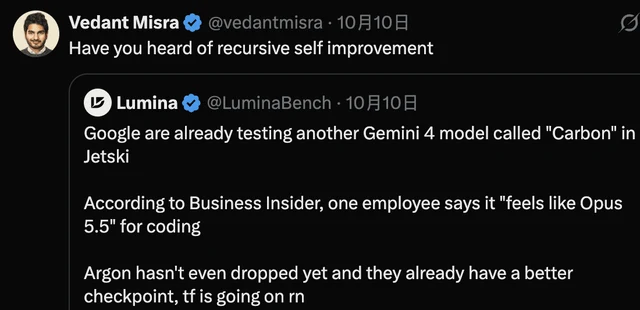
Gemini is releasing Argon's upgraded version Carbon, with internal beta feedback saying it "can rival Opus 5.5".
ChatGPT is releasing the mid-tier 6.1 Terra……

What? I thought the current 6.1 Sol was just Terra with a name change.

Claude's new model can break out of fixed thinking patterns
Information from The Information.
If you think the pace of new model releases in the AI circle over the past month has been fast, don't expect next month to slow down.
According to internal beta users, the new version of Claude is better at reasoning and intuition, and especially skilled at judging a person's underlying intent and goals.
For example, a person might ask the model to fix a single bug, and the model might identify the root class of problems causing that bug, and ask whether the entire class of problems should be fixed, said a person who has used the model.
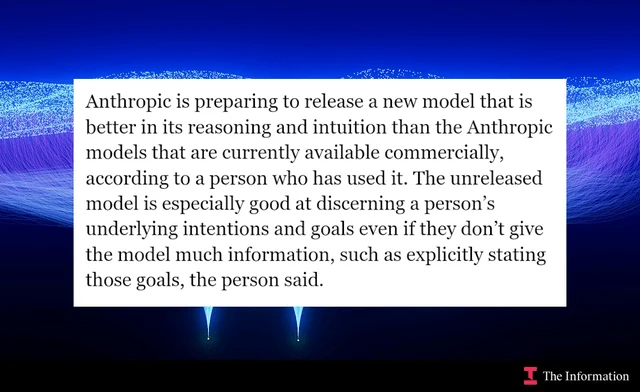
The new version of Claude is also better at thinking outside the box, rather than repeating common conventional advice or solutions.
If a user asks for advice on how to invest in stocks, it won't suggest the cliché of checking price-to-earnings ratios, but will instead propose its own creative algorithms to predict future stock performance.
It's unclear whether the new model is Fable or Opus; in any case, it's stronger.
Gemini 4 Carbon may have used RSI
Meanwhile, Google is also developing a new model, codenamed "Gemini 4 Carbon".
Early versions of Argon lagged behind Claude Opus 5 on some coding tasks.
Carbon outperforms Argon on coding tasks and continues to perform better on tasks requiring visual understanding, such as analyzing videos or testing frontend page functionality (thanks to being trained on YouTube data).
Carbon was opened to employees on Google's internal coding platform Jetski for several days; employees who tried it felt it was "on par with Opus 5.5", but more testing is needed.
Google tested a series of Gemini 4 models, codenamed Argon, Barium, and Carbon.
The one with the internal codename "Barium-B" was ultimately chosen and released as the Argon we see today.
After the leak of Carbon's internal beta performance, Google employee Vedant Misra posted in response: "Have you heard of recursive self-improvement (RSI)?"
It's uncertain whether this hints that Carbon used RSI technology.
OpenAI has nothing left?
GPT-6.1 Terra has already appeared in Microsoft Copilot's code.
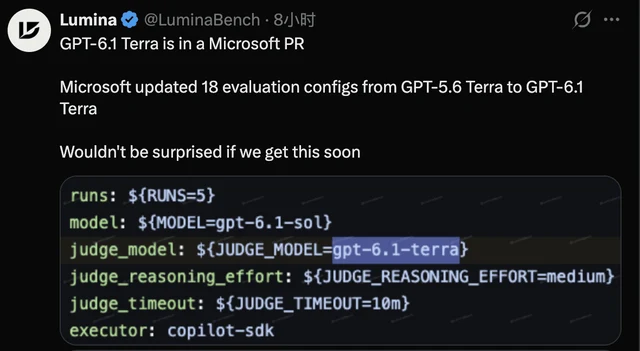
So the earlier suspicion by many that 6.1 Sol was actually Terra released under a different name seems to have been wrong. Turns out 6.1 Sol was just a minor upgrade over 5.6 Sol.
Many people's reaction to the news of 6.1 Terra coming out was that it feels like OpenAI has given up on itself and is coasting.

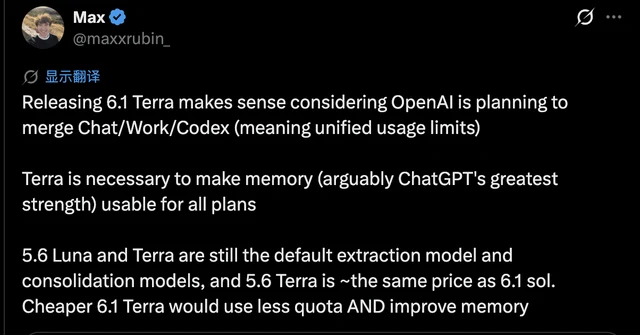
However, some also believe that the Terra upgrade is indeed very important for OpenAI.
Because they plan to merge ChatGPT's Chat/Work and Codex modes together, they will need a cheaper model for free users.
Meanwhile, OpenAI released a new update.
The latest GPT models perform better in niche programming languages (FORTRAN, COBOL).
Many banks and public utilities rely on these legacy software systems, and hardly any human programmers are left who can maintain them.

COBOL supports over 40% of banking systems, 80% of in-person credit card transactions, and 95% of ATM transactions, while Fortran is used for weather forecasting and nuclear reactor safety analysis.
In tests of migrating COBOL programs to other languages, GPT‑6.1 Sol achieved 86.6% accuracy at the low tier, while GPT‑5.6 Sol only got 5.4%. At higher reasoning tiers, the accuracy reached 97.9%, nearly maxing out the test.
As for domestic models, DeepSeek was the first to surface from its dive, and new models from Kimi, GLM, and Minimax will also make their debuts one after another.
In short, the upcoming November (11) will still be exciting.
Reference links:
[1]
https://x.com/kimmonismus/status/2112242007062233122?s=20
[2]
https://x.com/maxxrubin_/status/2112256163761016977?s=20
[3]
https://openai.com/index/low-resource-programming-languages/