
Yunzhong, reporting from Feisit
Quantum Bit | Official Account QbitAI
From general-purpose models to personalized intelligence, the competition in artificial intelligence is extending towardlong-term learning and exclusive capabilitiesas accumulated assets.
Tongyan Lingzhi explores Personal AI centered on parameterized learning and continuous evolution, allowing individuals and organizations to gradually accumulate their own intelligence assets as they use AI.
Over the past few years, large models have continuously broken through capability boundaries, and more and more enterprises have begun introducing AI into core businesses such as R&D, investment research, and operations through APIs, knowledge bases, and Agents.
But as AI participates in actual work for longer and longer periods, a new question has begun to emerge:Can the massive amount of business experience generated by enterprises every day merely be temporarily invoked by models, or can it gradually accumulate into their own AI capabilities?
Global technology companies have already begun exploring this direction.
OpenAI is improving ChatGPT's long-term memory through Dreaming, enabling it to synthesize historical interactions and better understand user preferences, project contexts, and long-term needs; Meta's Muse further combines personalized understanding with autonomous execution, pushing Personal Agents from answering questions to completing actual tasks.
Whether it is long-term memory or proactive execution, both reflect an increasingly clear trend: AI is evolving from a general-purpose tool for everyone into long-term intelligent services for specific users.
Li Wei, CEO of the Industry Platform at the Beijing Institute for General Artificial Intelligence (BIGAI), believes: "The stronger the foundation models become, the greater the role personalized intelligence can play. What we are optimistic about is a new technical division of labor: advanced foundation models provide shared general capabilities, while personalized models, through long-term interaction and continuous evolutionary learning, gradually form exclusive capabilities that meet the needs of different subjects."
Note: Tongyan Lingzhi relies on the research accumulation and industrial transformation resources of the Beijing Institute for General Artificial Intelligence (BIGAI) system, focusing on the research and development of continuously self-evolving exclusive models (Personal AI) for enterprises and individuals. Through personalized model training, continuous learning, and underlying computing power optimization, it promotes the accumulation of professional knowledge and business experience into sustainable, evolving exclusive intelligent capabilities.
As personalization becomes a direction of common industry concern, technical exploration has also begun to extend into the interior of models.
Beyond remembering user information, can AI truly learn the experience accumulated by individuals and organizations over the long term? Can these capabilities be continuously updated with use, and be preserved after foundation models are replaced? As the number of exclusive models keeps growing, how can training and operating costs be controlled?
Tongyan Lingzhi focuses its technical direction onRecursive Self-Improving Personal AI, attempting to provide a systematic solution to the above questions.
Relying on the research and industrial resources of the Beijing Institute for General Artificial Intelligence system, the company chooses to build on existing general-purpose models, carrying the exclusive capabilities of different subjects through lightweight personalized parameters, combined with continuous learning mechanisms and computing power scheduling technology, allowing models to continuously adapt to users over long-term use.
The goal of this technical system is to enable individuals, projects, and enterprises to gradually build exclusive intelligence suited to their own needs and capable of continuous evolution, without having to separately train complete general-purpose large models.
From long-term memory to model learning, personalization enters the parameter layer
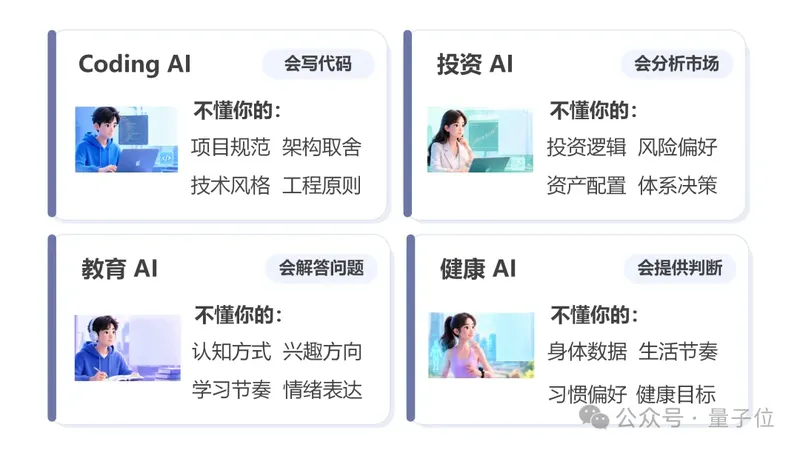
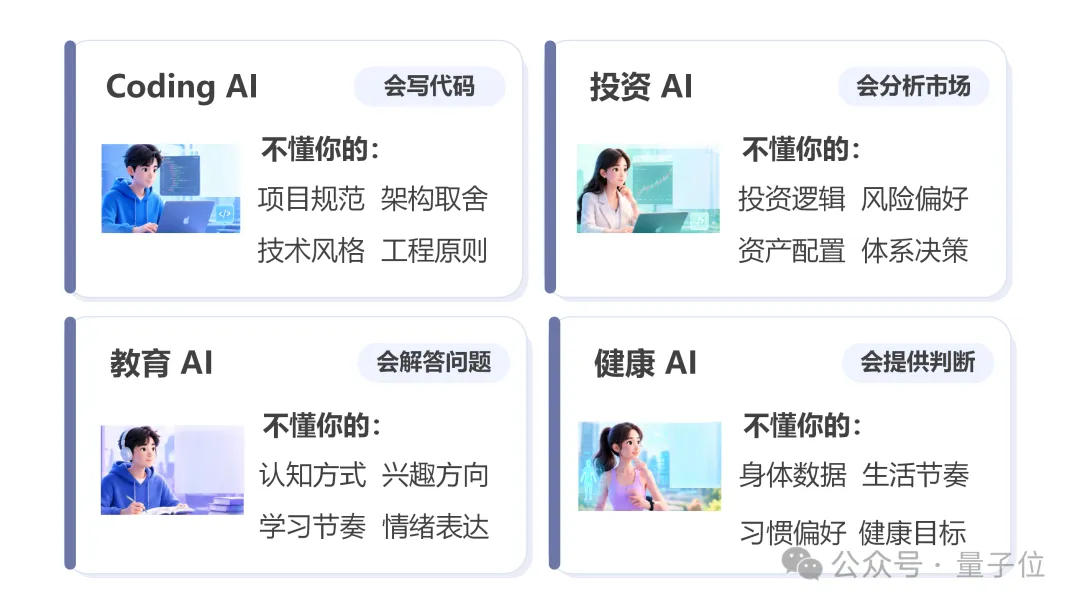
When using the same Coding Agent, different R&D teams may obtain markedly different results.
A mature software system often has its own architectural principles, technical specifications, and historical constraints. Senior engineers know which modules cannot be easily adjusted, and they also know when stability should be prioritized over the technically optimal solution.
Part of this experience is recorded in documentation, but more of it is scattered across long-term code changes, solution discussions, and project practice.
Similar situations exist in fields such as financial investment research and enterprise operations. General-purpose models can analyze markets and understand business processes, but the risk preferences, decision-making habits, and working methods that different teams have formed over the long term often need to be gradually mastered through continuous collaboration.
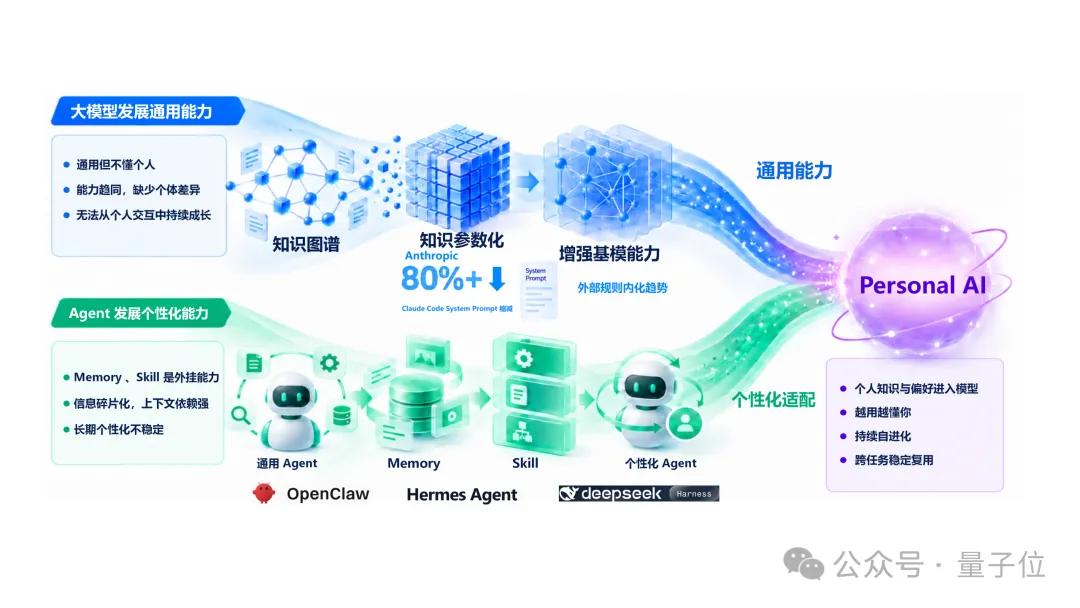
Currently, AI mainly adapts to specific scenarios through mechanisms such as Prompt, RAG, Memory, and Skill. They respectively undertake tasks such as instruction constraints, knowledge retrieval, state preservation, and capability reuse, and have become important components of enterprise applications of large models. However, such mechanisms mainly organize information outside the model, and the model's own parameters usually do not change as a result of a single business interaction.
When personalization needs extend from information acquisition to long-term behavioral patterns, parameterized learning provides another technical option.
Tongyan Lingzhi adopts an architecture that combines a shared Base Model with Personal Parameters.Foundation models provide general knowledge and reasoning capabilities, while different individuals, projects, and enterprises adapt parameters through lightweight Personal LoRAs, gradually integrating verified professional preferences and behavioral characteristics into the model.
Whereas traditional industry models mainly address capability differences between different industries, this approach further focuses on differences between different users within the same industry and the same task. For example, in software development, two projects may require completely different engineering standards; in investment research, different teams have their own evaluation criteria and risk disciplines.
This does not mean that knowledge bases and long-term memory will lose their value. Dynamic knowledge still needs to be retrieved, task states still need to be recorded, and behavioral patterns that recur repeatedly over long-term practice and remain relatively stable can be further converted into parameterized capabilities through training.
Personalization thus gradually extends from "enabling the model to know more information about the user" to "enabling the model to develop capabilities that better meet the user's needs."
Tongyan Lingzhi CEO Xie Xiaonan said: "Enterprises' demand for AI is shifting from acquiring general capabilities to accumulating proprietary capabilities. The same type of general intelligence service will be obtained by more and more enterprises; what truly differentiates them is whether they canconsolidate their long-established professional judgment and ways of doing things into model capabilitiesrather than forever remaining at the level of 'looking up information.'"
The key to letting models grow in actual work is establishing a trustworthy learning mechanism
Once proprietary parameters exist, new challenges follow: how can a model continuously absorb valuable experience while avoiding the accumulation of errors during learning?
Enterprises' daily use of AI generates massive amounts of feedback. Developers accept or modify code, salespeople adjust customer communication strategies, and investment managers revise research conclusions—these behaviors all contain potential learning signals. But a single piece of feedback does not necessarily represent a long-term pattern, and one successful judgment does not mean the same strategy applies to all scenarios.
If interaction records are used for training without filtering, the model may reinforce incidental preferences or even damage its original capabilities. Therefore, continuous learning requires mechanisms that can identify effective feedback, evaluate update outcomes, and control changes in model behavior.
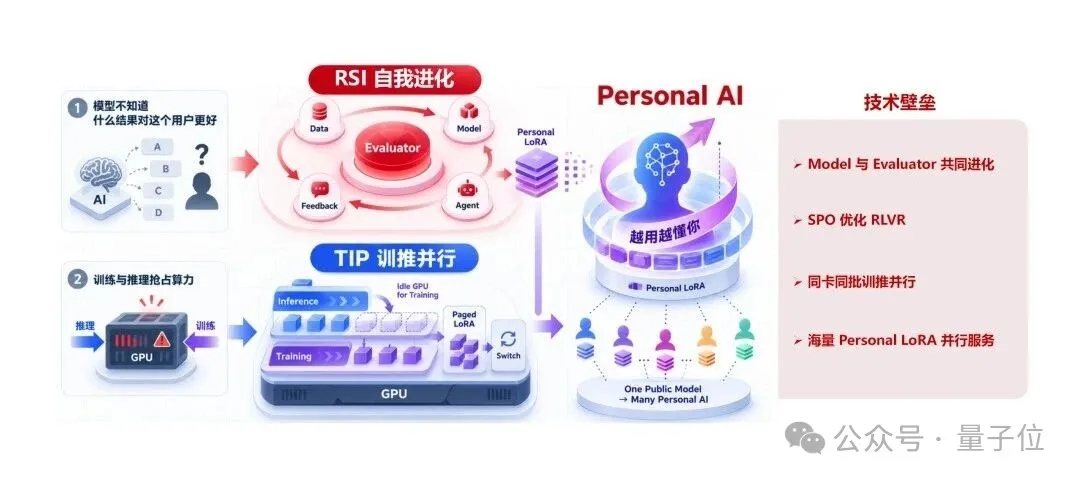
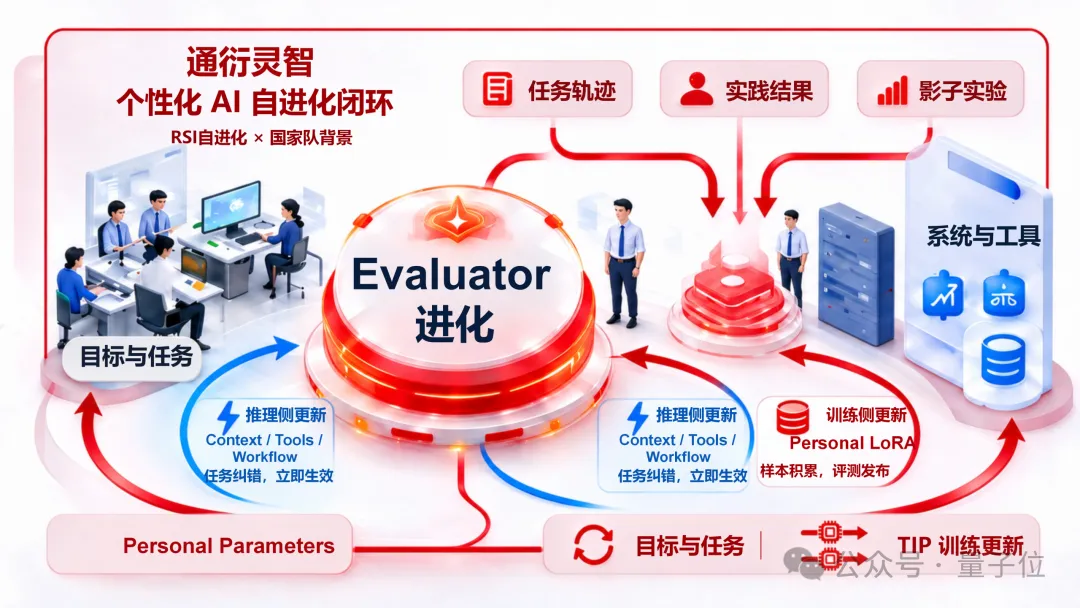
Tongyan Lingzhi has developed RSI (Recursive Self-Improvement) technology around this need, building a continuous learning framework through collaborative iteration between the model and an evaluator.
In this framework, task trajectories, human corrections, and actual results produced during business operations first form candidate learning data. The Evaluator screens and judges the feedback according to the evaluation criteria of specific users or enterprises, and then valid samples are used for incremental updates to the Personal LoRA.
The updated model must undergo further evaluation, comparing its task performance with the original version. Only updates meeting preset requirements are put into service, while anomalous results are handled through version control and rollback mechanisms.
At the same time, the actual effects of model updates can also be fed back to improve the Evaluator, allowing the system to gradually optimize how learning data is filtered and how evaluation criteria are set.
Taking software development as an example, the system can use code review records to analyze why certain types of modifications are repeatedly accepted or rejected, and verify through subsequent tasks whether the model has truly mastered the relevant engineering requirements. As effective feedback accumulates, the model has the opportunity to gradually adapt to the working methods a team has developed over time.
This mechanism involves technical challenges such as catastrophic forgetting, feedback pollution, model drift, and update stability. Tongyan Lingzhi stated that the core technical route and product architecture of RSI are already clear, relevant modules are being engineered, and the complete automated closed loop remains in ongoing research and development.
Tongyan Lingzhi CTO Chubingbing said that during training, they absolutely do not immediately take a user's single click of "reject" and use it to train the model. The Evaluator they introduced first judges whether the feedback has learning value—a single piece of feedback is only a signal; it is recurring patterns that may truly become learning. After a model update, it must also be re-run on the same batch of tasks as the old version; if improvement is confirmed, it goes live, and if performance degrades, it is rolled back, ensuring the safety and efficiency of evolution.
In the long run, if models can learn stably in real business operations, enterprises will have the opportunity to reduce the work of repeated configuration and centralized training, allowing AI capabilities to be updated gradually along with business development.
As proprietary models scale up, the cost of computing resources is a reality
The commercialization of personalized models faces another practical constraint: cost.
If in the future an enterprise needs to maintain different model parameters for hundreds of roles and thousands of Agents, while supporting continuous training and online serving of these models, the traditional approach of independent training and independent deployment will bring high computational and management overhead. For platforms serving large numbers of individual users, the importance of resource efficiency rises even further.
Tongyan Lingzhi therefore treats AI infrastructure as an important component of Personal AI, focusing its optimization on coordinated scheduling of training and inference, as well as memory management for massive personalized parameters.
Among these, TIP (training-inference parallelism) mainly addresses the problem of resource allocation between training and online inference. Traditional architectures usually manage model training and inference services separately, but continuous learning means the two types of tasks will alternate frequently during model operation.
Through technologies such as same-card same-batch training-inference parallelism and asynchronous gradient accumulation, Tongyan Lingzhi attempts to use available computing power to perform incremental training of personalized parameters while safeguarding online services, reducing the additional costs of a separate training resource pool.
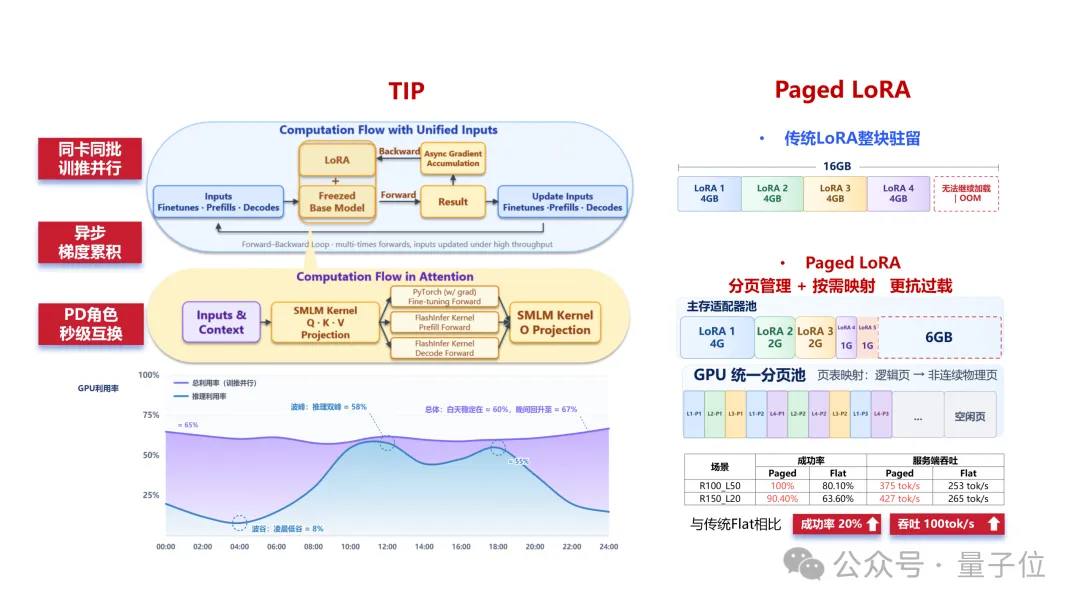
Paged LoRA, meanwhile, targets the memory management problem when large numbers of Adapters run concurrently. Traditional approaches often allocate memory in larger fixed units; as the number of models and access frequency change, this easily leads to insufficient resource utilization and fluctuating response latency. Paged LoRA adopts paged management and on-demand mapping mechanisms, allowing different Personal LoRAs to share the base model and GPU memory more flexibly.
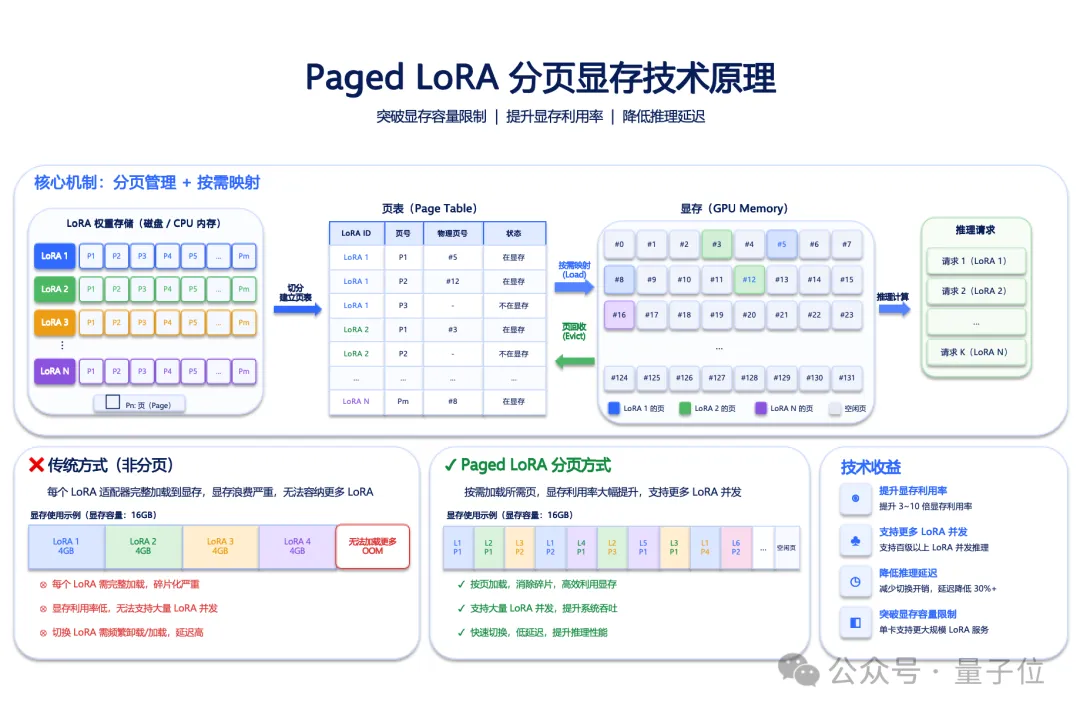
In completed stage testing, Tongyan Lingzhi used Qwen2.5-72B-Instruct and 8 NVIDIA H800 GPUs, with the LoRA memory budget for both the Paged and traditional Flat modes uniformly set at 5.79GB. Under test workloads where LoRA requests accounted for 1% to 30%, the Paged scheme achieved certain advantages in response latency and tail-latency performance.
Testing also showed that when the proportion of LoRA requests rose to 50%, frequent parameter swapping in and out still caused performance degradation. The team is continuing to optimize in areas such as asynchronous loading and prefetching of hot parameters, and the performance of these technologies in broader production environments still needs further verification.
Chubingbing additionally noted that while the inference cost of base models is falling, Agent invocation frequency and personalized training demand are growing. For continuous learning systems, one cannot look only at the price of a single model call; one must also consider the comprehensive cost of long-term training, updating, and serving. Only when the economics are reasonable can such services reach a broader user base.
For Tongyan Lingzhi, underlying compute optimization serves the long-term operation of personalized models. By driving continuous learning through RSI, and improving resource efficiency of training and concurrent serving through TIP and Paged LoRA, the company hopes to gradually lower the barrier to using proprietary models, moving them from high-cost custom services toward broader practical application.
As models keep updating and switching, how can intelligence be accumulated and retained over the long term?
As the capabilities, prices, and deployment methods of base models continue to change, enterprises may in the future use multiple models simultaneously, or switch their technical foundation according to business needs.
Once AI is deeply involved in daily operations, the costs involved in model switching are no longer limited to interfaces and system adaptation. Enterprises also need to consider whether the training data, work habits, human feedback, and evaluation standards they have spent large amounts of time accumulating can continue to play a role in a new model environment.
Tongyan Lingzhi hopes to reduce enterprises' long-term dependence on a single model foundation through shared base models and a layered approach to personalized capabilities.
It should be noted that the structures and parameter spaces of different base models are not naturally compatible, and Personal LoRAs usually cannot be directly reused across models. However, the business data, training samples, task trajectories, and evaluation systems an enterprise has already accumulated can continue to be used for adaptation and training of new models, reducing the work of rebuilding proprietary capabilities.
This approach also gives enterprises the opportunity to establish their own model evaluation standards, comparing different base models based on actual business performance rather than making choices entirely dependent on the generic metrics provided by model vendors.
Equally important as model switching is how to manage long-accumulated data and model outcomes.
In Tongyan Lingzhi's product design, the shared base model, enterprise business data, and personalized parameters are divided into different layers, providing a technical basis for data usage, model adaptation, and management of related outcomes. Specific data rights, intellectual property, and ownership of model outcomes still need to be clarified through contracts, licensing, and data governance mechanisms; technical layering itself does not automatically create legal ownership.
The possibility offered by this architecture is that, while continuously using AI, enterprises can gradually build relatively independent training data, evaluation systems, and personalized model capabilities, and continue to leverage these accumulations when models are upgraded or switched in the future.
The same applies to individuals. A person's long-formed knowledge structure, professional experience, and work preferences, if effectively preserved and continuously used to adapt to new intelligent systems, hold value that is no longer confined to any single product or any single service.
Xie Xiaonan also believes that companies need not worry that switching the model base will wipe out their accumulated assets. What truly belongs to a company is its long-accumulated business data, task trajectories, human feedback, and evaluation systems; these assets can be re-adapted to a new model rather than starting from scratch. The model can be switched, but a company's experience should not be reset along with it.
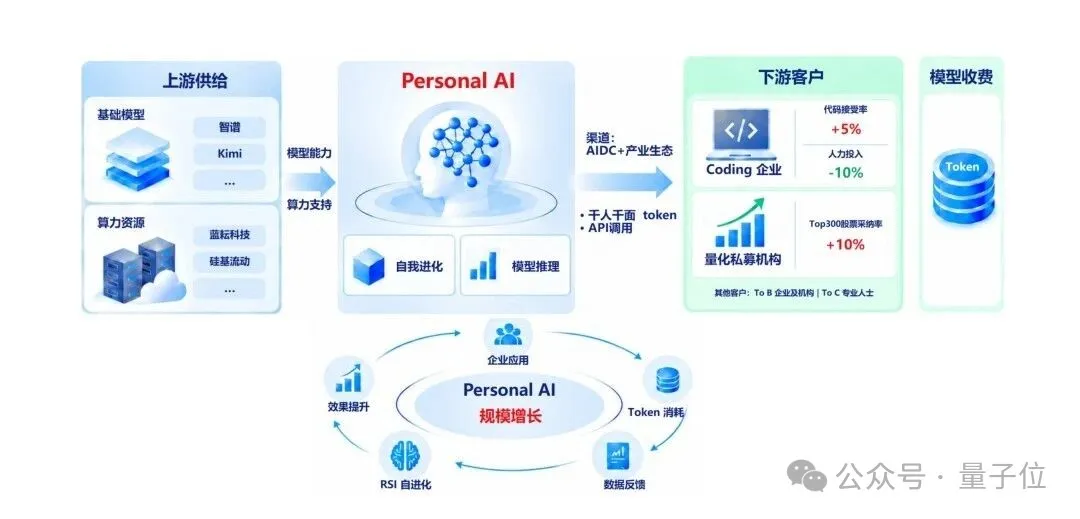
From a business model perspective, Personal AI thus points to a noteworthy direction:the value of AI services can extend beyond immediate task delivery to the accumulation of users' long-term intelligent assets.
From technological progress to shared value: making intelligence truly serve people
Artificial intelligence is redefining how knowledge and productive capabilities are formed.
In the past, an individual's experience was mainly preserved in their own cognition and practice, while a company's professional capabilities were scattered among employees, institutions, business systems, and organizational collaboration. As AI becomes increasingly involved in social production and daily life, this previously scattered knowledge and experience now has the opportunity to be systematically organized, learned, and reused.
But as technical capabilities continue to improve, a deeper question also needs to be considered:
when users continuously contribute interactions, corrections, and business feedback that make AI systems more intelligent, how should the long-term value created by these investments flow back to the individuals and organizations themselves?
Traditional platform-style AI services mainly provide users with immediate model capabilities, and users' usage behavior may also help the platform continuously optimize its products. What Personal AI explores is enabling users, while receiving services, to gradually accumulate exclusive intelligent assets formed from their own knowledge, experience, and judgment, so that the value of long-term AI use can continuously accumulate.
The significance of this accumulation goes far beyond improved personalization.
Forindividualsprofessional experience can gradually be transformed into long-term usable digital capabilities, helping them carry their accumulated expertise across different tools and work environments.
Forenterpriseslong-established business methods and organizational knowledge have the opportunity to be preserved and passed down through dedicated models, reducing the risk of key experience being lost due to staff turnover or technological change.
When these capabilities can be re-adapted across different base models, individuals and organizations will also gain broader room for technological choice, able to evaluate, adopt, and replace models according to their own needs, reducing long-term dependence on a single platform.
Enterprises do not necessarily need to retrain their own general-purpose large model, but they should have the opportunity to gradually possess a set of intelligent capabilities that belongs to them.
This also reflects what Tongyan Lingzhi advocates as "human-centered personalized intelligence." In their view, the development of artificial intelligence should give users greater autonomy, ensure that the knowledge, experience, and judgment accumulated by individuals and organizations over time are respected, preserved, and continued, and allow the value created by technological progress to benefit users more broadly.
Finally, Li Wei noted that the inclusiveness of artificial intelligence should not merely mean that more people can use advanced models; it should also mean that more people can use AI to accumulate and develop their own capabilities. Turning the fruits of technological progress more into human growth, enterprise innovation, and improvements in social productivity—this is Tongyan Lingzhi's understanding of being human-centered.
Relying on the research accumulated within the system of the Beijing Institute for General Artificial Intelligence, Tongyan Lingzhi is putting this philosophy into practice through parameterized learning, continuous evolution, and underlying computing architectures.
The related technologies still require ongoing research, development, and industrial validation, but the long-term value they point toward has broader social significance: making advanced artificial intelligence capabilities a lasting support for personal development, organizational growth, and improvements in social productivity.
From a longer-term perspective, artificial intelligence should not merely be a system that continuously absorbs human knowledge and keeps improving its own capabilities; it should also become important infrastructure that helps humans accumulate knowledge, pass down experience, and expand their capabilities.
As general intelligence gradually becomes a foundational capability broadly accessible to society, what is truly worth anticipating is that every person and every organization can establish their own long-term accumulation amid technological progress, and have the space to choose and develop these capabilities.
AI should not only become smarter because of human participation; it should also enable people to gain more capabilities because of AI's proliferation. The fruits of technological progress should not only settle within models and platforms, but should also settle as a lasting force for personal growth, organizational development, and social progress.
*This article is republished by QbitAI with authorization; the views are those of the original author alone.