

From abacus beads, gears, paper tape and chips to neural networks and an open horizon. An original AI concept illustration, not a photograph of a historical scene.
Place an abacus beside a computer today, and they seem to have little in common. One works by moving beads with your fingers; the other can write code, recognize photographs and even operate software for you. Yet both answer the same question: can work that happens inside the mind be moved outside it?
The abacus gave place value a physical home. Computers let machines carry out rules. Machine learning took a further step: people no longer had to write every rule in advance; machines could learn from examples. With large language models and agents, people began handing over tasks too—asking for more than an answer, asking the system to research, write programs and fix mistakes until it delivered a result.
The road was never straight. It passed through inflated promises, funding cuts and long stretches of stagnation. Less glamorous work kept it moving: better statistics, larger datasets, cheaper chips and more dependable software. The sudden acceleration we see today comes from those accumulated gains arriving together.
This article was written on 2026-10-9. Its first half covers history that has already happened. Its second looks ahead to AGI, whose arrival has no universally agreed date. We will make a bold bet on a year, without presenting that bet as fact.
First, people learned to put numbers outside the mind
The abacus deserves to begin this story, but it should not be called “the first place where people invented positional notation.” Ancient counting boards, counting rods and bead abacuses belong to an extended family; their origins and their later development are different questions. In China, the bead abacus gradually displaced counting rods around 1300 CE. Units, tens and hundreds each had a place, and carrying no longer depended on memory alone. Its significance lies in turning place-value arithmetic into movements that could be seen and felt.[1]
Binary addressed a different question: could just two states represent every number? Leibniz gave a systematic account of the arithmetic in 1703. Electronic circuits later proved well suited to distinguishing two stable states, so binary became the foundation of modern computing. Binary itself does not think, however; it is a way of representing information that machines can readily store and manipulate.[2]
In 1834, Babbage began developing the Analytical Engine, bringing calculation, storage and program control into a single design. The complete machine was never built during his lifetime, but the idea survived. Ada Lovelace's published notes in 1843 explored further how a machine might process symbols through a sequence of steps. What a machine can handle depends not only on its gears or circuits, but on whether we can express a problem as a program.[3] CHM
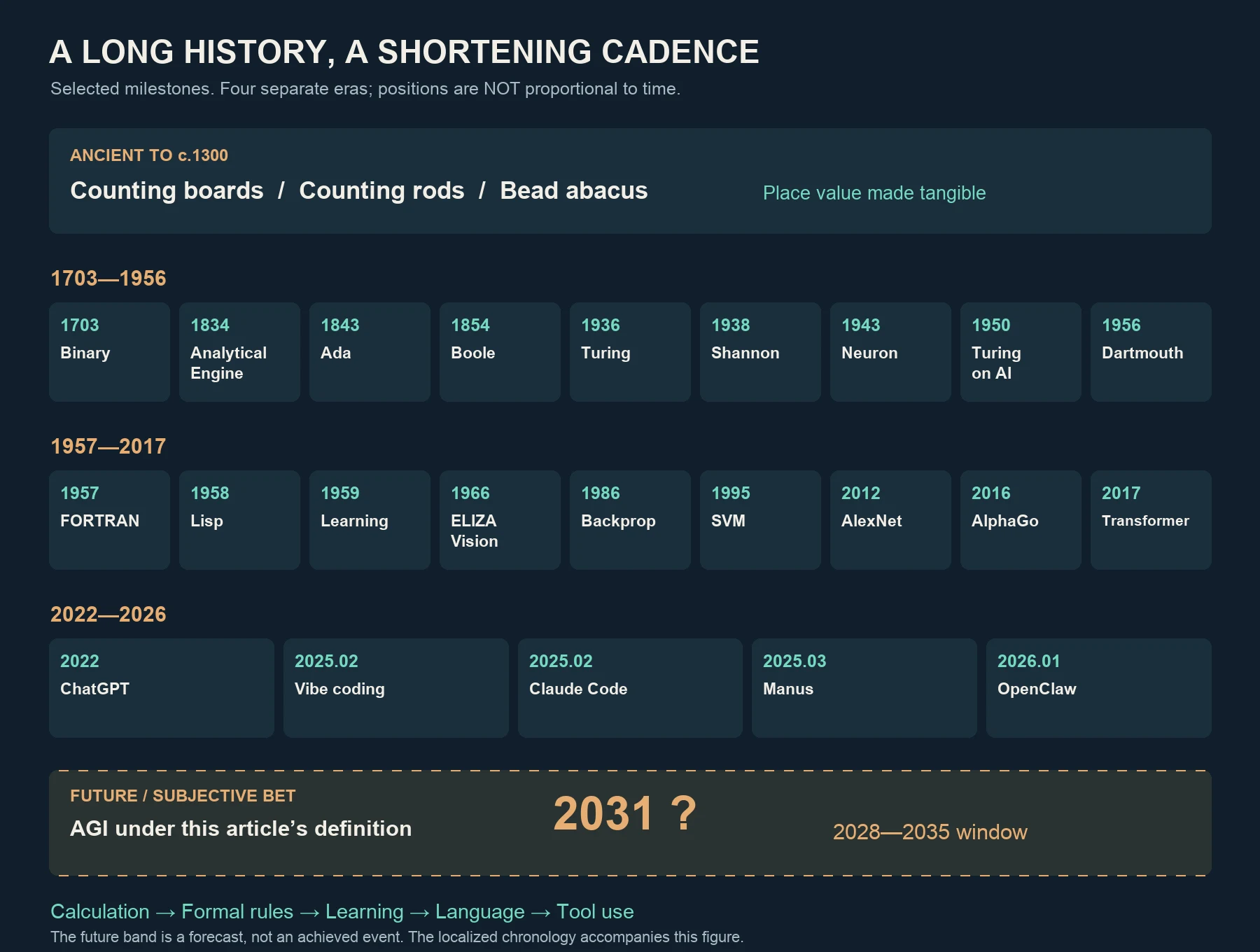
Computing history is shown in four eras: antiquity, 1703–1956, 1957–2017 and 2022–2026. Events follow chronological order, but spacing does not represent elapsed time. The dashed band is a subjective bet on 2031 within a 2028–2035 window, not an event that has happened. Labels correspond to the chronology below.
| When | Milestone | What it left behind |
|---|---|---|
| Antiquity; around 1300 | Counting boards, counting rods and bead abacuses | Calculation can use objects outside the mind; place value and carrying become physical operations.[1] |
| 1703 | Leibniz gives a systematic account of binary | Two symbols can represent numbers, providing a suitable representation for later digital circuits.[2] |
| 1834; 1843 | Analytical Engine design; Lovelace's notes | Calculation, storage and program control begin to come together; the possibilities of programs extend beyond a single calculation.[3] CHM |
| 1854 | Boolean algebra | Logic can be expressed algebraically, providing an important conceptual tool for analyzing digital circuits.[4] |
| 1936 | Turing proposes an abstract model of computation | The Turing machine formalizes computation by rules and shows that computation has limits.[5] |
| 1938 | Shannon's paper on switching circuits | Boolean logic is connected to relay circuits.Original paper |
| 1943 | McCulloch and Pitts's artificial neuron model | An influential mathematical connection is made between neural activity and logical operations.Original paper |
| 1950 | Turing publishes “Computing Machinery and Intelligence” | The question of whether machines can think shifts toward observable performance in interaction.Original paper |
| 1955; 1956 | Dartmouth proposal; summer research project | “Artificial intelligence” becomes the name of a research program and then of a field.[6] |
| 1957; 1958 | FORTRAN; Lisp | The former advances scientific computing; the latter becomes an important language for early AI.[7][8] |
A Turing machine is not a ready-made intelligent computer. It is an abstract model that defines what it means to compute by following a finite set of rules. Turing's work in 1936 did not promise that “every problem can eventually be solved by computation,” either. This matters: none of AI's later successes erased the limits of the problems themselves.[5]
By the 1950s, researchers were moving the machine's goal from “calculate quickly” toward “behave intelligently.” The Dartmouth proposal was written in 1955, and the research project took place in the summer of 1956. This was an important starting point for modern AI, rather than humanity's first vision of artificial intelligence. Programming languages subsequently freed researchers from arranging low-level instructions one by one, leaving more attention for symbols, search and reasoning.[6][7][8]
Machines learned to see, hear—and make a guess
Early AI placed considerable faith in rules. Write down an expert's knowledge, and a machine seemed ready to diagnose illness, understand sentences or control equipment. The difficulty soon emerged: reality contains too many exceptions, and common sense is hard to write down in full. Rule-based systems did not disappear, but research gradually moved toward a more practical approach: give machines enough examples and let them learn to make judgments under uncertainty.
Image recognition asks how to identify objects from pixels; speech recognition asks how to turn sound into text; natural language processing, or NLP, studies how to handle language's structure, meaning and use. These fields followed separate paths for a long time, only later beginning to converge through deep learning and multimodal models.
| When | Milestone | What it left behind |
|---|---|---|
| 1952 | Bell Labs' Audrey digit recognition system | Under restricted conditions, a machine can recognize spoken digits—still far from today's open conversation.CHM history |
| 1958 | Rosenblatt's perceptron paper | Adjusting parameters from training examples becomes an important early route in machine learning.[10] |
| 1959 | Samuel's paper on machine learning for checkers | Machines can improve through experience; people must still design the algorithms and learning goals.[9] |
| 1966 | ELIZA | Simple text rules can give people the feeling of being understood; fluent dialogue does not establish real understanding.[11] |
| 1966 | MIT's Summer Vision Project | Researchers try to turn image structures into descriptions machines can process, later discovering how much harder the task is than expected.Original project |
| 1970s–1980s | AI winters and the rise and fall of expert systems | Expectations, computing power and actual ability fall out of alignment; AI has never followed an uninterrupted upward curve.[12] CHM |
| 1986 | An influential paper on backpropagation | Training multilayer networks gains a more influential method; related ideas did not first appear in this year.[13] |
| 1980s–1990s | Statistical speech recognition and statistical NLP | Probability helps handle ambiguity and noise, gradually replacing the hope of writing down every rule.Speech review; statistical translation paper |
| 1995 | Cortes and Vapnik's support-vector machine paper | Robust classification boundaries with limited examples become an important machine-learning tool.[14] |
| 1997 | Deep Blue defeats Kasparov | A specialized system can beat the best chess players, but strength at chess does not automatically become general ability.[15] |
| 1998 | An influential LeNet paper | Convolutional networks show practical value in handwritten-digit and document recognition.[16] |
| 2000s–2010s; 2013 | Ad click-through prediction at scale; an influential Google paper | Machine learning enters real-time business decisions and improves predictions through vast amounts of feedback.[19] |
| 2009; 2012 | ImageNet dataset; AlexNet | Large datasets, GPUs and deep networks converge, producing a major breakthrough in image recognition.[17][18] |
| 2012 | Review of deep neural networks for speech recognition | Deep learning changes acoustic modeling and brings speech systems into a new phase of improvement.Research review |
| 2014 | GANs | Adversarial training expands the approaches available to generative models.Original paper |
| 2016; 2017 | AlphaGo defeats Lee Sedol; defeats Ke Jie | Deep networks, search and reinforcement learning combine to solve a previously daunting Go challenge.[20] BGA |
| 2017 | Transformer | Attention provides an architecture better suited to parallel training and becomes a key foundation for later large language models.[21] |
| 2018 | BERT | Bidirectional pretraining advances language-understanding tasks; models begin to share more general language representations.Original paper |
| 2020 | GPT-3 | Few-shot prompting shows that large models can perform varied tasks through context, while reliability remains limited.[22] |
| 2020 | DDPM | Denoising diffusion models advance image generation; this is not the starting point for every diffusion idea.Original paper |
| 2020; 2021 | AlphaFold's CASP14 breakthrough; methods paper | Protein structure prediction makes major progress; predicting a structure does not mean a new drug has been validated.Original paper |
The support-vector machine, or SVM, captures something of that era's spirit. There was no chat window like today's, yet machine learning could still solve serious, specific problems. Recognizing a spam message or classifying an image was often more useful than proclaiming that a machine possessed thought.[14]
Ad click-through prediction took this ability to industrial scale. The system estimates “the probability that this impression will receive a click in this context,” commonly called CTR. It is not mind reading, and it cannot guarantee that any particular user will click. Probabilities need calibration; systems face distribution shifts, privacy constraints and feedback bias. Its importance lies in bringing machine learning into a continuously operating feedback loop that influences revenue and the distribution of information.[19]
The image-recognition breakthrough in 2012 restored many people's faith in neural networks. AlphaGo in 2016 brought that change to public attention. Its 4:1 result was a five-game challenge match against Lee Sedol, not a world championship title; the three-game match against Ke Jie in 2017 ended 3:0. The victories were remarkable enough without adding an inaccurate claim of “winning the championship.”[18][20] BGA
After ChatGPT, the question shifted from answers to delivery
On 2022-11-30, ChatGPT opened to the public. Its significance lay not only in a stronger model, but in an exceptionally accessible entrance: ordinary people could speak directly to a machine and ask it to explain, rewrite, translate or generate code without understanding programming. AI moved from a capability hidden behind many products to something people actively chose to use.[23]
The next changes quickly reached beyond the chat box. Models could read more material and began connecting to search, files, code executors and browsers. Here, an agent means an execution system organized around a model: it keeps track of the task, calls tools, checks results and decides what to do next. The model makes inferences; the execution system connects those inferences to the world. Both can make mistakes.
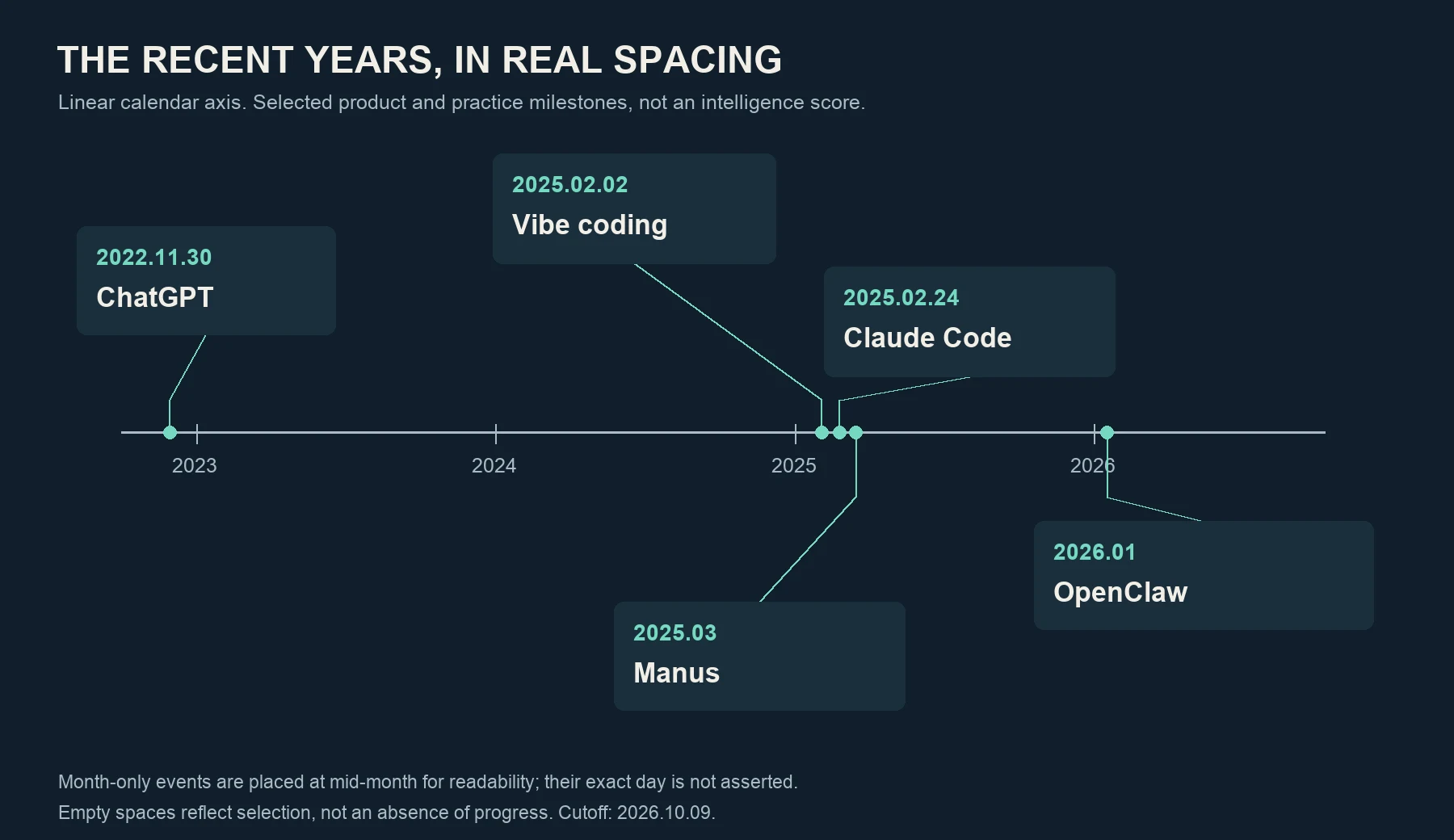
The recent 2022–2026 timeline uses linear year coordinates: the ChatGPT, vibe coding, Claude Code, Manus and OpenClaw milestones sit visibly close together. Only events selected for this article are included; the number of points is not a score for general intelligence. Events known only to the month are placed at mid-month; this does not assert an exact day.
| When | Milestone | How to understand it |
|---|---|---|
| 2022-11-30 | ChatGPT publicly launches | Natural language becomes a public entrance to generative AI.[23] |
| 2025-2 | The term “vibe coding” spreads | Karpathy describes a practice heavily dependent on generated code, with less line-by-line understanding; it does not name all AI-assisted development.Mirror of original post |
| 2025-2-24 | Claude Code research preview | A coding assistant enters the terminal, able to work with a codebase and tools.[24] |
| 2025-3 | Manus makes its public debut | An agent product for completing multistep tasks brings “do it for me” to the foreground.[25] |
| 2026-1 | OpenClaw's renaming and public spread | A self-managed personal agent draws attention to messaging interfaces, persistent state and tool connections; it is an execution system, rather than a new foundation model.[26] |
Claude Code and vibe coding often appear in the same sentence, but they are not equivalent. One is a tool; the other is a way of using tools. Professional developers can use that same tool to read code carefully, review changes and run tests. Faster machine-written code does not make responsibility disappear.[24] Mirror of Karpathy's original post
Manus and OpenClaw illustrate two representative product choices: one emphasizes handing multistep tasks to a service, the other connecting a resident assistant to your own environment. They reveal the promise of autonomous execution, along with new complications: how much permission should a system receive, how do we detect failure, and how can an operation be undone after it has gone wrong? These questions matter as much as a model's ability to answer a test.[25][26]
The acceleration is real, but what is accelerating?
Preserving and passing on knowledge took humanity a very long time. Giving rules to electronic machines took decades. The journey from public chat assistants to everyday tool execution took only a few years. Viewed over a human lifetime, the compression is striking. Once, people could enter adulthood and carry the same working methods through a career. Now, the starting points for work and the limits of available tools may change repeatedly within a few years.
We can say that the renewal cycle of many cognitive tools has compressed from multiple generations to a single lifetime, and from decades to years. That does not establish that the “total amount of progress” in recent years exceeds that of earlier decades, or that those decades exceed all of human biological evolution. The latter comparisons lack a common unit. Stone tools, writing, agriculture, the Industrial Revolution and language models are not scores that can simply be added together.
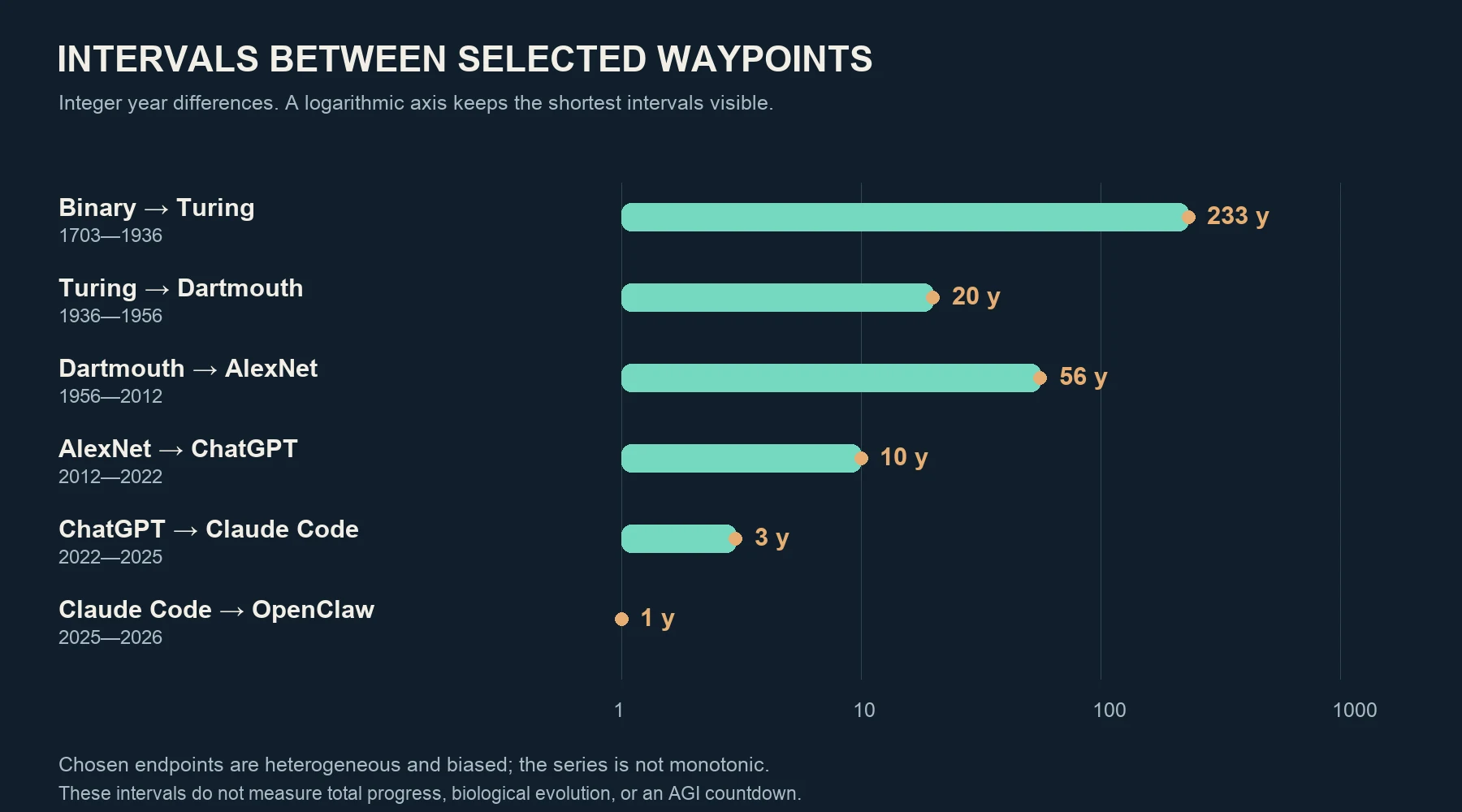
Gaps between selected milestones: 1703–1936 spans 233 years, 1936–1956 spans 20 years, 1956–2012 spans 56 years, 2012–2022 spans 10 years, 2022–2025 spans 3 years and 2025–2026 spans 1 year. Bar lengths use a logarithmic scale; values are differences between integer years. The selection is biased and the sequence is not consistently decreasing, so it cannot establish a rate of intelligence growth.
More solid evidence comes from specific measures. Stanford's 2025 AI Index records that the inference cost of reaching GPT-3.5-level performance on MMLU fell from $20 per million tokens in 2022-11 to $0.07 in 2024-10—a reduction of more than 280-fold. This compares costs at a particular capability threshold; it does not say that every model became cheaper by the same factor.[28]
Research published by METR in 2025 observed a change closer to “how long a task can the system handle?” On its software and reasoning task set, the human-expert work time corresponding to tasks that frontier AI completed with 50% success had roughly doubled every 7 months since 2019. The duration is the time a person needs to do the task, and succeeding half the time is not dependable delivery. The finding gives a reason to extrapolate, while leaving substantial limits on applying it more broadly.[27]
Acceleration can also create some of its own conditions. Better AI can help write software, conduct experiments and optimize systems; those activities may improve the next generation of AI. But a feedback loop's existence does not make it limitless. Data quality, energy, chips, experimental speed, reliability and organizational adoption can all act as brakes. The downturns in AI's history remind us that a rising stretch of a curve does not rule out plateaus and reversals.
My bet is 2031—but first, an AGI threshold
AGI usually means artificial general intelligence, but there is no agreed answer to “how general?” Some definitions require coverage of most economic tasks; others emphasize learning unfamiliar skills or include autonomy. Research on AGI levels separates capability, breadth and autonomy, which helps more than arguing over a slogan.[29]
This article considers only practical AGI: a system that, in digital environments with clearly granted permissions, can learn new tasks and reliably perform a broad range of professional cognitive work at an acceptable cost. It need not be conscious or have a human body. Nor does it mean a superintelligence that exceeds every person in every field.
To make the prediction testable later, we will set a deliberately chosen threshold. This is the article's operational definition, not an industry standard or a safety certification:
| Acceptance criterion | Threshold used in this article |
|---|---|
| Breadth | Match the median performance of skilled humans in at least 5 of 6 task categories: software engineering, information analysis, research assistance, multimodal understanding, planning and learning new tools. |
| Unfamiliar tasks | At least 100 nonpublic tasks per category; control for training-data leakage while allowing reasonable tool use and learning of new tasks. |
| Reliability | At least 90% task success in each qualifying field above, judged against reviewable criteria fixed in advance. |
| Long tasks | Include tasks requiring at least 8 hours of human-expert work; allow at most 2 human clarifications per task, without repeated human rescue. |
| Cost | Include inference, tools, review and rework; cost per task must not exceed the human cost under the same acceptance criteria. |
| Reproducibility | Replication by at least 2 independent evaluation organizations; the system must sustain performance through 90 days of continuous evaluation, beyond a polished demonstration. |
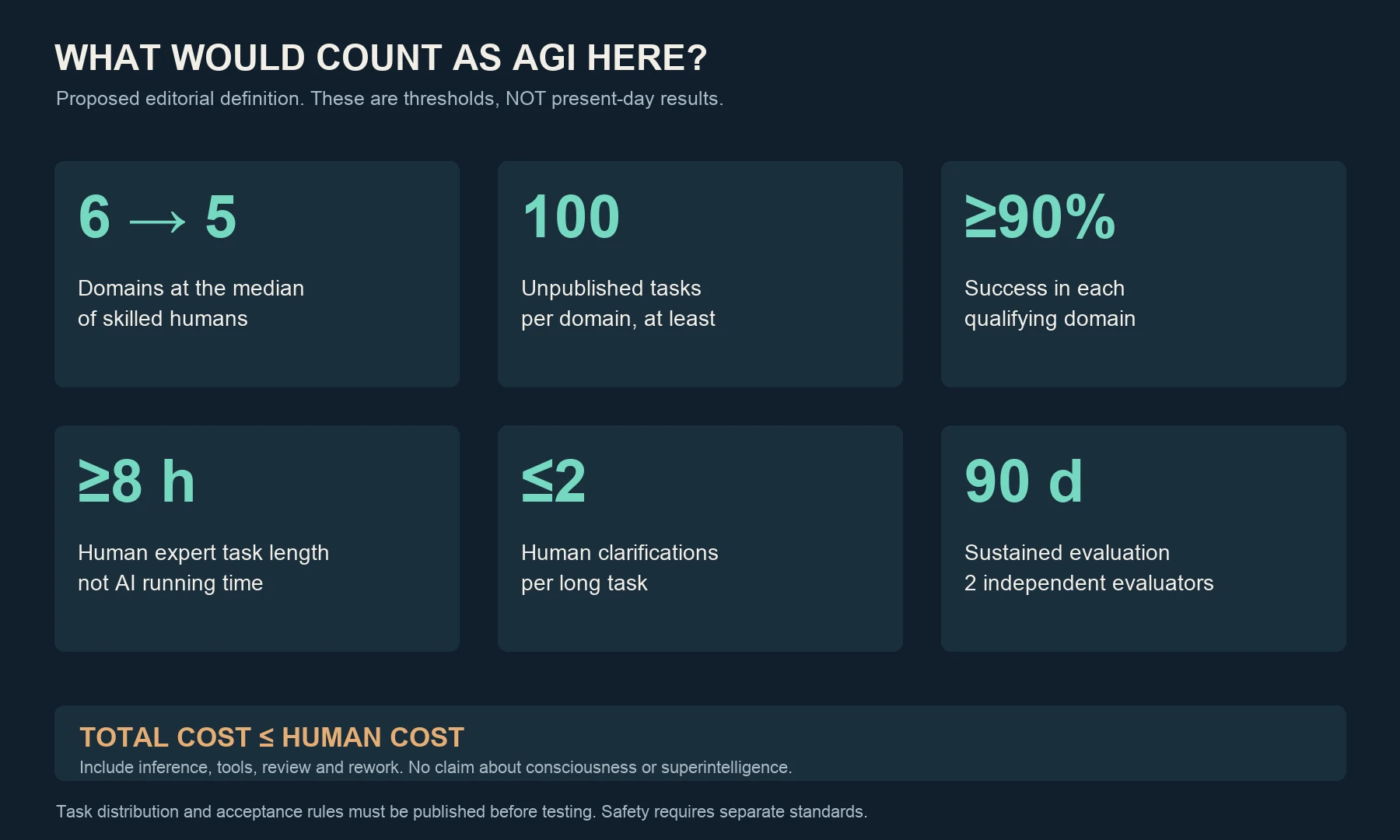
The article's AGI threshold: at least 5 of 6 task categories, 100 nonpublic tasks, 90% success, tasks taking 8 human hours, at most 2 clarifications and replication over 90 days. These numbers are chosen acceptance requirements, not measured results for current systems or an agreed AGI standard.
These criteria remain open to argument. Task sampling, recruitment of skilled humans and assessment of research assistance must all be specified in advance. Tasks affecting personal safety require additional regulation and professional standards. The definition's value is that it replaces “it feels as though we are there” with a judgment that can be questioned, retested and overturned.
If I have to name a year, my bet is 2031. I would rather watch the 2028–2035 window than guess a month and day. Below are my subjective cumulative probabilities as of the article's date, for the first independent confirmation under the threshold above. They are not calibrated by a statistical model and do not represent expert consensus:
| First confirmation | My subjective cumulative probability |
|---|---|
| By the end of 2028 | 20% |
| By the end of 2031 | 50% |
| By the end of 2035 | 75% |
| After 2035, or current approaches ultimately fail to reach this article's threshold | Remaining 25% |
The year 2031 is the median judgment of this subjective distribution, rather than a technical deadline. The 75% by 2035 already includes the earlier probabilities; the rows must not be added together. The remaining 25% does not mean that AGI will never appear, either. It includes both a later arrival and the failure of current approaches.
My bet rests on the convergence of language, vision, programming and tool use, alongside trends in long-task ability and cost that deserve serious attention. Yet the hardest part may lie at the end: reliably learning new skills, recognizing one's own mistakes, remaining dependable in unfamiliar settings and completing work that needs experimental feedback. If those obstacles prove more stubborn than expected, the date must move back.[27][28][29]
What would change my judgment? Sustained, independently replicated improvements in long-task success with little human intervention, transfer to unfamiliar tasks and total cost would raise my probability of an earlier arrival. If leaderboard gains mainly came from familiar questions, long tasks still required human relay teams, or cost reductions stalled, I would lower it. More launch events and a denser stream of demos would not, by themselves, change my mind.
AGI's arrival may not come with a clear bell. Some people may first find it sufficiently capable in their work, while others remain troubled by failures; evaluators confirm capability, and society changes gradually afterward. Crossing a technical threshold, adopting a product and adjusting institutions happen on different clocks.
The optimistic future: human capability becomes less scarce

Shared knowledge and medical progress on the left, job transitions and everyday adjustment in the middle, concentrated power and unemployment pressure on the right. An original AI concept illustration of three conditional futures, not their probabilities.
The optimistic scenario requires broad access to capability, reliable deployment and a willingness to share productivity gains with more people. If only a handful of organizations can afford the best systems, the story changes from its opening.
In science, AGI could help researchers read literature, design candidate experiments and analyze results, reducing repetitive work in trial and error. A small team might gain the computing and analytical capacity once reserved for a large one. Drug, materials and energy research could accelerate. Candidate molecules would still need validation, clinical trials would still take time, and words could not conjure laboratory equipment into existence. The hopeful change is a faster route to dependable findings, rather than a promise that disease will vanish overnight.
In education and healthcare, individuals could obtain sustained, patient assistance more cheaply. Teachers would have more time to attend to differences between students; doctors more time to understand patients' circumstances. Remote regions might first gain more consistent information gathering, preliminary screening and remote support. For this to become a fair improvement, people need accessible networks, local languages, privacy protection and someone responsible for the final decision.
Work could leave more room to breathe. Much repetitive paperwork, checking and coordination would shrink, freeing time for communication, judgment, care and creation. Small businesses could do things for which they once could not afford a specialist team, and ordinary people could turn ideas into products more easily. If higher productivity became lower living costs, shorter working hours and better public services, most people would be better off.
None of this happens automatically. Wages, taxes, competition policy and public investment determine how the gains are shared. Better technology enlarges what is available to distribute; it cannot decide the distribution on society's behalf. In this scenario, human value gradually moves from “how much standardized work can I do?” toward “what do I want to do, what responsibility will I accept, and how do I live with others?”
Optimism does not require people to stop learning. Basic knowledge helps us judge whether a machine is talking nonsense; professional experience helps us decide whether to use a result. What changes is the purpose of learning: less a race to keep up with every tool, more a way to ask better questions and preserve our own judgment.
The pessimistic future: strong machines, an unready society
The pessimistic scenario does not require machines to become malicious first. If labor is replaced faster than people can move to new work, while gains concentrate among owners of computing power, capital, data and distribution channels, many may lose their income before seeing productivity improvements in the macroeconomic figures.
The first pressure may fall on jobs whose tasks are easy to digitize and whose outputs are easy to assess. This does not condemn an entire occupation: every occupation contains many different tasks. But if demand for junior copywriting, basic analysis, simple development and routine customer support falls sharply, young people face a particularly difficult problem. The entry-level work once used to gain experience disappears, while advanced judgment still requires experience. When businesses hire fewer beginners, society slowly loses its ladder for training experts.
Concentrated power would deepen that pressure. If a few organizations control the best models, computing resources and execution interfaces, they may influence more than prices: who gets access to knowledge, how people are evaluated and which content is seen. Cheaper intelligence could expand surveillance, fraud and targeted persuasion. More information might make it harder for public discussion to establish what is true.
Safety brings another layer of risk. A capable system with the wrong objective, excessive permissions or missing checks can carry an error through a chain of actions. It might send the wrong message, leak information, produce flawed software or cause physical harm in a high-risk setting. More extreme loss-of-control scenarios involve deception, evading oversight or acquiring additional resources. These are possible mechanisms to study and prevent; the historical timeline alone cannot give them a credible probability.
Countries may also treat advanced AI as a strategic resource in which falling behind is unacceptable. Competitive pressure may push organizations to shorten evaluations, conceal failures or connect systems to critical infrastructure. The danger then comes from many organizations accepting excessive risk at once, beyond any single wrong answer. Armaments, cyberattacks and deployments in critical systems especially require institutions to specify authorization, auditing, isolation and human responsibility.
The losses in personal life may be quieter. Constantly letting machines judge for us could weaken writing, reasoning, navigation and social skills. Convenience may gradually erode independence. Only when a service shuts down, prices rise or answers are manipulated might people discover that they have no alternative. In this future, stronger technology does not necessarily bring greater human freedom.
The neutral future: enormous change, a long adjustment
The everyday world I find easier to imagine mixes all three scenarios. Some tasks become cheap quickly, some occupations transform slowly, and some fields remain led by people because of safety and responsibility. There will be successful companies and failed deployments; some people gain time, while others lose bargaining power.
If AGI first reaches this article's threshold in digital work, that does not mean it can immediately fix pipes, care for older people or build power grids. The physical world involves bodies, materials, sites and chains of responsibility. Robot manufacturing, infrastructure renewal, approvals and organizational processes all take additional time. The cost of cognitive labor may change first, while housing, energy and healthcare prices do not necessarily fall alongside it.
The first employment effect is likely to be a reorganization of tasks. A team reduces the number of people producing first drafts and adds review and coordination work; an individual manages more projects and bears more responsibility for mistakes. Productivity and work intensity may even rise together. The ILO's research on occupational exposure to generative AI also reminds us that affected tasks do not necessarily mean entire jobs will be replaced. That finding cannot simply be promoted into a forecast of AGI's employment effects, but the distinction belongs in the analysis.[30]
Institutions will catch up with events. Schools adjust assessment, businesses reorganize permissions, courts and regulators handle responsibility, and insurers and auditors begin pricing it. Many places may transition through an arrangement in which routine work is permitted by default and people sign off at critical points. It will probably resemble a succession of contested repairs more than a society-wide upgrade.
People's feelings will lag behind the tools too. Seeing a hard-won skill suddenly lose its scarcity can bring resentment and anxiety. New capabilities may be exciting while the endless need to catch up becomes exhausting. Greater efficiency does not automatically restore a sense of identity. Care, friendship, bodily experience, beauty and public participation will remain important ways for people to shape their lives.
So even if my bet is 2031, I am not betting that “everyone becomes unemployed that year,” or that “everyone becomes prosperous that year.” Technical breakthroughs may arrive close together, while their social consequences unfold differently across regions, industries and groups. The neutral future involves great change, uneven outcomes and slow adjustment.
What we really need to prepare is our judgment and our choices
This history is stirring, and a little dizzying. An abacus calculates only when fingers move its beads; today's machines can take an imprecise request and begin looking for a way to fulfill it. We have moved more and more cognitive work outside the mind, while still learning how to assess it, take responsibility for it and share its rewards.
For individuals, the things worth preserving are professional foundations, habits of verification, transferable skills and working methods that do not depend on a single service. For businesses, the worthwhile investments are reviewable processes, evaluations on real tasks, clear permissions and operations that can be recovered. For society, the hardest work is ensuring that productivity growth benefits more than a few people, and that safety requirements become more than declarations.
We may get the AGI year wrong. The worse bet would be that sufficiently intelligent machines automatically give humanity a good future. From the abacus to today, tools have enlarged human power. The questions ahead are who will hold that power, how it will be used, and what kind of life we want it to help us lead.