
Sometimes the world really does feel like an improvised operation.
Follow the AI industry and the future seems close enough to touch. Models write code and solve difficult problems. Agents are meant to take over entire workflows. The debate about how much work will remain for humans grows louder by the day. Then you need the technology to do a job, and no answer arrives.
Even DeepSeek, widely regarded as a standard bearer for AI, can stumble.
According to its notice, a service failure prevented normal API use on October 15, 2026, from 8:11 a.m. to 1:04 p.m. Beijing time, UTC+8. Those published times span four hours and 53 minutes, almost five hours. Calling it half a day expresses the frustration; losing most of a working morning was real enough.[1][2]
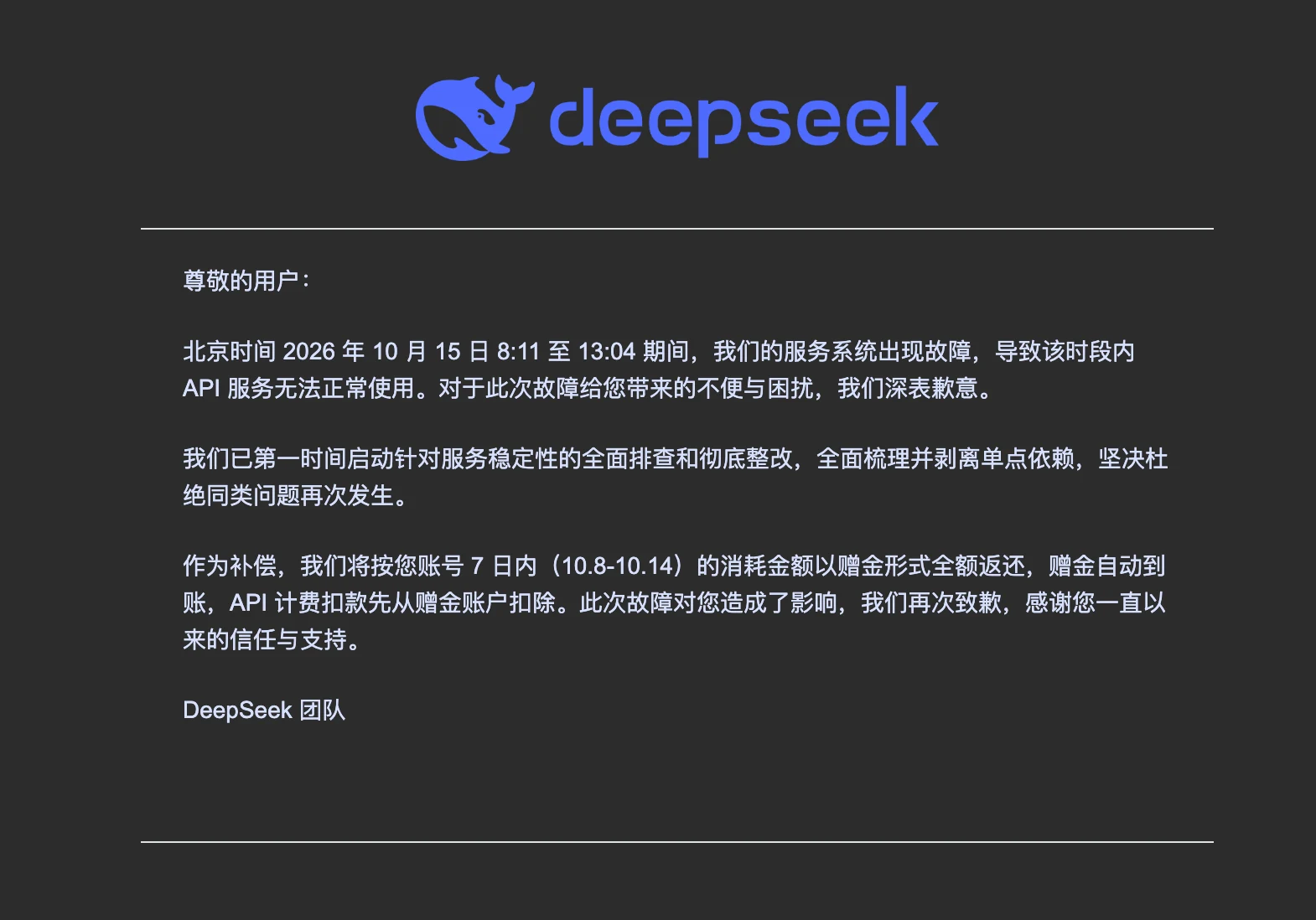
DeepSeek service recovery and compensation notice, supplied by a reader. Its timing and compensation terms match reporting published that day.
If you were only chatting, you could walk away for a while. But an API may already be part of a product, a customer support service, a content pipeline or an internal business process. When the upstream service stops, downstream work may have to wait. Customers still expect delivery from your team. A model's impressive answers on a good day do not make several hours of silence acceptable.
The outage brings two separate responsibilities into focus: model capability and service reliability.
Can the model answer a question correctly? Can it deliver that answer when the business needs it? The first question gets attention in rankings and launch events. The second tends to receive serious attention after something breaks. People who depend on AI need satisfactory answers to both.
That gap explains the sense that the world is held together with makeshift arrangements. We see intelligence that can discuss the universe and write software. Underneath it are machines, programs and people that can fail. Technical prestige does not remove the need for monitoring, redundancy and recovery.
Still, DeepSeek's compensation deserves a fair hearing.
The notice says accounts will receive credits equal to their actual spending during the previous seven days, October 8 through October 14. The credits will arrive automatically and be used first when subsequent API charges are deducted.[1][2]
For example, an account that spent 100 yuan during that period would receive 100 yuan in credits under the announced terms. DeepSeek chose a full week of prior spending as the basis for compensation, rather than limiting it to the charges associated with the hours of disruption. That is a meaningful gesture.
Credits are different from a cash refund. Nor does this offer mean seven days of unlimited future use. The amount depends on actual spending during the specified earlier period and offsets future API charges. Getting those details right leaves plenty of room to appreciate the offer.
The decision shows a willingness to bear a clear cost for the failure. Automatic credits also spare users the effort of making individual claims and repeatedly explaining their losses. For developers who intend to keep using the service, credits that directly reduce their next bills have practical value.
The value of the offer does not depend on calling the company wealthy. Turning an apology into credit that customers can actually use is the part worth appreciating.
Appreciating that response should not turn the outage into good news.
The API bill is only part of the cost. Interrupted operations, delayed delivery and lost customers are also risks. Credits may fall short of an individual team's losses. Money can be replaced; lost time and damaged trust can take longer to recover. DeepSeek can deserve praise for its response while still facing questions about reliability.
The notice also says DeepSeek will identify and remove single points of dependency.[1] Where could such a capable model's service get stuck? The outage began at 8:11 a.m. Beijing time. That suggests one possibility worth checking: an overnight change whose weakness only became visible under morning traffic.
First, the limits of what we know: this notice does not disclose a technical root cause. An overnight deployment and a rise in morning traffic both need confirmation from logs and monitoring. Let us follow just this one possible sequence and see how it could unfold.
Suppose a shared service was updated overnight. It checks API keys and available credit before requests reach the model. The new version runs and passes its checks, but a check that previously read from a cache now queries a database on every request. This service and this change are illustrative, not established details of DeepSeek's infrastructure.
With little overnight traffic, the extra query seems harmless. The endpoint still responds. Tests report no errors. The dashboard may even stay green. Yet some of the system's processing capacity has quietly disappeared.
Morning arrives, people start work, and requests from products and background jobs begin to build. Eventually, they arrive faster than this shared service can process them. Requests start queuing for database connections. Waiting requests hold on to resources, and later arrivals have to wait longer still.
Think of a breakfast shop with only one checkout open. The kitchen works and the cooks are there, but everyone has to pay at the same counter. Once that doorway is blocked, a bigger kitchen does little good.
Then the problem starts feeding itself. Callers wait too long, time out and retry. Some downstream products retry on behalf of their users as well. If earlier requests have not been cancelled promptly, new work piles onto unfinished work. Actual new business may not have surged, yet the load on the system keeps growing.
Even rolling back the release may not restore service immediately. The backlog remains, connection pools have not recovered, and retries keep knocking at the door. As soon as the service catches its breath, the load knocks it down again. Recovery may require limiting incoming traffic, stopping useless retries, discarding expired work and reopening capacity gradually. Fixing the code and getting the system back on its feet can be two separate battles.
In this sequence, a change plants the problem, traffic exposes it, and queues and retries amplify it. The expensive inference clusters might still be healthy, with requests stuck at a narrow entrance in front of them. The single point of dependency need not be one lonely server. It can be a shared dependency that every replica still needs.
There is a documented example of this kind of amplification. Google Cloud's June 2025 incident report describes quota policy data triggering Service Control crashes, followed by concentrated restarts overloading an underlying database and delaying recovery in some regions.[3] That shows why fixing the original trigger may leave a system congested. It does not establish that the same thing happened at DeepSeek.
Testing this scenario means aligning several timelines: what changed before the incident, when traffic rose, when latency, queues and connection usage became abnormal in the shared service, whether retries increased, and what happened after rollback or traffic limits. If those events line up, the hypothesis gains weight. The 8:11 a.m. start gives us a question to investigate. It does not close the case.
A promise to prevent a recurrence will ultimately be judged against the service's subsequent record.
There is a lesson here for anyone connecting AI to a business: prepare a way to keep going when it fails.
For an important workflow, decide whether work can queue for later, switch to a tested alternative service or return to a person. If retries are necessary, limit their number, increase the intervals and spread their timing so they do not add fuel to the failure. Workflows that make payments, send messages or change records also need protection against duplicate actions after service resumes.
These preparations have little futuristic glamour. They can protect an existing business during the next outage. The more seriously you use AI, the less you can rely on the assumption that a company this capable simply will not fail.
DeepSeek deserves criticism for an outage of almost five hours. A highly regarded AI service still has to earn trust through reliability. It also deserves credit for offering compensation based on seven days of previous spending. Acknowledging the problem, bearing a cost and rebuilding trust through dependable service is an attitude worth encouraging.
The world may indeed be more improvised than we like to admit. We can demand fewer failures and still say, when someone accepts responsibility, that they handled this one fairly.