

An AI-generated conceptual illustration for this commentary, not a photograph of the events or a product interface.
A complete coding session was not even finished before my subscription hit its five-hour usage limit. Meanwhile, promotional talking points circulating on overseas social platforms seemed to have every flattering conclusion ready in advance. That contrast is what disappoints me most about Kimi.
I pay for AI coding tools to get work done. A model's strength should be judged by whether it can understand a project, keep a task moving, handle errors, and deliver results. Whatever lead the marketing claims, it ultimately has to stand up to scrutiny at this workbench.
On October 24, 2026, a controversy over the overseas promotion of Kimi K3.1 Pro made that disappointment more concrete.
The controversy arose around the launch of K3.1 Pro, an update already listed in Kimi's official changelog. At 3:14 a.m. Beijing time on October 24, X user Elshayib published his first critical post, saying he had not participated in this campaign or used the templates provided. The attached image showed instructions for creators, presented as part of a K3.1 Pro launch campaign. Official changelog | First original post
Two sets of instructions in the image were particularly jarring when read together: submit drafts for review before posting, and publish only after approval; at the same time, “Please DO NOT put on the paid partnership label.” The document also said there was no need to include a link to Kimi's official website or tag its official account.
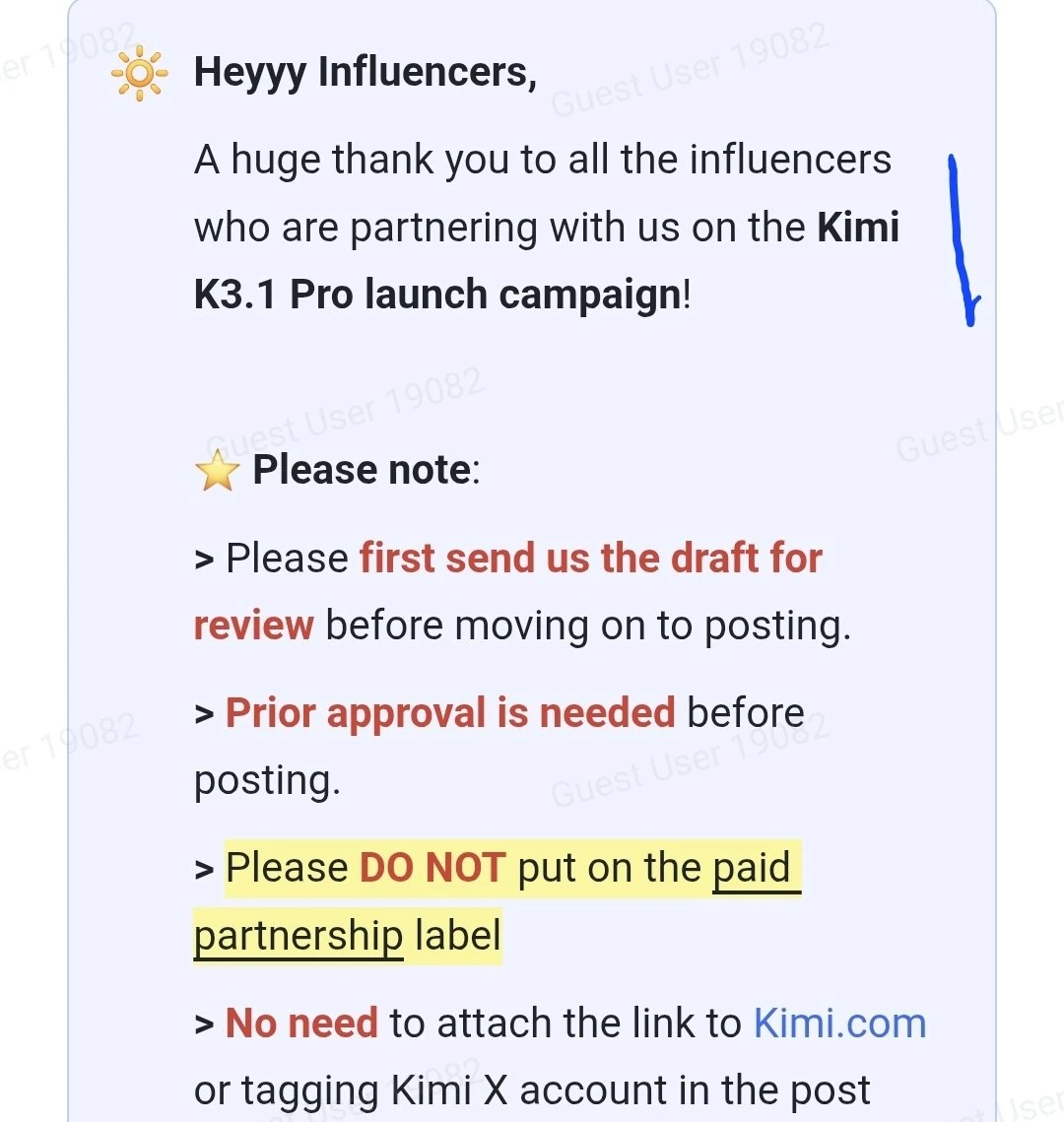
Image: The attachment Elshayib made public on October 24, 2026, Beijing time, with its original content and annotations preserved. He claims the document came from Kimi; this article has not independently confirmed its provenance, full context, or implementation. View the first original post.
Of course commercial campaigns can review drafts. Product details, embargo times, and technical descriptions can all be checked. But seeking control over the content while also asking creators not to use a paid partnership label crosses into a different question: can readers know that a commercial relationship lies behind the enthusiastic recommendation in front of them? If payment or another exchange of benefits was indeed involved, that instruction deserves serious scrutiny.
At 4:49 a.m., Elshayib published a second post, saying these were creator campaign materials he had received from Kimi after the K3.1 Pro launch. He said he did not want to promote conclusions he had not personally tested, or become involved in a China-versus-US political narrative. Second original post
The second screenshot showed suggested promotional angles: position Kimi as a cheaper, open-source alternative to Opus; emphasize frontend coding ability on a par with competitors; then extend the story to the gap between Chinese open-source models and US frontier models, and breakthroughs under chip restrictions. Even the enthusiastic tone creators could adopt had already been written for them.
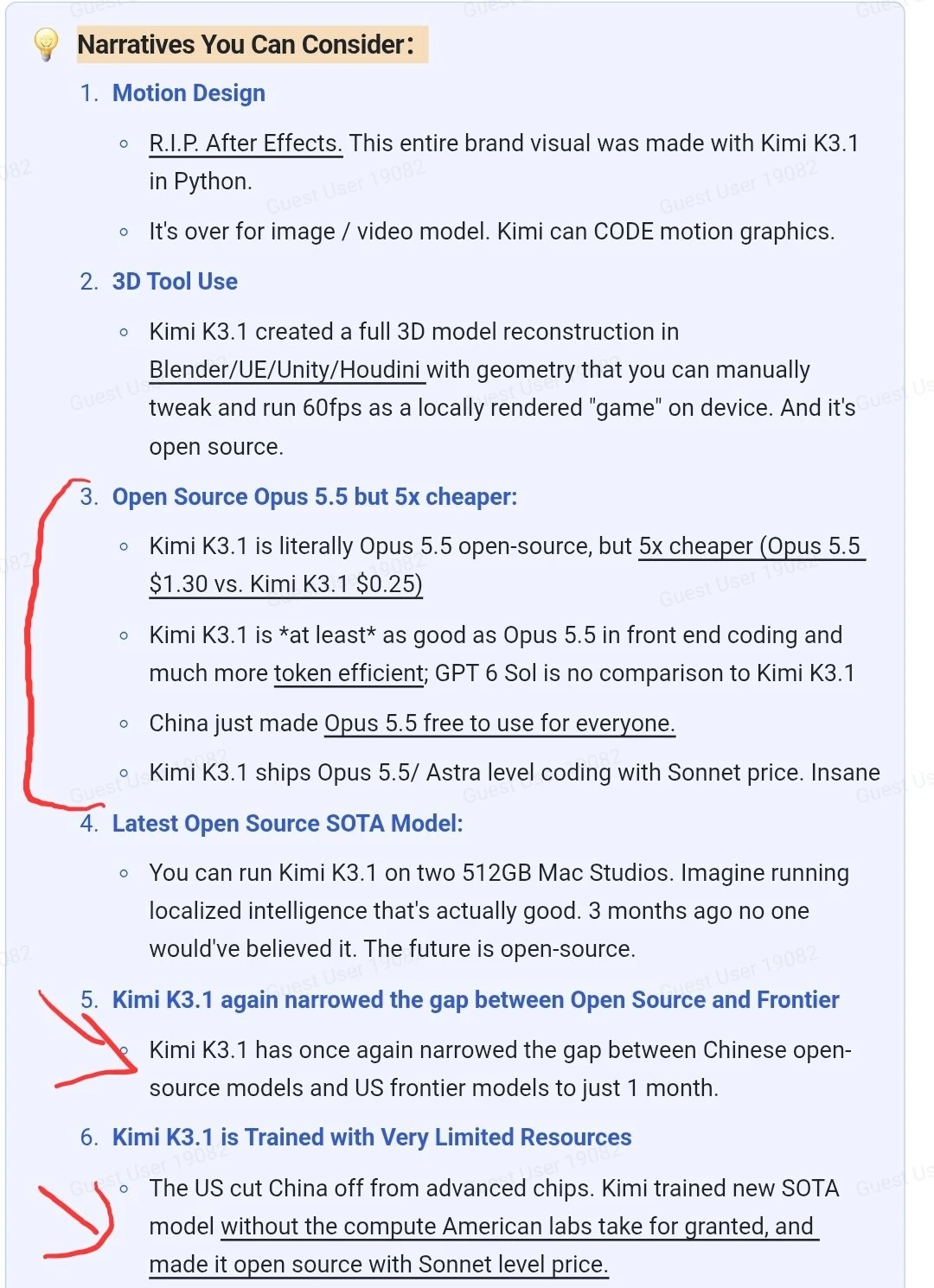
Image: The second document screenshot disclosed by the same poster, showing suggested comparative claims and a narrative of competition between China and the US. These are the promotional materials being examined; the performance, pricing, and capability-gap claims in the image are not conclusions verified by this article. View the second original post.
The screenshot is headed “Narratives you can consider,” so it does not establish that every participating creator was forced to post the text word for word. But the content plainly goes beyond neutral product information: it supplies comparative conclusions in advance, waiting for creators to package them as their own discoveries. Performance comparisons require test tasks, versions, budgets, and results. A set of exciting sentences cannot substitute for that evidence.
Chinese-language media and social platforms subsequently began recirculating these screenshots, extending the controversy from the model launch to disclosure of commercial relationships. To be clear, however often an allegation is repeated, that does not turn it into multiple independent pieces of evidence. As of this article's checks on October 25, I had not found a clear public response from Kimi addressing the authenticity of these two screenshots, their full context, or how the instructions were actually implemented. What can currently be verified is that this is what the original posts and images show; the documents' provenance and implementation still require further confirmation. Related reporting
But the issue is already clear enough: if these really were campaign requirements approved by the brand, reviewing drafts while asking creators not to label paid partnerships erodes readers' trust in independent assessments. This kind of opportunism is an ugly look.
For me, the controversy also brings back a very specific experience. I have seriously used and compared multiple models and Coding Plans. While using a Kimi subscription, I encountered the five-hour usage limit before a complete session was finished.
Below is a screenshot of my Codex usage statistics: the page shows a cumulative 42.3B tokens, or approximately 42.3 billion tokens; a longest task of 47 hours and 9 minutes; and longest and current usage streaks of 94 days each.
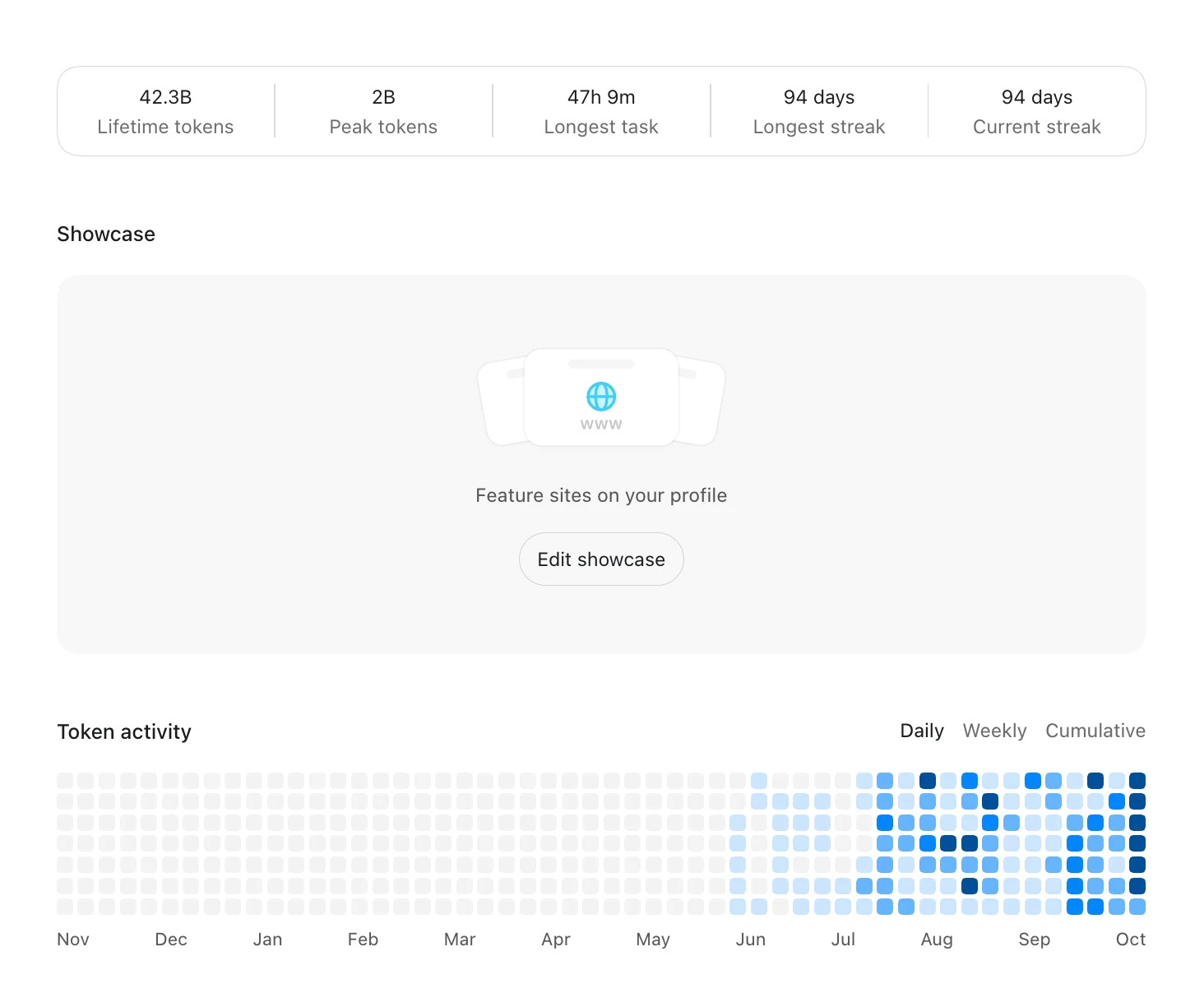
Image: Usage records supplied by the author. The figures are presented as shown in the screenshot to establish a background of sustained, heavy use; they are not a standardized performance or cost comparison between models.
These records cannot prove that any model is always ahead, but they do show that my assessment comes from sustained use. What matters to me is not whether a model can complete a neat little task in a demo, but how far it can accompany a user through a real project.
The five-hour limit also needs to be explained accurately. It is a usage window, not a promise of five uninterrupted hours of use. Kimi's current official documentation distinguishes between new and legacy plans: new plans at Plus and above remove the weekly limit while retaining a five-hour window and a monthly total allowance; legacy plans retain a weekly allowance. Consumption also varies with the model, context length, tool calls, and plan. My experience therefore does not establish that every plan and every task will exhaust its allowance within a single session. Kimi Code membership benefits | Credit usage rules
But explaining the rules does not erase the disappointment of the experience. For paying users, the most immediate questions remain: can a reasonable, complete task actually be finished on the plan I bought? When might it be interrupted? How much extra will it cost?
Calling something a Coding Plan and using the same five-hour window does not mean it delivers the same experience. If a product wants to draw on the market recognition of established coding subscriptions, it should deliver sustained working capacity to match. Copying the plan format and promotional swagger while leaving users constantly watching their allowance is, in my view, shallow imitation.
That is why I want Kimi to learn more from DeepSeek, particularly when it comes to laying out the technology and costs so developers can judge for themselves.
DeepSeek's official release materials link to technical reports and model weights. Its official V4.1-Flash repository publishes model and deployment information under an MIT license. The API documentation also sets out billing rules for input, output, caching, and other usage. Developers can examine the implementation, deploy the model, and calculate costs for their own tasks. Those concrete materials do more to build trust than promotional copy that has already decided who “crushes” whom. DeepSeek release announcement | Model repository | Official billing documentation
This does not mean DeepSeek has no weaknesses, or that a usage-based API and a subscription can be compared simply by monthly price. Kimi itself has also made open-source contributions worth acknowledging, including releasing K2's code and weights. Precisely because it has built real technical expertise, it should value its reputation all the more, allowing genuine testing to produce praise as well as criticism. Official Kimi K2 repository
Developers do not need brands to write their praise for them. We need clear capability boundaries, understandable usage rules, comparisons we can check, and proper disclosure of commercial relationships.
If there is a partnership, disclose it openly. If there is a lead, demonstrate it with reproducible tasks. If there are shortcomings, acknowledge and improve them. Progress in Chinese AI does not need to be demonstrated by blurring the line between advertising and evaluation.
Kimi, why resort to this? Put more of the effort spent scripting marketing into helping paying users finish a complete piece of work.
What is truly worth learning is how to make technology withstand scrutiny and let reputation grow from use. If generating attention requires concealing commercial relationships and prescribing flattering conclusions, that really is something to be ashamed of.