

Cover: AI-generated conceptual illustration.
On today’s Hurun China Rich List, Zhang Yiming is worth 670 billion yuan and Liang Wenfeng 280 billion. One has reclaimed the top spot; the other has entered the list for the first time, straight into seventh place. Between them lies a gap of 390 billion yuan. Lianhe Zaobao links this leap in wealth to the rise of AI.
Ask me who will be richer in three years, and my vote goes to Liang.
The reason may sound counterintuitive: he seems in the least hurry to cash in.
To understand Zhang’s strength, just pick up your phone. Scroll Douyin, watch short dramas on Hongguo, ask Doubao for help; overseas, there is TikTok. Entertainment, shopping, getting things done—ByteDance keeps finding ways into people’s lives, holding their attention, then connecting it to advertising and commerce.
In June, ByteDance apps accounted for 40.1% of the total time spent in China’s top 50 apps. Recommendation algorithms helped it win the last round. Large language models have opened another door.
Liang has chosen a different way to spend his time.
What struck me most in the notes from his investor meeting, leaked in July, was his repeated emphasis on restraint. National Business Daily checked the account with institutions that had invested in DeepSeek and reported that the meeting took place in May. Liang drew a narrow line: stay on the main path toward AGI. Consumer and enterprise products—and their revenue—must serve that goal.
While others are busy proving how much a business can earn, he first asks whether it deserves time that could be spent on research. An opportunity can be right in front of him, and he can let it go.
On pricing, the notes describe Liang using roughly ten months to recover equipment costs as his benchmark, rather than pushing prices higher. Open source, affordable access and a reasonable return: he wants to make those work together. The newspaper had not received a response from DeepSeek by publication, but those choices fit the direction the company has consistently shown.
Back in February 2025, DeepSeek explicitly described its pursuit of AGI in its Open Source Week announcement on X. Its October 17 model release post was still making the same point: better capabilities, lower costs to complete a task.
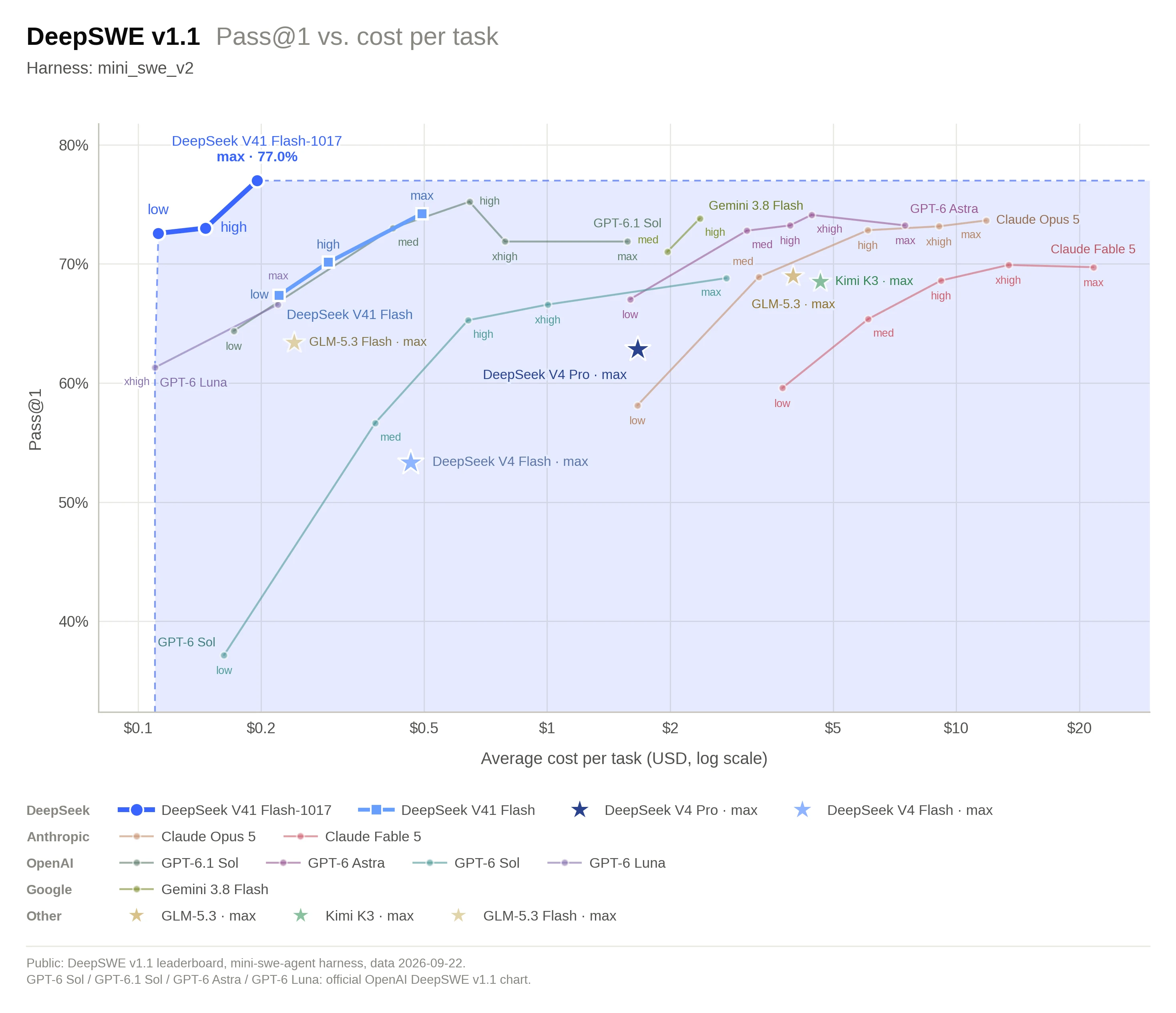
Image: from DeepSeek’s October 17 post on X, obtained from the matching official release page. The figures are from DeepSeek’s own tests.
As I see it, this path leads toward intelligence becoming like water or electricity: cheap, commonplace and available wherever it is needed. Reach that point, and many of today’s apps will have to rethink how they work.
ByteDance is developing foundation models too, of course. But a vast business empire has many operations to tend and many growth targets to meet. What makes me back Liang is his willingness to keep giving his best attention to the same hard problem, year after year.
When the opportunity is big enough, someone with extraordinary focus, determined to take one thing as far as it can go, has a chance to leave the leader behind.
A 390-billion-yuan gap will not disappear on the strength of an ideal. To overtake Zhang within three years, Liang must turn technical breakthroughs into substantial commercial value. What that means for his personal fortune will also depend on valuations and the stake he owns.
Still, I am willing to make this bet. Sometimes the most profitable existing business is exactly what makes it hard to take the next step.
On the Yangtze, each new wave pushes the one before it. For 2029, I back Liang Wenfeng—the man putting AGI first.