
At 17, many people are still being asked what they want to do someday. Guangyu Chen, known as Nathan Chen, has already contributed to research on the underlying architecture of large language models. The Attention Residuals paper, submitted on March 16, 2026, names him alongside Yu Zhang and Jianlin Su as co-first authors with equal contribution.[2]
On October 15, he announced on X that he had recently left Kimi. He recalled work on computational kernels, attention residuals and optimizers, and especially thanked Yulun Du for trusting and hiring him when he was 16. His farewell post did not name his next employer.[1]
We could call this a child-prodigy story. But following the traces of his learning and work leads to a more useful question: how can a young person move so quickly from absorbing knowledge to participating in frontier problems? And how has AI amplified that transition?

Conceptual artwork about learning and collaboration, not a photograph of Nathan Chen.
A public record of learning and work
| Item | Public record |
|---|---|
| Name | Chen Guangyu, Nathan Chen; published as Guangyu Chen.[2] |
| Age and upbringing | Born in 2009, raised in Shenzhen; 17 in reporting published in 2026.[6] |
| School | BASIS International School Park Lane Harbour; a Grade 12 student when the paper became public in March 2026.[13] |
| Earlier experience | Algorithmic programming, a personal technical blog, open-source projects and small machine-learning experiments.[9][12][15] |
| Research experience | An internship at Tilde Research, followed by work on Moonshot AI's Kimi team.[5][6] |
| Representative public work | A MoMoE coauthor; an equal-contribution author of Attention Residuals who helped propose Block AttnRes.[2][4][7] |
| Latest public update | Announced on October 15, 2026, that he had recently left Kimi; the farewell post did not disclose his next employer.[1] |
Describing his progress as going from zero to success in a few months would leave out substantial preparation. His website includes a decision-tree project article dated 2024: he turned everyday observations into data and tried training a predictive model. He also acknowledged weaknesses in his choice of variables and reasoning. The experiment shows a habit of moving from observations to questions, data and tests.[12]
His GitHub profile also links to a Codeforces account and displays the gesture-recognition project gestureX. Algorithm practice, building projects and researching large models are different activities. But these public traces show why moving rapidly into a new field can rest on practical skills developed earlier.[15]
Earlier records reach back to 2023. His project page lists him as a cofounder of OpenTeens, an open-source community for teenagers; an organizer's agenda for an open-source event that year introduces him in the same role. His project archive also lists experiments in gesture recognition and marine-debris detection. These show ongoing work and community participation, making 2025 an inaccurate date for his very first encounter with AI.[17][18]
The school-student hackathon in February 2025 was another turning point. He entered with an idea related to ThirdArm, met Kehan Dong and subsequently gained contact with researchers and more advanced problems. That summer he interned at Tilde Research; in November he joined Kimi. By March 2026, the AttnRes paper was public.[2][5][6][23]
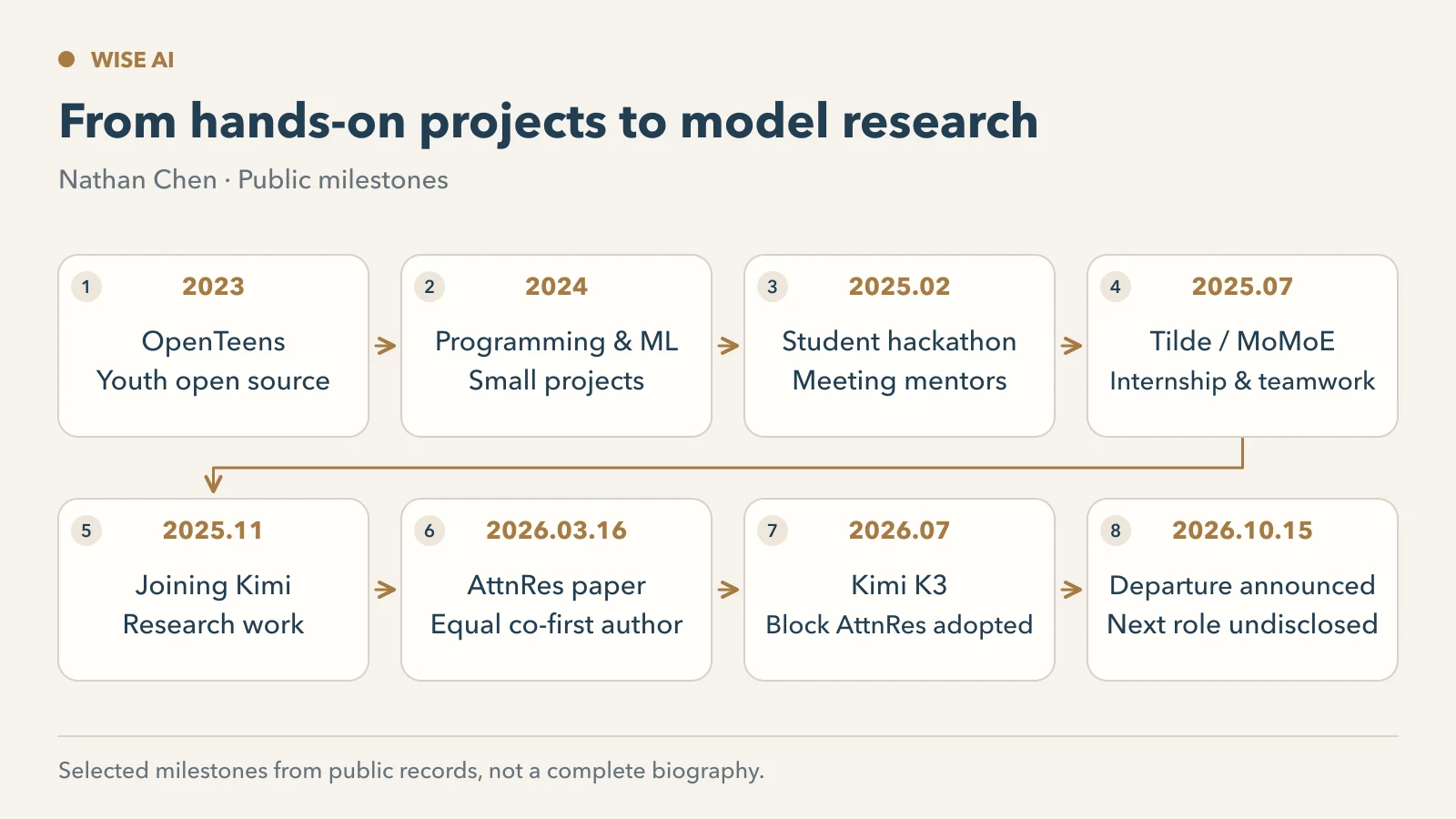
The timeline draws on personal writing, research papers, institutional records and his farewell post. Early contact with machine learning and later intensive study of Transformers were separate stages.[1][2][5][11][12][14][18][23]
An announcement for Tsinghua University's Yao Class Seminar on April 11, 2026, lists Chen and Yu Zhang as speakers and describes them as researchers on Moonshot AI's Scaling Team and principal AttnRes authors. This is a concrete record of a research exchange being scheduled: he had work that peers could discuss.[14]
From asking AI questions to being noticed by peers
Chen grew up in Shenzhen and was still a high-school student when the paper appeared in March 2026. He interned at Tilde Research in summer 2025 and joined Kimi that November. His path had already crossed milestones often associated with university or graduate study.[6][23]
In an autobiographical essay, he recalled meeting Kehan Dong after a school-student hackathon in 2025 and being introduced to DeepSeek researcher Jingyang Yuan. He began with papers, sending screenshots of passages he did not understand to Gemini, asking further questions, and reading GitHub code and researchers' blogs. For important judgments, he continued to consult a human mentor.[5]
The value of this approach lies in getting a faster response to confusion. An unfamiliar formula, concept or piece of code need not remain unexplained until the next class. A learner can move back and forth around the immediate problem until they can continue reasoning, building and testing.
AI explanations can still be wrong. Understanding ultimately has to withstand checks against papers, code and experiments. Chen's later public tutorials on Triton and FlashAttention discuss GPU memory access and kernel implementation in concrete detail. Readers can follow the code and examine his understanding themselves.[8]
His public record includes wrong turns. In a May 2025 account of an optimizer assignment, he described using AI to understand concepts and find resources, deriving an approach and running experiments, only to discover after training that he had misunderstood the task. He published the process and its problems anyway. Learning faster can coexist with making mistakes; identifying and explaining an error is itself part of developing competence.[21]
Making his learning visible also gave peers a way to find him. In his own account, sharing technical thoughts publicly brought him to the attention of a Silicon Valley AI startup's leader and led to conversations and an internship opportunity. Tilde's MoMoE open-source project subsequently listed Nathan Chen among its authors, leaving a concrete record of collaborative work.[5][7]
MoMoE concerns implementations of mixture-of-experts models, particularly memory efficiency and computational performance during training and fine-tuning. It addresses a different problem from the combination of information across layers studied in AttnRes, but reflects a related interest: understanding algorithms and making them run efficiently on hardware. The author list establishes his participation, without assigning particular code modules to each individual.[7]
Young people can learn something practical from this. Working through a problem, building something that runs, and documenting the process gives strangers a way to assess the work directly. Personal websites, technical blogs and open-source contributions can all provide evidence beyond a résumé.
What equal-contribution authorship involved
Attention Residuals, which Chen helped develop, studies how information is passed and combined between the layers of a large model.
Common residual connections keep adding outputs from earlier layers. AttnRes introduces attention along model depth, allowing later layers to form selective, weighted combinations of earlier representations. It changes how information is combined between layers; describing it simply as a chatbot remembering an earlier sentence would misrepresent the mechanism.[2][3]
Applying the design to large-scale training brings memory and communication costs. In his research memoir, Jianlin Su explains that he initiated the idea and small-scale experiments. Chen and Yu Zhang then joined larger-scale validation and jointly proposed Block AttnRes, which groups layers into blocks to reduce implementation costs.[4]
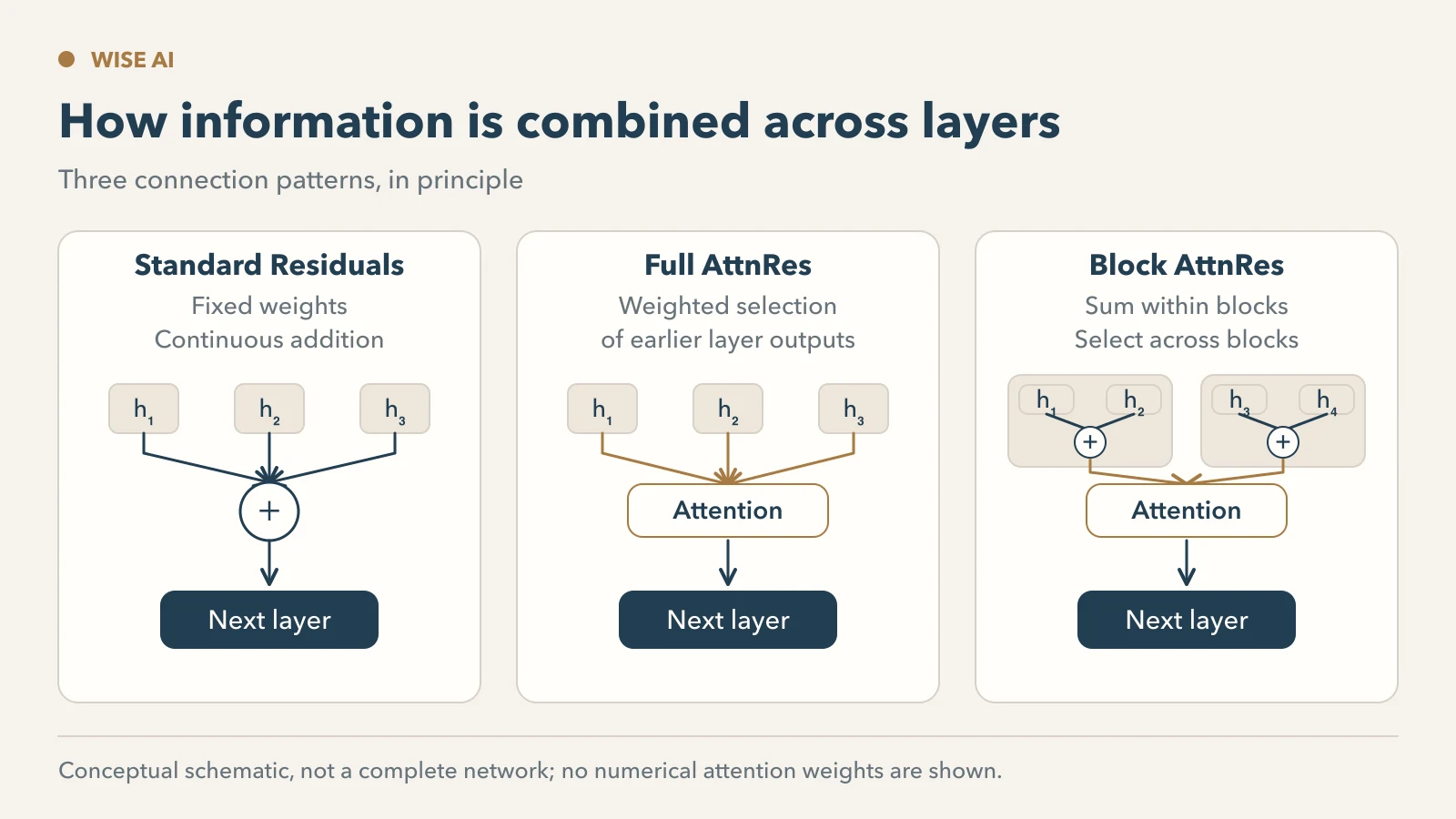
Editorial schematic: standard residuals accumulate outputs, Full AttnRes selects among earlier layer representations, and Block AttnRes makes selections between blocks. The complete network architecture is not shown.[2][3]
His contribution thus involved understanding principles, developing a design and handling engineering constraints. A promising idea must go through experiments and implementation before entering a real system. A young researcher can take on essential work in this process and share credit with experienced researchers.
The official project materials report that, in their scaling experiments, Block AttnRes matched a loss level that required 1.25 times as much training compute for the baseline. Algebraically, reaching that loss level corresponds to roughly 20 percent less compute. This figure has a specific experimental basis; it cannot be treated as a 20 percent reduction in every model's costs or Kimi's overall bill.[3]
Block AttnRes, which he helped propose, subsequently entered Kimi K3, as its technical report explicitly describes. This creates a path for the contribution to reach further: an architectural improvement can be reused throughout a model system, extending the effect of an individual's work through a team and software. K3's overall performance combines several technologies and training efforts, and cannot be attributed entirely to one design or person.[11]
Computational kernels and optimizers were part of his work too
In his farewell post, Chen listed optimizing KDA kernels among his early work and recalled trying many designs with Yu Zhang. Kernels turn algorithms into GPU execution, where efficiency often depends on how data is accessed and reused. His work therefore touched both model design and systems implementation.[1]
Open-source code provides more detailed records. In September 2025, the FLA project merged a DeltaFormer model implementation he submitted; that December it also merged KDA backward-kernel fusion work he participated in. These records contain code, reviews and merge history, allowing others to examine his engineering contributions.[19][20]
He also wrote that working on optimizers taught him the most about training dynamics. Optimizers determine how parameters are updated during training, a different problem from residual connections. His blog index includes optimizer analysis alongside implementation tutorials on matrix multiplication, FlashAttention and Triton. These materials show the scope of his continued learning; they should not all automatically be counted as original results adopted in production models.[1][8][16]
This specific record shows that his authorship involved more than a single flash of inspiration. Reading papers, understanding implementations, trying designs, running experiments and dealing with constraints all form part of research. AI can assist some of these activities, while authorship and technical results still entail responsibility for the actual work.
How AI shortens the distance to real problems
Chen's experience makes several connected changes visible.
First, learning feedback can be more frequent. AI can explain unfamiliar terms and help break down complex problems, allowing learners to identify the knowledge they need next. This gives proactive people more opportunities to practice. Turning practice into competence still depends on checking, reasoning and doing.
Second, work can be easier to inspect and discover. Open-source code, public papers and technical discussion shift part of the evaluation toward concrete contributions. A clear analysis or a well-supported change can reach people who care about the problem before degrees and job titles enter the conversation.
Finally, collaboration can bring individual contributions into larger systems. Frontier research still requires compute, team experience and serious validation. Access to that work can help a young person turn rapid learning into reusable technical results.
Together, these changes create the amplification discussed here: AI supports learning, public work connects peers, and teams bring validated contributions into real models. Technology, individual action and organizational opportunity work together.
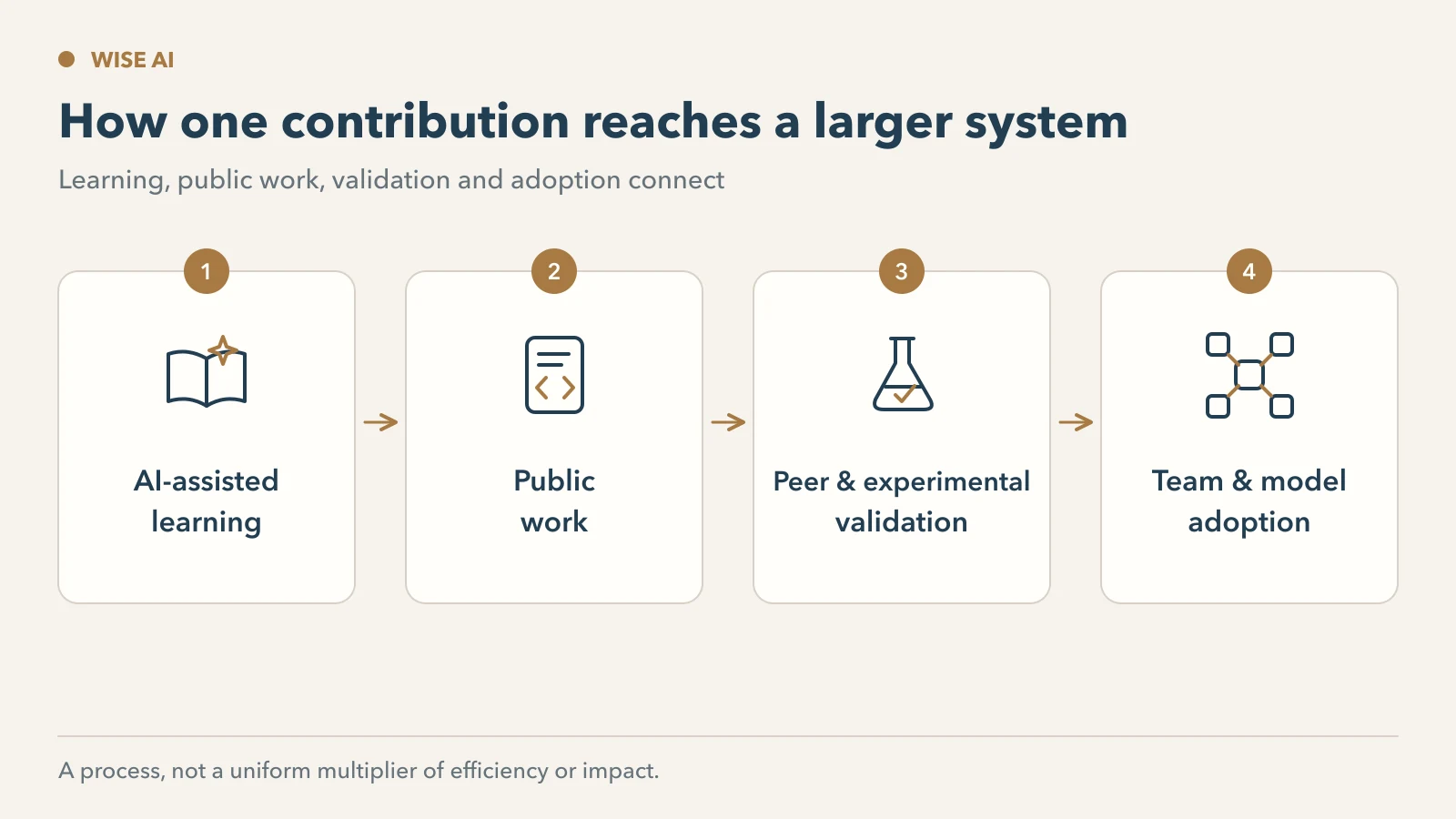
A schematic of how individual work enters larger systems, without implying a measured universal multiplier for efficiency or impact.
The limits of age and years of service as proxies for ability therefore become more apparent. Time spent in a field provides some background. What someone understands, what they have solved, and whether they can explain and reproduce a result provide more direct evidence.
Experience proves its value through collaboration
Challenging seniority-based ranking also requires taking experience seriously. Chen's progress involved guidance from researchers, the accumulated work of an open-source community and a team willing to give him real problems. AttnRes itself was a collaboration between researchers with different levels of experience.[4][5]
Experienced colleagues' judgments about failed approaches, experimental design and system constraints can save younger researchers time. Young people's commitment, questions and exploration can also produce new approaches for a team. When these abilities meet around a problem, experience demonstrates its value in the results.
The conditions that made this path possible also deserve attention. An international-school environment, mentor networks, an overseas internship and research-team resources all appear in Chen's story. AI has made explanations more accessible, but has not automatically given everyone equal time, support or experimental resources.[6]
Schools and companies can respond constructively by creating more opportunities for ability to become visible: offer well-defined small research problems, accept work that can be inspected, provide timely expert feedback and record contributions accurately. This gives people without established titles an entry point for demonstrating their capabilities.
Space for young people includes room to explore what comes next
On his personal website, Chen has written that agency is a superpower and taste can be learned. He has also written an essay reflecting on how chasing social-media reach can consume attention needed for original research, and expressing a preference for substantive conversations.[9][10]
These statements make his story more concrete. He is looking for problems worth pursuing and adjusting his relationship with opportunities, attention and work. Leaving a job at 17 is one point in that continuing exploration.
We can recognize a young person's potential while allowing room to keep learning, change direction and make mistakes. A paper deserves careful evaluation without becoming a demand that its author keep producing miracles.
The change worth pursuing in the AI era is to let more young people start exploring when they have good questions and receive a serious response when they do good work. A validated improvement can spread and be amplified through open-source communities, research teams and model systems.
As contributions become easier to inspect directly, ranking people by seniority becomes harder to justify. Chen's story is a reminder to offer opportunities to people who can solve problems, and to give those still developing their abilities a way to participate in the world sooner.