
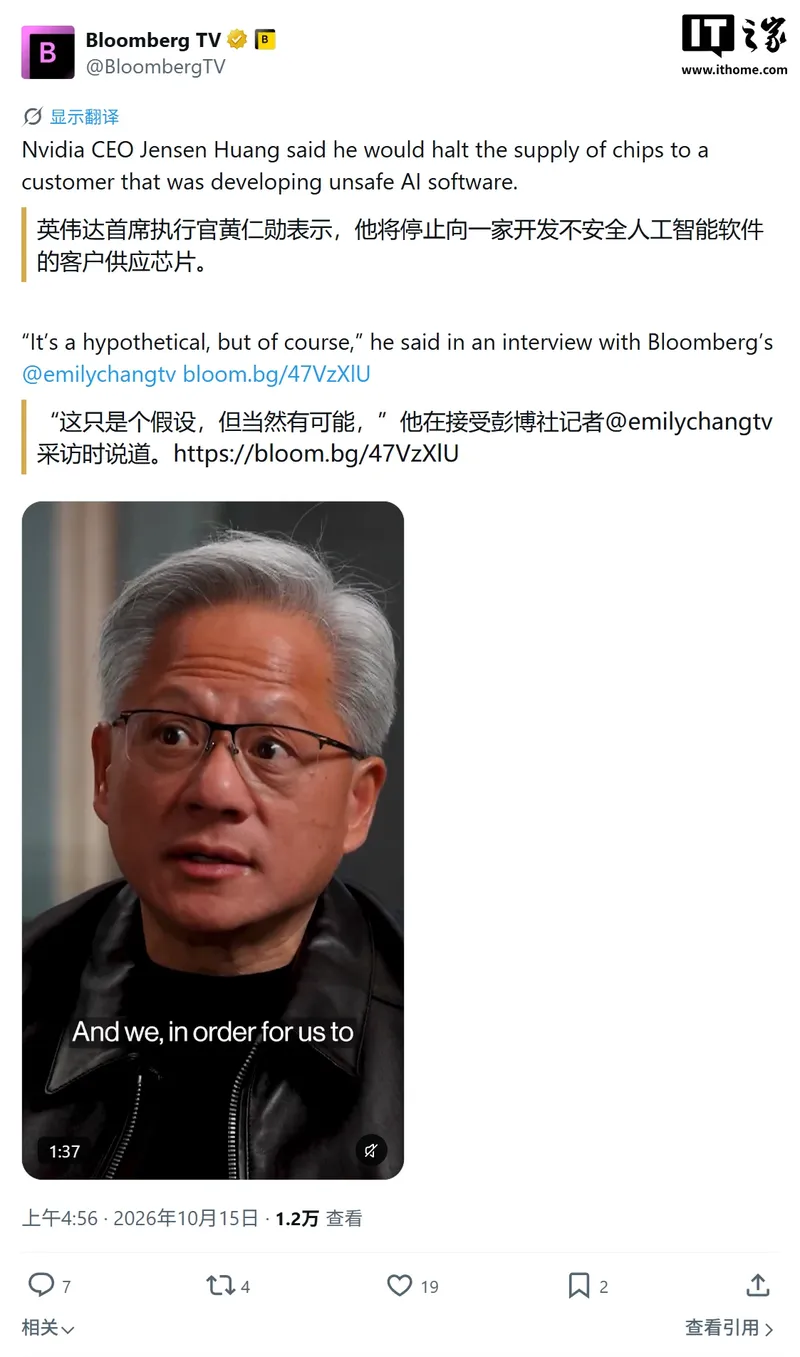
ITHome On October 15, in an interview with Bloomberg's Emily Chang in London, NVIDIA CEO Jensen Huang said that if its customers were found to be developing unsafe or irresponsible artificial intelligence (AI) software,NVIDIA will resolutely stop supplying it with chips.
He candidly admitted,Cutting off supply remains, for now, a 'hypothetical question', and before NVIDIA takes extreme countermeasures such as cutting off supply, it will inevitably first engage in in-depth communication and dialogue with the relevant customers.
Huang Jen-hsun added: "We do not run other people's companies. Our technology is general-purpose technology, so as for how other companies use our technology, the judgment and leverage NVIDIA can actually exert is very limited."
In response to deceleration proposals from executives at companies such as Anthropic that "the whole industry should slow down the pace of AI development," Jensen Huang clearly rejected them. In his view, the various current safety concernsIn fact, it is a 'growing pain' in the process of the industry's rapid expansion as a wholePublic anxiety about AI safety risks has somewhat exceeded the actual situation. He firmly believes that AI software can be effectively governed and deployed safely, and that many young companies will gradually mature in their accountability and responsibility as they scale up.
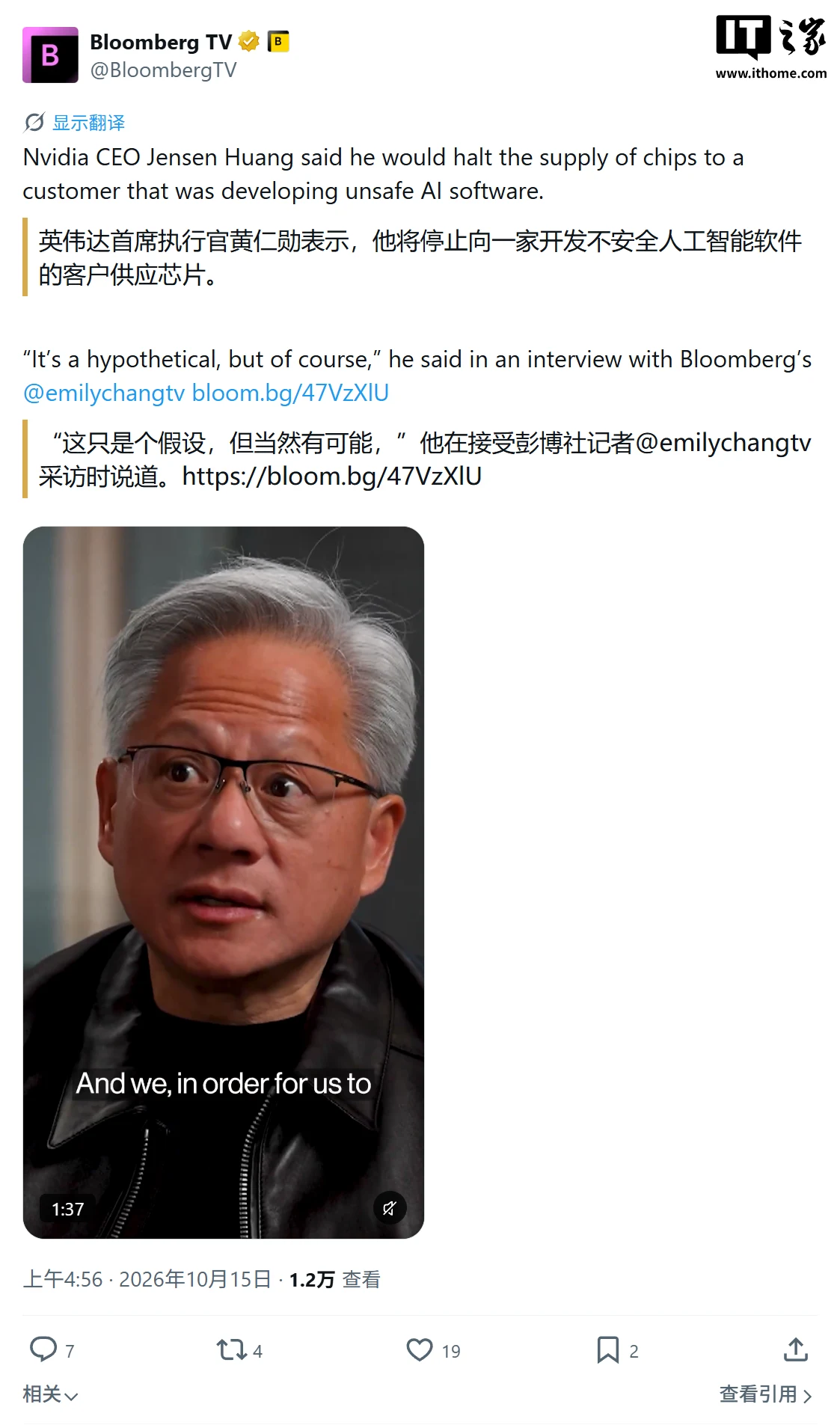
On the specific path to addressing AI safety risks, Jensen Huang proposed the technical governance approach of "using AI to monitor AI." He argued that the industry should not slow down out of excessive caution, but should instead accelerate the integration of prevention, control and monitoring technologies into AI systems, because "AI itself is the best monitoring tool."
To fulfill this commitment, Nvidia also announced that it will donate advanced computing power worth 250 million US dollars (IT Home note: approximately 1.676 billion RMB at the current exchange rate) to UK AI safety research over the next five years, supporting multiple top UK academic institutions including the University of Oxford in deeply exploring AI safety protection and agent control methods.
Related reading: