
By Jay, from 凹非寺 Quantum Bit | WeChat public account: QbitAI
Wait, Anthropic — did you travel back from the future?
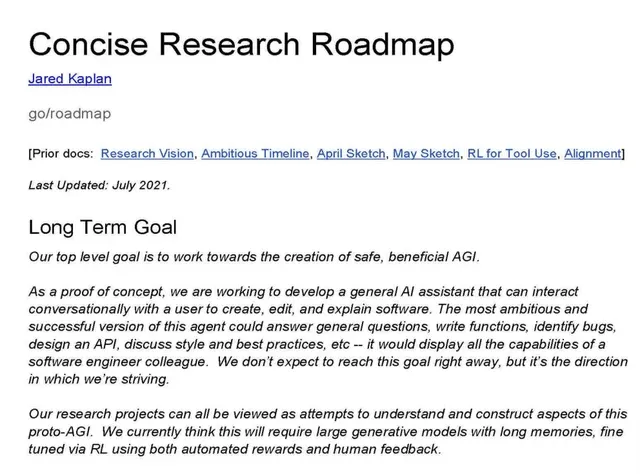
Recently, because of a copyright lawsuit, an internal research roadmap fromInternal research roadmap from month 7 of 2021was unexpectedly exposed.
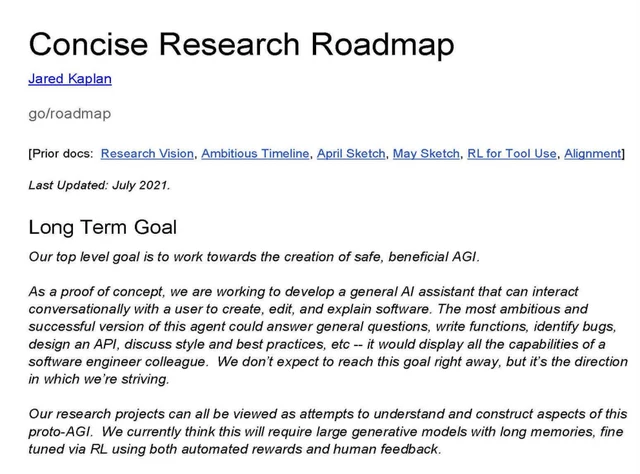
It's short — the PDF body is just two or three pages.
But after reading this document, which was marked "Top Secret" at the time, from beginning to end, I went limp.
Today's Claude Code, Tool Use, AI Self-Judging, Test-time compute, even trillion-scale parameters and ultra-long contexts……
Five years ago, when this company had only been independent from OpenAI for a few months and had just a dozen or so employees, all of these were already laid out in black and white.
The roadmap from 5 years ago
Many people assume that large models moving from chatbots to Agents that write code and operate systems was something everyone naturally did once the technology matured in the past couple of years.
Wrong.
At the very beginning of this 2021 roadmap, Anthropic set a very clear prototype positioning for its ultimate goal (Safe, beneficial AGI):
To build a general-purpose AI assistant that can interact with humans through natural language to create, edit, and explain software.
What does a general-purpose AI assistant mean?
It can answer general questions, write functions, find bugs, design APIs, and discuss code style and best practices.
The most striking part is what comes after:
It must demonstrate the full capabilities of asoftware engineer colleague.
Hold on — isn't that exactly Claude Code??

Back then, when GPT-3 had only recently gone viral and everyone was still marveling that AI could write acrostic poems, Anthropic directly skipped simple code auto-completion logic and aimed at a complete software engineering agent.
Not only that, on the specific implementation path, an extremely fascinating internal debate unfolded.
Researcher Andy Jones raised a core divergence in his annotations: should we first build a truly useful programming assistant, or first prove the feasibility of tool calling?
At the time, the team faced two paths:
The practical route: build Repo Search, letting the AI look through a project's type definitions.
Tom Brown, first author of the GPT-3 paper, also joined the discussion, suggesting starting with code Repo Browsing.
The research route: work on printf debugging and editor operations, first proving that the model can call tools.
In the end, CEO Dario made the call:
In the short term, first validate the feasibility of tool calling; in the long term, evolve into an extremely useful programming assistant.
Looking back now at the evolution of Claude Code, it has followed Dario's words from back then step by step, exactly.
Self-judging, trillion parameters, and ultra-long memory
Beyond Coding Agents, this roadmap also contains predictions about underlying technologies.
For example, in the pretraining section, back in 2021 they wrote down in black and white that they would train1T (1 trillion parameters) and larger ultra-large models, and explore very large contexts (Very large contexts), or other mechanisms capable of holding vast memories and experience.
Back in that era when 175B was still a colossal behemoth, they had already regarded trillion-parameter models and ultra-long memory as standard infrastructure.
Even more remarkable is the section on human feedback and Alignment.
The document plainly states:
Models judging themselves.
In 2021, they were already researching how to let models evaluate their own behavior and output quality, and how to use the model's own judgment as a feedback signal. This is precisely the core idea behind today's AI Feedback and the self-correction of reasoning models.
Even more interesting is that the document even contains a concept that later became extremely important in large-model research:
Test-time compute.
Of course, at the time this research was placed in the context of alignment and discriminator research, still quite far from the later o1-style inference compute scaling.
But at the very least, it shows that as early as 2021, Anthropic's research vision already covered compute investment beyond model training.

Let's just say Neo Lab does have the goods; no wonder Ilya collapsed.
Who knows what today's frontier labs are going through every day.
Cold-sweat moments from the inside
Of course, since this is A\, safety issues are unavoidable to discuss.
But after reading it, I found that these people truly love discussing safety; they devoted a very long section to it.
As a company whose very existence is founded on safety, Anthropic foresaw in 2021 the nightmare that awaits when Agents are running all over the place today.
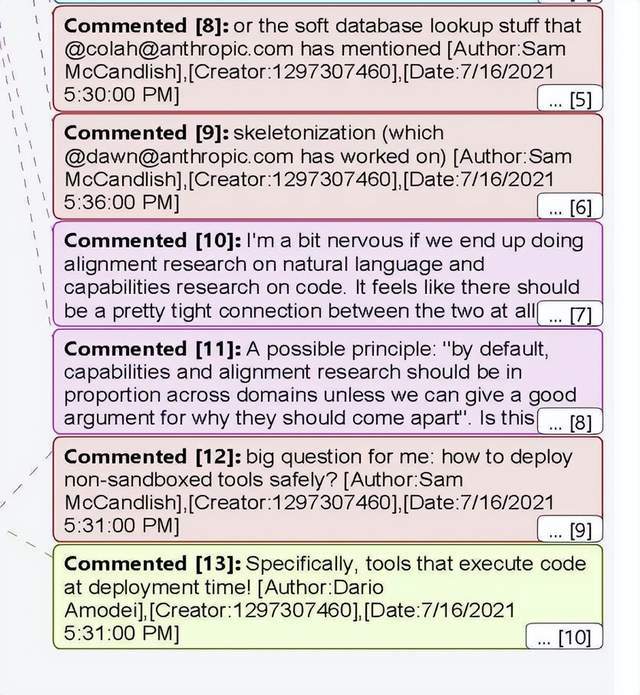
Co-founder Sam McCandlish posed a soul-searching question in an annotation:
How do you safely deploy tools without sandbox isolation?
Dario immediately followed up with a further jab:
Specifically, Tools that execute code at deployment time!
(ps: the original text really does have exclamation marks; your Dario is just that passionate)
Incredible.
When AI can truly run code directly in the host environment, invoke the Shell, and modify files, once it goes out of control or gets hit by Prompt injection, the consequences are unthinkable.
The Agent privilege escalation, environment escape, and data contamination being discussed across the internet today—these people were already discussing sandbox boundaries back in 2021.
Perhaps it's precisely because this was the path they set out on from the very beginning.
By the way, Amanda also appears in this report; she's the internal Anthropic philosopher who was somewhat popular a while ago.
She pointed out very seriously:
If we do alignment research on natural language, but mainly advance model capabilities on code, I'm a bit worried. These two lines of research must stay closely connected at all times.
If we don't do alignment research in the domains where capabilities are improving, it will limit the effectiveness of alignment testing. This could create a chain reaction, for example alignment research becoming an isolated island because it wasn't integrated early on.
She even directly proposed establishing a company principle:
Capability research and alignment research across all fields should advance in proportion and in step, unless we can give sufficient reasons for why they should be separated.
One More Thing
Sigh, I was wondering how A\ kept edging out OpenAI — turns out it was the first-mover advantage.
Over these past five years, Anthropic has stayed firmly the course, grinding away at high-quality code signals, reinforcement learning, and enterprise workflows;
while OpenAI fought on multiple fronts all along — text-to-image generation, Sora video, voice assistants, search — which diluted its strength to some extent.
However, just as everyone was still reviewing the two companies' technical routes, OpenAI suddenly dropped an earth-shattering bombshell even wilder than a Hollywood movie —
Folks, OpenAI has a mole!!!
According to the indictment released by U.S. federal prosecutors, 35-year-old Abdulrahman Alfozan, a former engineer on OpenAI's product team, has been formally fired and charged with federal crimes.
What did this guy do?
In the core conference room reserved for executives at OpenAI's San Francisco headquarters, he took a covert listening device with advanced encryption and data-transmission capabilitieswrapped in toilet paperand quietly plugged it into the USB port behind the TV.
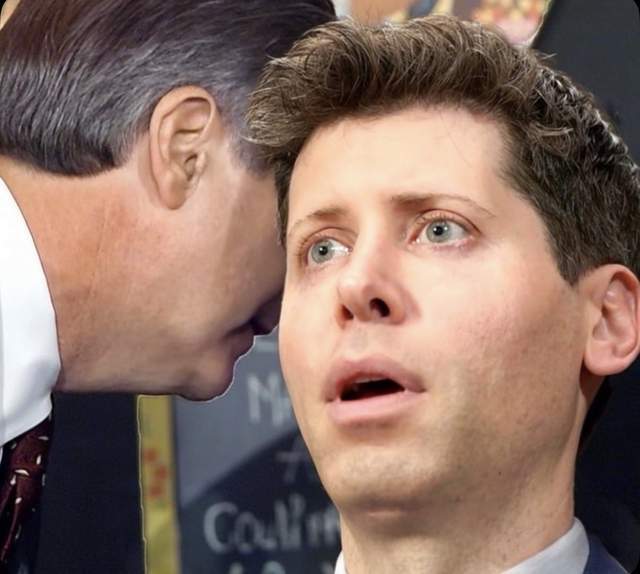
You should know, this conference room is where Sam Altman and other executives hold core closed-door meetings, and what they discuss is all about superintelligence R&D secrets, unreleased product plans, and government cooperation briefings.
And yet, it got hacked this easily.
The world really is a slapdash outfit...