

QbitAI Think Tank
WeChat official account AI123All
Over the past year, hardly any enterprise has not been loudly proclaiming its "full embrace of AI."
Chatbots have been deployed, Agents are in use, and the "XX% efficiency improvement" figures in internal reports keep looking better and better.
But if you ask business leaders a simple question—has the stock shortage decreased? Has delivery gotten faster? Has customer satisfaction risen?—the answer is often far from certain.
In fact, the vast majority of enterprises' intelligent transformation is collectively experiencing a bout of "false prosperity." We have grown accustomed to treating AI as a personal productivity tool, while overlooking a harsh truth:
The efficiency of individual tasks does not equate to the realization of business operating value.
If AI cannot truly connect the full-chain closed loop ofdata, judgment, action and system control, enterprise intelligence will forever be stuck at the last mile of scaled application.
In the second half of enterprise-grade AI, how exactly can we break through? And how can Agents truly penetrate deep into the capillaries of business and accomplish a future-oriented systematic reconstruction?
Recently, QbitAI Think Tank officially released the report"Agent-Driven Enterprise Intelligence: From Single-Point Efficiency to Scaled Reinvention". In this report, we attempt to dispel the fog surrounding the implementation of large models and seek a brand-new solution for enterprise intelligent planning.

AI is being used, but where is it stuck?
The places where enterprise AI implementation tends to get stuck can be connected through a single scenario:handling stock shortage risk in stores。
With the same business analysis assistant, the technical team considers the job done once the report is generated, business staff consider it resolved only when the cause has been identified, and managers care about whether the stock shortage has actually decreased—the three parties' completion criteria simply don't align.
There is a similar misalignment at the data level: the books show inventory on hand, but after subtracting allocated and frozen stock, the amount truly available for allocation differs considerably from the number in the system. When AI makes judgments based on book figures, its starting point is already skewed.
Even when the data is accurate and the analysis correct, there still lies a whole chain between recommendation and execution: manually filling in forms, submitting for approval, and tracking delivery. A recommendation entering the system does not mean the matter is done, and whether the completion status can be sent back to the AI determines whether the task loop can truly be closed.
Not to mention that behind every operation lie questions of authority and responsibility such aswho has the right to initiate, who approves, and who takes over when problems arise>
These breakpoints have been summarized into six categories:task definition, data credibility, verifiability of judgment, action implementation, division of authority and responsibility, and value measurement and replication。
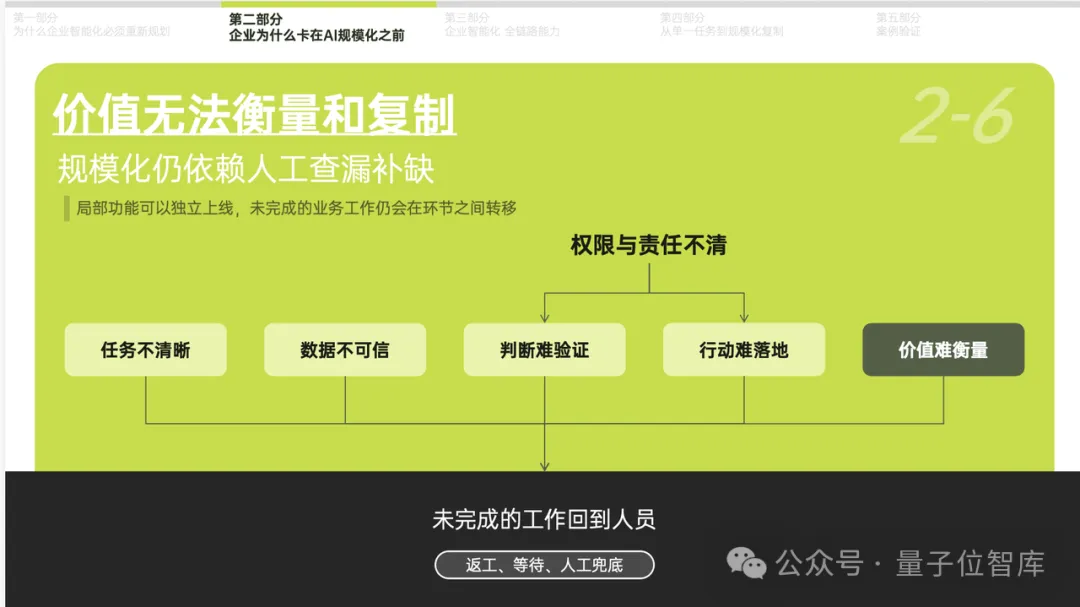
Each one alone is not fatal, but strung together, they explain why many enterprises' AI projects are stuck in a state of "locally usable, but unable to scale overall."
These unfinished tasks ultimately fall back into human hands, becoming lengthy rework, waiting and fallback handling.
So how exactly can enterprises systematically eliminate these blind spots?
A full-chain framework centered on business outcomes
Since piecemeal local fixes cannot solve the fundamental problem, how should enterprises restructure an effective intelligent solution?
In its report, QbitAI Think Tank proposes that a mature enterprise-grade Agent is by no means an isolated Q&A tool, but must possessa 'full-chain capability' that runs through tasks, context, judgment, action, control and measurement。
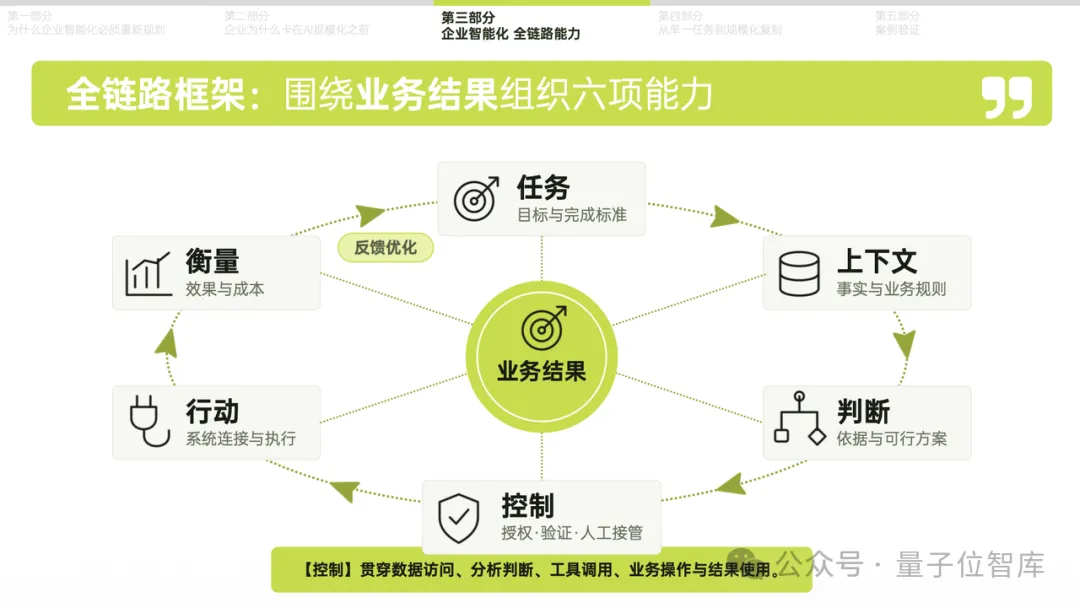
Among these, the starting point of all intelligent decision-making lies in breaking down data silos and establishinga truly trustworthy contextual environment。
Often, the root reason why AI appears 'not smart enough' in business analysis is the disconnection between underlying data and business semantics — with chaotic field definitions and inconsistent version calibers, AI naturally cannot produce reliable conclusions.
To make an Agent truly become a business-savvy 'advisor', data must first evolve from merely being 'findable' to being full-chain 'trustworthy'.
In this regard, some leading technical practices provide an excellent model for the industry. For example, Shufan, the data intelligence brand under NetEase ZhichaoShufan, through its integrated development and governance platformEasyData, deeply integrates data development, quality, security and business governance, steadily delivering high-quality, traceable asset semantics to the Agent.
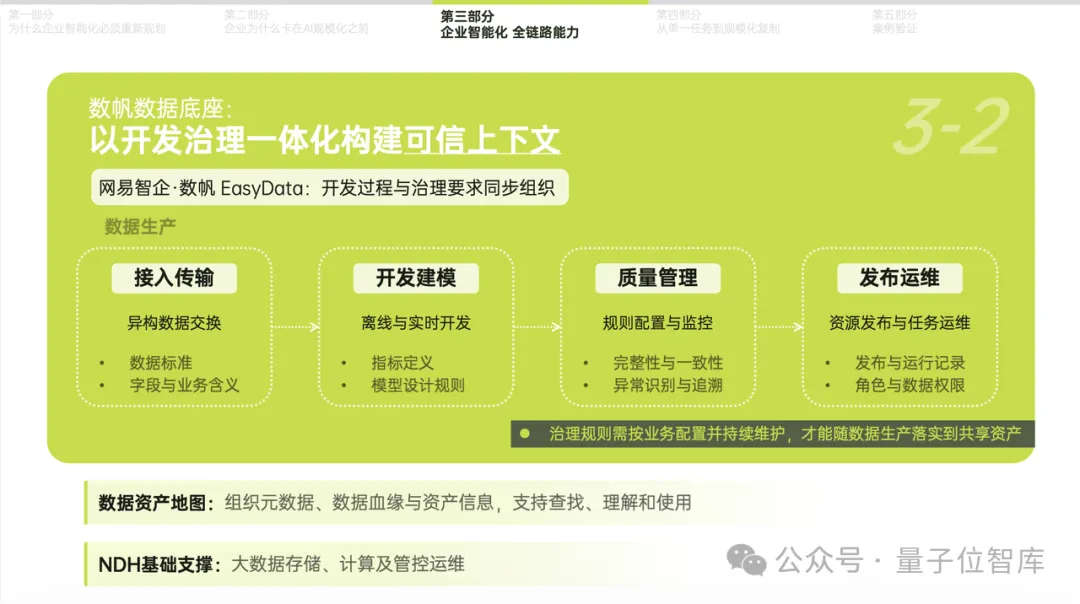
On this basis, relying on NetEase Zhichao'sZhishu DataAgent, enterprises can seamlessly connect dispersed metrics, knowledge bases and natural language queries, allowing AI to truly understand business language.
In actual deployment, this full-chain integration is unleashing business potential. TakingSanhua Intelligent Controlsas an example, with Shufan unifying data and semantic calibers at the underlying layer, AI can automatically pull budget-versus-actual data and identify deviations, compressing budget analysis that originally took2-3 hoursdown to10 minutes, freeing the finance team from heavy report processing to focus on in-depth business judgment.

But when intelligentization moves from analysis and decision-making deeper intosoftware engineering and application delivery, new challenges arise: how to avoid requirements drifting off course when Coding Agents develop applications, and the time-consuming frontend-backend integration?
One noteworthy change is that enterprises are trying to pull AI development back from "free-form generation" into a more controllable engineering process.
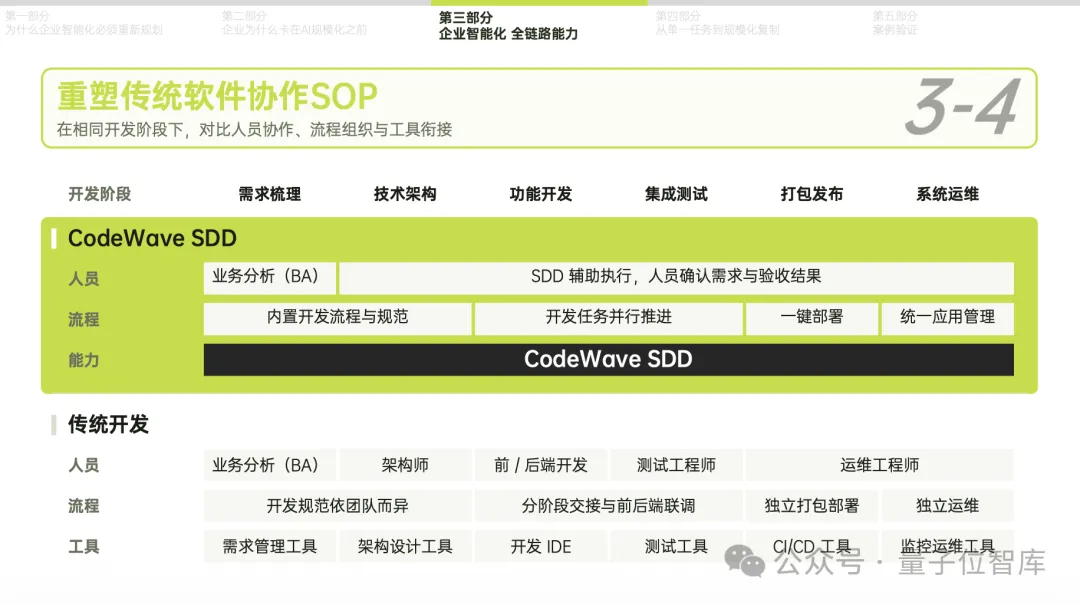
TakeNetEase Smart Enterprise · CodeWave SDD (Spec-Driven Development) as an example: its core idea is not to let the AI directly "start writing," but to break delivery into requirements, architecture, development, testing, release, and delivery stages that cascade level by level:
business requirements are first converted into structured specifications, then technical design and task breakdown are derived downward, and only then does code generation begin.
Each stage has clear inputs, outputs, and validation checkpoints, keeping the entire workflow from requirement clarification and development to testing and release controllable and traceable.
This "level-by-level cascade" precisely addresses three breakpoints in common SDD solutions on the market: specifications are written non-standardly and lack clarification mechanisms, making them only a soft constraint for large models; complex requirements blow up the context window, causing forgetting and hallucinations; and capabilities cover only part of R&D, leaving both requirements and delivery unaddressed.
CodeWave SDD fills these gaps one by one: it standardizes requirements with the EARS format and explicitly clarifies ambiguities, uses modular decomposition and fine-grained subtasks to isolate context and divide complexity, and chains requirements, design, coding, testing, and release into an end-to-end, multi-role collaborative pipeline.
This approach is already demonstrating efficiency value in real projects. For example,Kongge Digital Technologyshortened the development cycle of its new energy CRM project from 60 person-days to 16 person-days;Shanghai Qitong Digital Technologyachieved roughly 2.5x efficiency gains in its BIMS system development, with a first-time usability rate of 78.63% for features.
Getting a Demo working is easy; replicating it 100 times is the real skill
With the framework in place, the next question is how to get started.
Many enterprises launch pilots in parallel across multiple tracks, but the advice from QbitAI Think Tank is:first pick one high-value scenario, get the closed loop working, and only then consider scaling.
There are five screening dimensions for choosing a scenario:
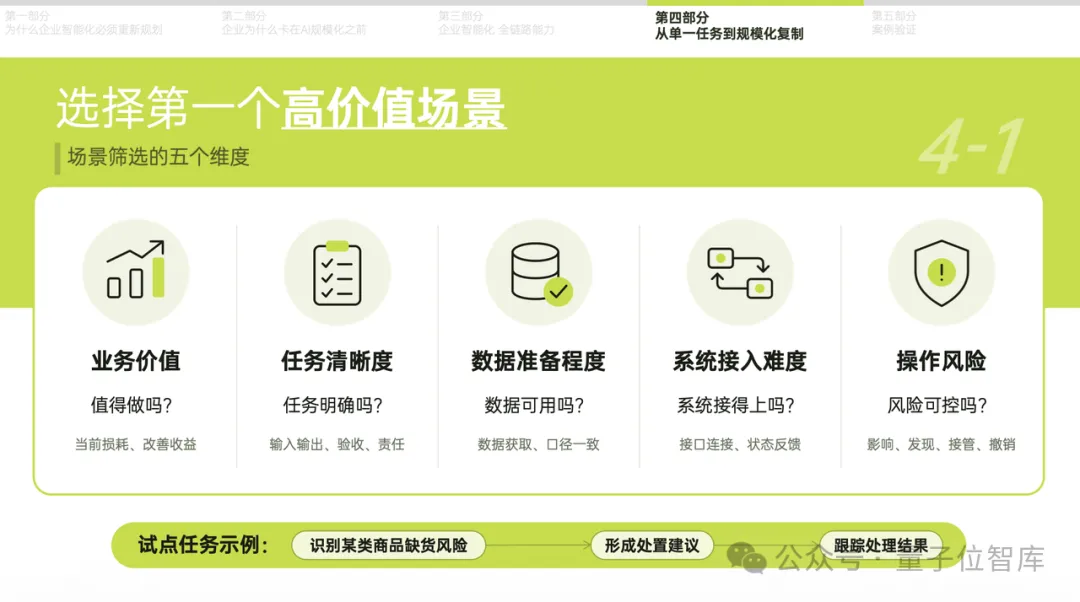
It sounds like common sense, but in practice many teams do the opposite — they start with whatever is technically easiest, and only after finishing discover it has little business value, so momentum for rollout evaporates.
Once a scenario is chosen, the pilot phase involves more detailed work than expected.
Which steps of the existing process can be handed to the system, which still require human review, how exceptions are handled — all of these need to be redesigned rather than simply layered on.
One easy pitfall: keeping the entire old process and additionally adding checks on AI results, which ends up increasing overall investment instead.
After the pilot, enterprises often face three choices:
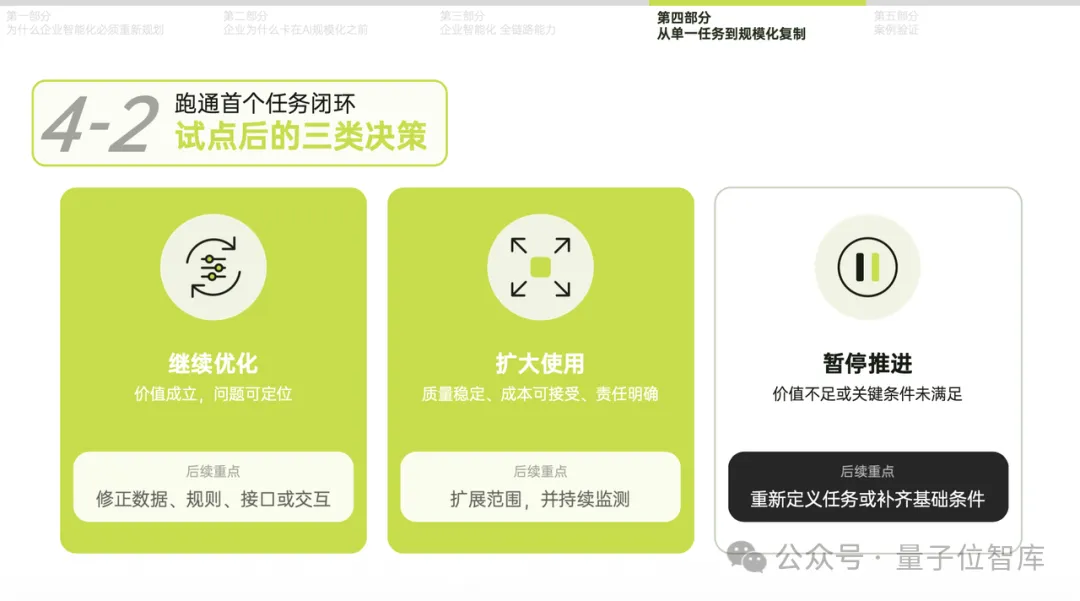
But what truly determines whether an enterprise can go from "1" to "100" lies further ahead —turning the experience from the first success into reusable intelligent assets.
For example, validated metric definitions, interface components, approval rules, and exception samples don't need to be redone every time the scenario changes. New tasks can directly reuse these shared capabilities, making only the necessary adjustments for the specific business.
So the essence of scaling and replication is ensuring that the 2nd, 10th, and 100th build can each stand on the foundation of the previous one and keep moving forward.
Get the full report for free
Where enterprise intelligentization stands today, what really sets companies apart is whether they can connect model capabilities into their business, organization, and processes, ultimately turning them into visible business results.
Good AI planning never starts from tools; it needs to "trace back from business outcomes"; and for future-oriented Agents, the core lies more in achieving "humans define boundaries, AI drives forward”。
". What this report provides is exactly such acomplete approach from diagnosing problems, building frameworks to implementation and validation。
". Whether you are a business leader currently advancing AI pilots, a technical team asked to "use AI to improve efficiency" but unsure how to measure results, or a manager who needs to coordinate responsibilities across parties at the scaling stage, you will most likely find a reference in it that matches your current stage.
Many details, such as how to define task completion criteria, how to design before-and-after comparison measurement methods, and how to consolidate pilot results into reusable assets... are not elaborated one by one in the article, but they may be exactly the step where you are currently stuck.
The full report can be downloaded for freevia the link below:
https://jkhbjkhb.feishu.cn/wiki/W5D7wuDcbiPXDLkaRLQcAJpOn8f