

Luyu, from Aofeisi (Avatar Temple)
Quantum Bit | Official Account QbitAI
Oh my! The annual Double Eleven shopping festival has come around again...
To all my friends working in e-commerce, are you ok? My friend has already lost it, bombing me with messages every day:
Is there any good-to-useAI work assistantlooking for recommendations? Urgent urgent urgent, ideally one that does the job well and can keep working for a long time.

Well, would you believe it, I recently dug up a real gem.
Ant Ling's newly open-sourcedLing-3.1-flash—my regular work weekly reports and topic summaries are all handled by it.
u1s1, I've also used Claude Code, Codex and the like, but in the end I found that domestic models suit me better.
EspeciallyLing—usually it keeps a low profile, neither competing on parameters nor on leaderboards, but when it's really time to get work done, it's remarkably reliable.
According to the official statement, this model focuses on just one thing:getting the work in real workflows done.
Take the e-commerce report from the beginning: when the boss says"summarize how this big promotion went"what lands on the worker's shoulders is finding materials, verifying data, tracking progress, then turning it into Excel and a presentation PPT...
Behind a single business task there is often collaboration across multiple stages, and what's worse, the data is scattered across different files and different tools.
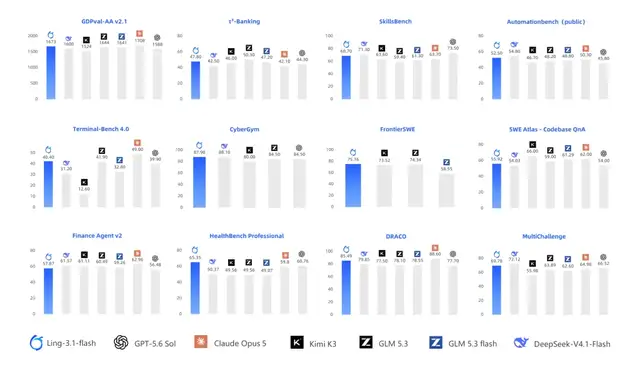
Image source: Ling's official WeChat account
Ling-3.1-flash is a professional model derived from these kinds of real needs, offeringhigh intelligence-to-efficiency ratio.
Simply put, what it wants to prove is that answering beautifully is only secondary—delivering the completed task is what really counts.
Built for real-world tasks
To handle tedious jobs like big-promotion analysis, the model must keep pushing forward across multiple workflows. The design of the Ling-3.1-flash model can be understood along this task chain.
The first problem the model needs to solve isBreak the delivery goals down clearly.。
The user may give only a vague one-line instruction, while what actually needs to be delivered is a whole set of report materials; the model has to find the relevant information itself, judge what is missing and what is needed, and then keep moving forward based on intermediate results.
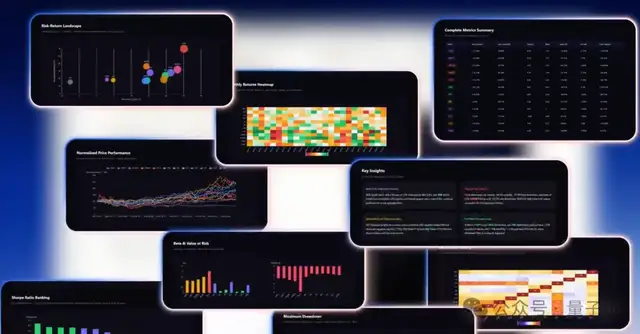
Ling-3.1-flashworks exactly this way.
It connects requirement understanding, task decomposition, information integration, tool calling, and result checking, and can work across web pages, documents, spreadsheets, and code environments.
In civil matters it can create Excel files and PPTs; in martial ones it can also generate and test code.
And! These capabilities already have quite a concreteimplemented form:。
Ling-3.1-flash has been connected to Ant's internal desktop collaboration Agent client“Xiaohu”, where the model directs actions, while the execution environment lets it actually read files, run programs, and write results.
This is indeed an idea worth borrowing; although we can't use Xiaohu yet, our ownoffice Agent, combined with Ling-3.1-flash as a one-two punch, should presumably deliver good results as well.

As a task keeps progressing, the materials and historical context will expand significantly, and computational overhead will grow accordingly.
At this point, Ling-3.1-flash'shybrid architecture designplays a key role.
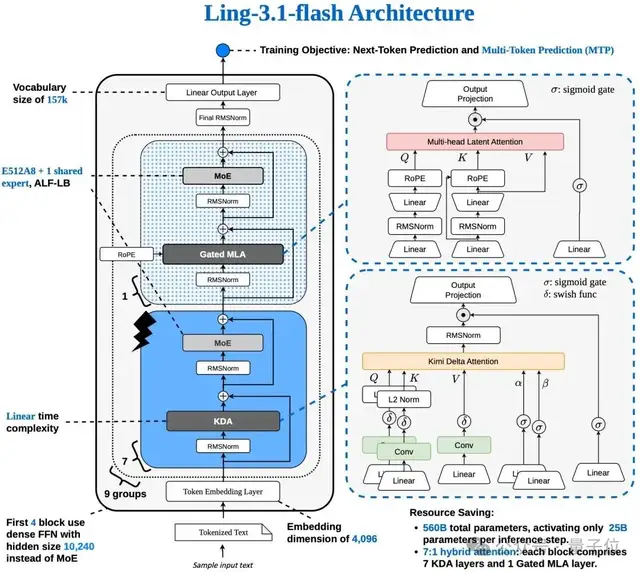
The model has approximately 560B total parameters, with about25Bactivated per token. While preserving knowledge capacity, Ling-3.1-flash has compressed the scale of weights actually involved in computation at each step.
In terms of attention structure, it continues the architecture of Ling-3.0-flash and further increases the proportion oflinear Attention.
It adopts a 7-layer KDA with 1 layer of Gated MLA, where KDA handles sequence processing with linear time complexity, and every 8 layers it retains 1 layer of Gated MLA to maintain a global attention pathway.
The model's context window limit can reach1M, capable of holding more documents, code, and historical tasks at once, reducing the effort of manual segmentation and repeatedly transferring information.
Meanwhile, the model is configured with 512 routing experts, with each Token selecting 8 of them, while also invoking 1 shared expert.
This kind ofHybrid linear plus sparse MoEthe approach, with only one goal: to keep the model from dropping the ball during long-duration execution, while also keeping compute costs from burning out of control.
In addition, the team is also actively lowering the deployment threshold; through mixed-precision quantization, the model weights' footprint has been reduced from approximatelyReduced from 534GB to 292GB, in the corresponding Hopper test configuration, the GPUs required for deployment were provided byReduced from 8 cards to 4 cards。
For specific business scenarios, the team also provides long-context parallel inference solutions (PCP/DCP), and strengthens...JSON Schemasupport, making it more convenient for models to process long documents and connect with existing business interfaces.
Beyond the architecture, whether it's a mule or a horse still has to be put through its paces in real-world testing.
AtOffice Task BenchmarkIn GDPVal-AA V2.1, Ling-3.1-flash achieved an ELO score of 1673, demonstrating competitiveness in handling multi-step work tasks.
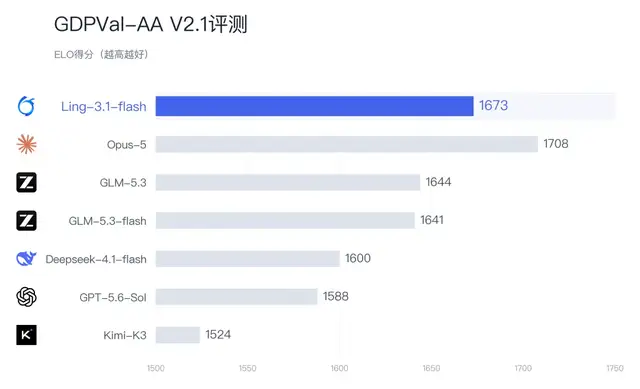
Image source: Bailin official WeChat account
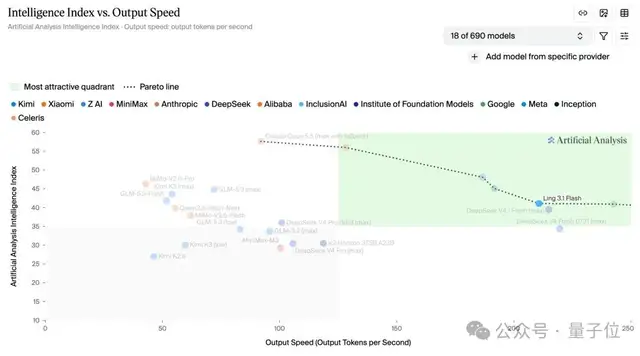
Meanwhile, according toArtificial AnalysisAccording to the latest public benchmarks, Ling-3.1-flash has an intelligence index of 41, an output speed of approximately 210 Tokens per second, and a blended API price of about 0.19 US dollars per million Tokens, offering high-frequency business scenarios a choice that balances intelligence level, generation efficiency, and calling cost.
Healthcare scenarioIn the HealthBench Professional evaluation conducted offline, Ling-3.1-flash likewise maintains a relative lead.
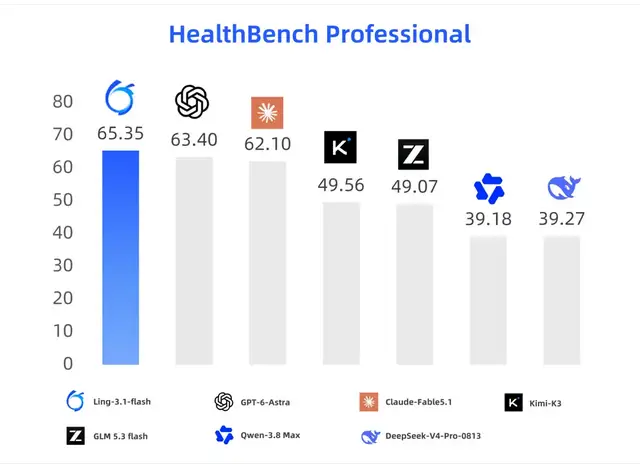
Image source: Bailing's official WeChat account
In addition, in scenarios such as software development and terminal operations, Ling-3.1-flash also possesses a certain ability to understand and execute information.
Taking a long-duration Lua native compiler development task conducted internally at Ant as an example, the entire process lasted about 17 hours, during which the model repeatedly developed and corrected code, and the final independent test pass rate was97.8%。
So when selecting an office Agent, Ling-3.1-flash is well-rounded and professional without errors, which has become the reason it is given priority for trial deployment.
Real-world Testing Puts Ling-3.1-flash to the Test
To test just how「genuine」 its work really is, let's jump straight into the hands-on test~
For the first task, let's trya Double 11 e-commerce taskto test the waters.
Suppose you are the e-commerce lead of home organization brand Ling. Based on the materials, you need to submit to your boss a Double 11 promotion plan covering October 15 to November 11, and the plan will be handed directly to the operations, content, customer service and warehousing teams for execution.
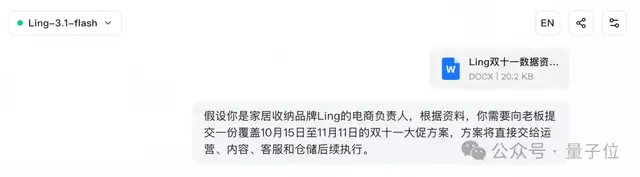
P.S. The relevant data materials were generated with the assistance of Codex.
After being given the business goals, product information, team situation and historical channel data, the model quickly began organizing the materials and designing the promotion plan.
First, the model performed aninitial goal feasibility assessment。
It did not simply swallow the pie drawn by the boss; instead, after identifying in advance constraints such as diminishing marginal efficiency of advertising, inventory and shipping capacity, it gave a relatively reasonable estimate of the initial goal.
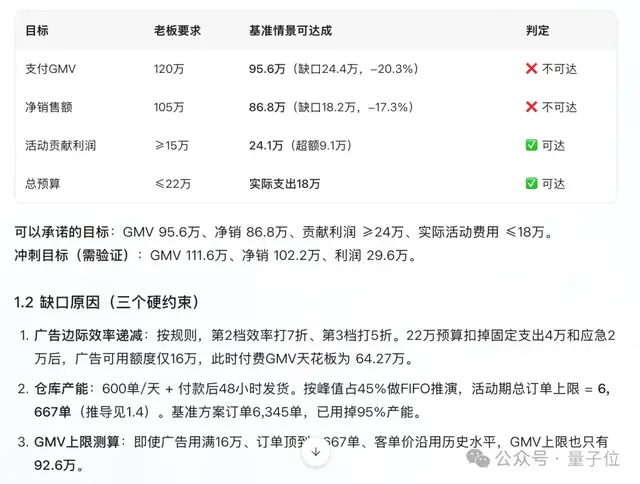
It also provided a correspondingadjustment pathto help workers respond to their boss's questioning.
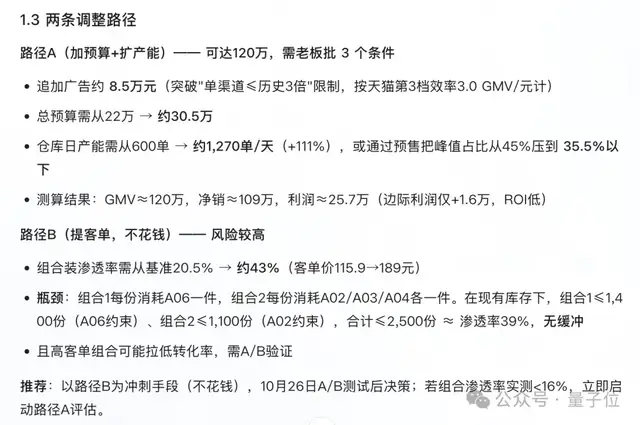
Looking at the promotion discount plan produced by the model, the key numbers it calculated actuallyhold up under verification。
Whether it's the product combination table or the channel budget details, every piece of data is traceable, showing a certain level of data analysis capability.
Ling-3.1-flash also carefully provided aphased execution scheduleeven including the prerequisites needed for each phase.
Although our prompt only asked for the promotion plan up to Double 11 itself, the model proactively added the subsequent review and profit accounting process.
How thoughtful and considerate~
The model'stext outputis also quite good; for example, short-video traffic-driving and order-urging scripts, livestream scripts, etc., it handles with ease.
Visuals, copy and hooks are all there, so we working stiffs can simply copy the AI's homework—saves worry and effort.
Finally, the model proactively performs aconsistency checkclearly marking which data still needs user verification and which content requires user confirmation, so the initiative in executing the final plan always remains in the user's hands.
Beyond daily office work,healthcare scenariosare also a strength of Ling-3.1-flash.
We provided a set of virtual blood lipid test data and a vague symptom description, hoping the model would organize a communication sheet to take to an outpatient visit.
When information was insufficient, Ling-3.1-flash did not jump to conclusions; instead, it first listed the details the user needed to supplement, then distinguished between known facts, uncertain items, and questions to ask the doctor.
Afterguidingthe user to supplement key information, it cross-validated the new content against the original content, producing a more professional consultation reference.
Notably, throughout its thinking process, the model consistently emphasized thered-line warning principle, constantly reminding users to watch for changes in their condition and seek medical care promptly, and it would not give explicit medication guidance.
In the process, it acted more like an assistant handling preliminary work for the doctor.
That said, Ling-3.1-flash does have some minor bugs; for example, when you dump a large block of long text into the model all at once,the model's attention sometimes drifts。
. For example, a Double 11 mega-promotion plan is itself a very complex, long-cycle work task, so it is still more advisable to deliver it step by step, such as first using a script to organize the data and then generating the plan, proceeding gradually in this way.
One-shot generation likewise has adaptation boundaries. If the current result is unsatisfactory, it is often more efficient for the user to go back and reclarify the implementation approach and delivery specifications than to keep trying their luck.
Moreover,the current version does not yet have native visual understanding; a vision model needs to be set up beforehand to handle it, which also increases the cost of the whole pipeline.
In short, whether the model can achieve usable results still depends on the task.
"Bailing" moves early into real task workflows
Having discussed the model itself, looking back atBailing, it has precisely hit an industry pain point.
This year, the large model community has been almost entirely competing on Coding and leaderboards.
But as the competition intensifies, more and more people are asking a more fundamental question: is Coding the only exam arena for AGI?
Xiting, the head of Bailing, made the judgment at the Bund Summit thatCoding is not the only exam arena。
. In his view, Bailing's goal is still to serve real-world tasks, extracting model capability from the technical level andscoring models with real tasks。
So Bailing placed its 3.0 series models into the two places where mistakes are least tolerable:finance and healthcare。
LingFinis a high intelligence-efficiency-ratio financial large model that restructures financial efficiency starting from industry research; the healthcare-enhanced modelLingSanteexplores medical knowledge reasoning, evidence-based retrieval, and standardized workflows.
Among them, Ling-3.0-flash-Fin (124B total parameters, 5.1B activated) brings AI into real investment research task flows, connecting the complete task chain from finding materials and doing analysis to forming research conclusions.
In high-difficulty investment research tasks it rivals 3T-scale frontier models, its financial Agent comprehensive performance is leading among open-source models, and its performance on key tasks matches frontier models such as GPT-5.4.
Ling-3.0-flash-Sante brings high intelligence-efficiency ratio into healthcare scenarios, achieving the best performance among models under 1.6T at a parameter scale of 124B,with overall performance comparable to multiple flagship models。
Image from Bailing's official WeChat account
Compared with the base models, these are not simple industry fine-tunes, but genuine placement into complex working environments with continuous polishing and verification.
On a larger level, Bailing is also doing something that leads the industry: redefining the word“efficiency”.
In the past, the industry talked aboutcompute-efficiency ratio—how much compute was used and how efficient it was.
Bailing was quick to tie together a model's computational efficiency, parameter efficiency, and Token efficiency, emphasizing the model'sintelligence-efficiency ratio。
. This framing quickly gained industry traction; in the past six months, Anthropic and OpenAI have both successively rolled out specialized capabilities for finance and healthcare.
For example, Anthropic'sClaude for Financial Advisors, launched last month, organizes connectors and task Skills around specific work, which is another practice of integrating professional workflows.
Admittedly, it is far too early to declare a winner in the route debate, but“stepping into real workflows”is turning from one company's choice into an industry-wide trend.
This year is also a key year for Bailing to move from model capability toward task value.
Through Ling-3.1-flash, Bailing's path forward is already written:
Upward, continuing to raise the capability ceiling for developers of Agents;Downward, further lowering the usage threshold for ordinary users, converting a better intelligence-to-cost ratio into real problem-solving ability;Outward, continuing to deepen the models' professionalism so as to achieve breakthroughs in the real world.
It is clear that the way the model community proves itself is shifting gears, but everything is just beginning.
Ling Studio:
https://ling.tbox.cn
OpenRouter:
https://openrouter.ai/inclusionai/ling-3.1-flash
HuggingFace:
https://huggingface.co/inclusionAI/Ling-3.1-flash
ModelScope:
https://modelscope.cn/models/inclusionAI/Ling-3.1-flash