
Yunzhong, reporting from Aifeisi
QbitAI | Official account QbitAI
As AI begins to reshape industries, a top business school is rethinking: what kind of business leaders will the future actually need?
AI can write code, do analysis, generate plans, and has even started autonomously executing complex tasks.
But there is one question that seems to have never been solved:
When AI gives an answer, who decides whether that answer is worth executing?
For example, a company needs to optimize procurement. AI can simultaneously calculate supplier quotes, delivery cycles, inventory costs and expected returns, and find the mathematically optimal solution from dozens of combinations.
But if the lowest-cost solution means increased supply chain risk, if an efficiency gain in one department actually harms the company's overall interests, how should the final choice be made?
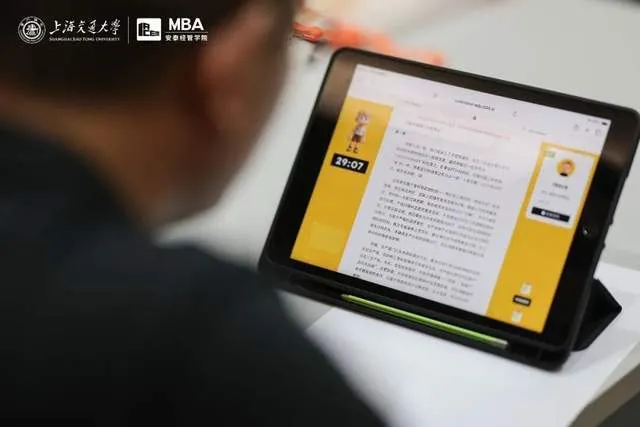
In July this year, an AI strategy workshop at Antai MBA of Shanghai Jiao Tong University brought exactly this kind of procurement decision problem into the classroom.
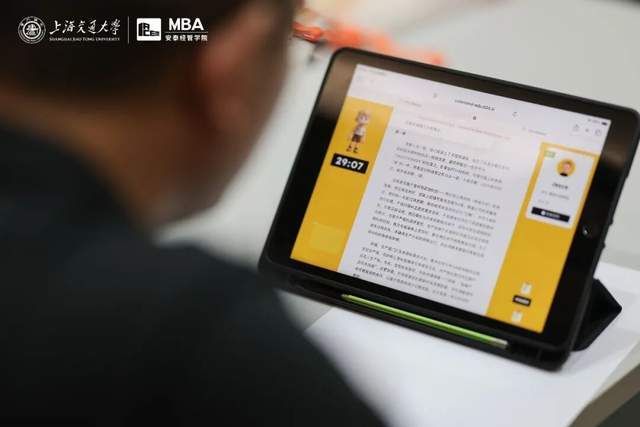
Participants were assigned to different roles and, using large models and optimization algorithms, engaged in three rounds of decision-making across cost, efficiency, risk and return.
Interestingly, the stronger the technical tools, the clearer the management problems became.
Computing the optimal solution is one thing; turning it into a decision the enterprise can actually execute is quite another.。
This may be precisely the talent transformation now taking place as AI enters the deep waters of industry.
AI is getting stronger, yet companies are beginning to pay for another kind of capability
First, look at some data.
According to McKinsey's 2025 global AI survey, 88% of respondents said their organizations are already using AI routinely in at least one business function.
But only 7% have truly achieved enterprise-wide, full-scale deployment.
There still seems to be a chasm between “using AI” and “using AI well”.
In the past, when companies discussed AI, they focused more on model parameters, reasoning capability, and computing power costs.
Now, more and more questions point to the business itself:
Can an Agent truly integrate into existing workflows? Can an intelligent system improve business metrics? Can an AI solution that looks very advanced actually deliver sustainable business returns?
This change is also redefining the value of technical talent.
One highly representative phenomenon is the rise of the FDE.
FDE stands for Forward Deployed Engineer. Unlike engineers in the traditional sense who bury themselves in development, such talent often needs to go deep into customer sites, understand the actual business, and bridge the gap between technical deployment and application delivery.
They not only need to understand models and engineering, but also must be able to understand customers' problems and grasp the complex constraints in business processes.
In other words,what companies need is no longer just people who can build the technology, but also people who can truly put the technology to use。
But FDEs are only part of the change.
Looking further ahead, as AI moves from an assistive tool to a business system, technology deployment will also involve organizational restructuring, resource allocation, strategic choices, and even business model reconstruction.
Is an AI solution worth the investment? After a new system goes live, how should existing roles be adjusted? How should humans and Agents collaborate? And how should one balance efficiency versus safety, and short-term profit versus long-term competitiveness?
These questions cannot be answered by stronger models alone. They point to another kind of composite capability: the ability to understand technical logic, to discern the laws of industry, and also to make business judgments and drive organizational change.
This is also why talent competition in the AI era is expanding beyond the boundaries of traditional technical roles.
As technical capabilities become increasingly easy to obtain, the ability to understand real problems, organize complex resources, and create business value becomes even more important.。
The question arises: how should such talent be cultivated?
In the AI era, business schools also need to redefine themselves
An interesting change is taking place in the Antai MBA training system at Shanghai Jiao Tong University.
On July 29, 2026, the Antai College of Economics and Management of Shanghai Jiao Tong University released the "Antai Declaration on Business Talent Cultivation in the AI Era", systematically responding to the challenges that artificial intelligence has brought to business education.
One noteworthy judgment is the following:Humans always remain the subject of decision-making and responsibility.。
This is not a simple declaration of the human-machine relationship.
When AI can rapidly process massive amounts of information and output professional analysis, some of the traditional business school teaching methods that focus primarily on knowledge acquisition, case analysis, and standardized problem-solving inevitably face disruption.
In the past, mastering more management knowledge often meant having a stronger professional advantage.
But today, AI can provide a seemingly complete strategic analysis, financial model, or market research report in a very short amount of time.
If knowledge itself no longer constitutes a high enough barrier, what exactly should business schools teach?
The direction given by Shanghai Jiao Tong University Antai MBA,shifting further from imparting knowledge and problem-solving methods toward cultivating the abilities to define problems, think independently, integrate across disciplines, and make value judgments。
This is also consistent with the business education reform philosophy promoted by Chen Fangruo, Dean of the Antai College of Economics and Management at Shanghai Jiao Tong University: no longer positioning teachers merely as transmitters of knowledge and solutions, but placing greater emphasis on guiding students to confront real problems and form judgment in complex situations.
In fact, the Antai MBA at Shanghai Jiao Tong University did not just start paying attention to AI.
As early as 2020, the college had already launched an Artificial Intelligence MBA program, exploring the intersection and integration of AI and business management.
By 2026, however, the reform clearly no longer amounted to merely offering a few AI courses.
On August 16, Antai MBA of Shanghai Jiao Tong University officially released the "Five-Chain Talent for the Intelligent Era" training system.
This system attempts to connect five previously dispersed resources and capabilities:
Linking intelligence, linking science and innovation, linking industry, linking the world, linking Jiao Tong。
Linking intelligence helps managers understand the technical logic and application boundaries of artificial intelligence; linking science and innovation promotes the combination of cutting-edge technology with innovation and entrepreneurship; linking industry brings business learning into real enterprise scenarios; linking the world expands a global business perspective; and linking Jiao Tong further leverages the interdisciplinary strengths of Shanghai Jiao Tong University as a comprehensive research university.
Behind this lies an important change in the training logic:
Future business leaders cannot be cultivated within a business school alone。
Because complex problems in the real world often have no clear disciplinary boundaries。
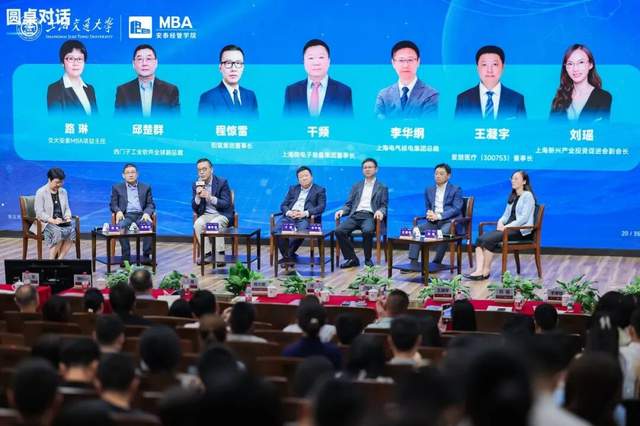
The transformation of intelligent manufacturing requires simultaneously understanding engineering technology, supply chains, and organizational management; AI entrepreneurship requires connecting product development, business models, capital resources, and market demand; and enterprises going global involves global markets, technological competition, cross-cultural organization, and business decision-making.
If the goal of talent development is to solve these problems, business schools must proactively break their own boundaries.
And Shanghai Jiao Tong University's accumulated strengths in engineering, artificial intelligence, and other disciplines, along with Antai's long-established industrial research, technology finance, and alumni ecosystem, precisely provide the foundation for this kind of cross-disciplinary training at the SJTU Antai MBA.
Co-creating 1000 AI scenarios in ten years: not just bringing AI into the classroom
Beyond the philosophy, the reform also needs to find concrete footholds.
A 2026 initiative announced by Antai MBA at Shanghai Jiao Tong University has quite the flavor of the AI industry:
the 100 Industries, 1,000 Enterprises 10×100 AI Scenario Co-Creation Initiative。
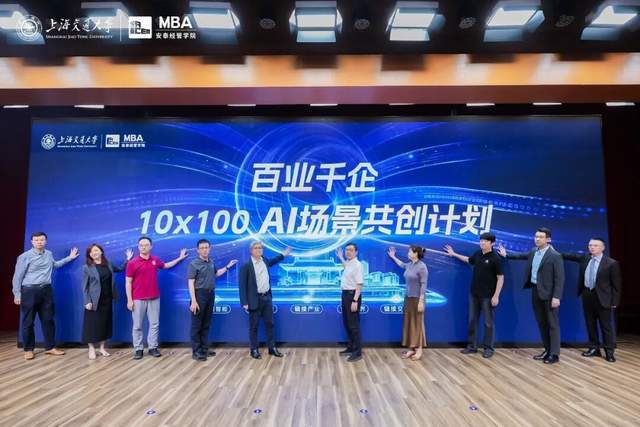
According to the plan, over the next ten years, Antai MBA at Shanghai Jiao Tong University will join hands with enterprises across various industries to jointly create and implement 1000 dedicated AI real-world project topics.
These are not 1000 classroom exercises in the traditional sense.
The core idea is to make enterprises' real business challenges the starting point of talent cultivation.
In traditional business schools, case teaching is usually built on business events that have already taken place, with students analyzing why a company succeeded or failed at the time.
But in an environment where AI is evolving rapidly, many questions do not yet have mature answers.
How should a manufacturing enterprise redesign its AI-driven production processes? Which stages should an Agent in the service industry take over? How does a tech startup move from a technical prototype to commercialization?
Enterprises may well be searching for solutions to these problems.
If these unresolved real-world problems are brought into the classroom, students will no longer be mere after-the-fact analysts, but will have the opportunity to become participants in the problem-solving process.
To support this model, Shanghai Jiao Tong University, together with relevant industry organizations, research institutions and colleges, has initiated the establishment of an AI-era Business Talent Cultivation Alliance to promote synergy among curricula, scenarios, industrial resources and talent cultivation mechanisms.
And in moving from plan to practice, Antai MBA at SJTU has already made new progress.
On September 6 this year, Antai MBA announced the first batch of AI scenario lists and co-building ecosystem partners for its "Hundred Industries, Thousand Enterprises" initiative, reached a strategic cooperation with the AI open-source learning community Datawhale, simultaneously launched the FDE talent specialized cultivation program, and released "AI+X" practical training courses and selected FDE courses.
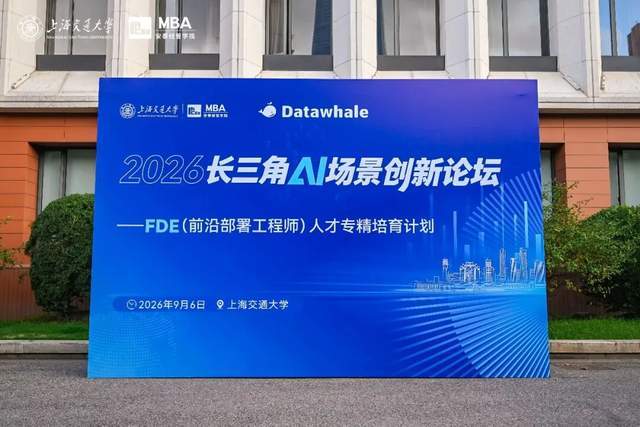
These measures will further connect enterprise needs, technological capabilities, practical cases with the Antai MBA curriculum.
Particularly noteworthy is that this cultivation system of Antai MBA places special emphasis on three kinds of hands-on capabilities:
AI4O, FDE and OPC。
AI4O, namely AI for Operations, emphasizes using AI to understand and optimize enterprise operations, so that technology truly translates into operational efficiency and business value.
FDE focuses on engineering implementation, requiring the ability to go deep into the industrial field and transform business problems into deliverable, verifiable AI solutions.
OPC, namely One Person Company, points to new forms of entrepreneurship and business operation empowered by AI, emphasizing full-stack business capabilities from product and market to operations.
The three focus on different scenarios, yet they point to a common question:
How can AI technology truly create value?
From enterprise operations, to engineering deployment, to entrepreneurial management, the challenges new business talent must face are no longer just single tasks within traditional functional divisions.
This also explains why the reform of Antai MBA extends the classroom to the industrial frontline, science and innovation parks, R&D bases and laboratories.
After all, understanding how a model works and driving an AI project to land in a real enterprise are two different challenges.
True capability formation needs to be tested on the industrial front line.
A systematic upgrade from training objectives to curriculum mechanisms
Of course, for a business school to truly adapt to the AI era, a few new concepts or a few additional courses are far from enough.
The cultivation approach itself also needs to change.
In this round of reform, Antai MBA has simultaneously introduced a series of cultivation adjustments for the 2027 cohort.
These include:The length of study is uniformly adjusted to 2 years, implementing a flexible credit system of 40—50 credits, with practical courses accounting for no less than one quarter of total class hours.。
In terms of teaching arrangements, the part-time program of Antai MBA adopts a weekend class model; the full-time CLGO program adopts Chinese-language instruction with 4—5 concentrated days per month.
Behind these changes lies a rethinking of the relationship between career development rhythms, learning needs and industrial practice.
For managers already on the industrial front line, the most urgent need may not be to temporarily leave the business scene and receive a relatively fixed set of knowledge training in a concentrated period.
They need all the more to bring the industry problems they are currently experiencing into the classroom, and then take the new methods from the classroom back to their work and practice.
Meanwhile, Antai MBA at SJTU continues to set up training tracks around different career development needs.
The AI MBA focuses more on the integration of AI and business management, the Technology Finance MBA connects technological innovation with financial resources, CLGO emphasizes interdisciplinary training in engineering and operations management, while the IMBA focuses on global business vision and international management capabilities.
On top of these different tracks is the shared, constantly expanding ecosystem of intelligence, sci-tech innovation, industry, and global resources of Antai MBA at SJTU.
From this perspective, the reforms to the academic system, credits, and curriculum are not merely changes to the teaching system.
The deeper change lies in this:MBA education is attempting to shift from relatively fixed knowledge transmission toward continuous capability building oriented toward real industry needs。
and judging whether this reform succeeds ultimately still comes down to the industry front line.
Can students identify business problems worth solving? Can they make cross-disciplinary teams collaborate effectively? Can they turn technical solutions into real business results?
These capabilities do not form automatically just because someone has taken a course.
They must be honed through repeated practice, judgment, and review.
This also means that business schools need not only to understand the latest technological changes, but even more to continuously receive feedback from industry.
In the AI era, what may truly be scarce are "the people who define problems"
Returning to the original question.
As AI grows ever stronger, what will future business leaders still need to do?
Perhaps part of the answer can be found in that AI strategy hands-on workshop held by Antai MBA at SJTU.
When models can already analyze complex data and compare large numbers of options, what people truly need to do is identify business goals, understand the costs of different decisions, and make choices amid uncertainty.
More crucially, to get these choices accepted and executed by the organization and ultimately produce results.
Technical capability determines what an enterprise can do, while business judgment determines what it should do.
Today, we see AI lowering the barriers to code development, content production, product design, and even entrepreneurship.
But low barriers do not mean low complexity.
As more and more people can use AI to possess productive capacity that once required an entire team, the value of understanding needs, organizing collaboration, building trust, and taking responsibility will instead become more prominent.
For technical talent, future career advancement may involve not only moving from engineer to more senior engineer, but also moving from solving technical problems to defining business problems, and from managing a project to coordinating an industry scenario.
For business managers, AI is no longer an elective course that can be handed off to the technology department; it is becoming a fundamental capability for understanding how future enterprises operate.
This is precisely the question of our times that this round of training reform at Antai MBA at SJTU responds to.
From the AI Manifesto to the Five-Chain talent cultivation system, from the Hundred Industries and Thousand Enterprises scenario co-creation to AI+X practice courses, and then to the systematic adjustments of the academic system, credits, and training mechanisms, Antai MBA at SJTU is attempting to answer a longer-term question:
As technology keeps evolving, what kind of people should business schools cultivate for the future?
The answer is not to turn all managers into algorithm experts, nor to make everyone chase the latest AI tools.
Rather, it is to cultivate a group of versatile business leaders who understand technological innovation while being rooted in real industries, who possess a global vision while being able to make independent judgments.
AI can provide more and more answers。
but it is still people who decide what questions should be asked, which direction to choose, and who bear responsibility for the final results.。
Perhaps this is the core value that business education in the AI era truly needs to hold onto, and that is most worth redefining.
*This article is republished by QbitAI with authorization; the views belong solely to the original author.