
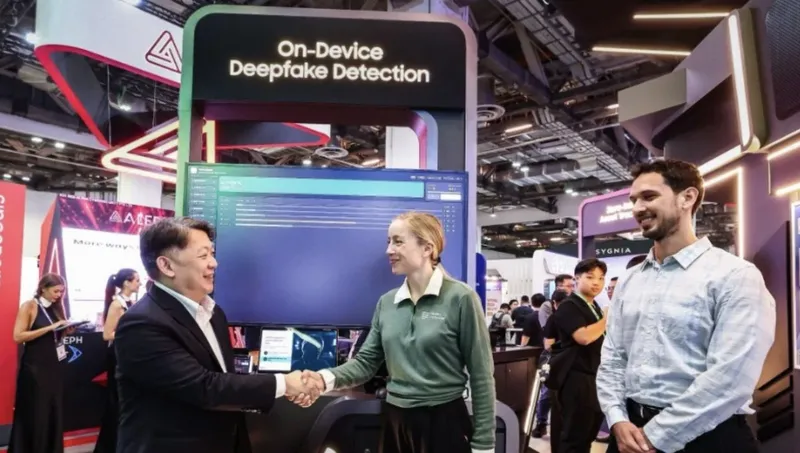
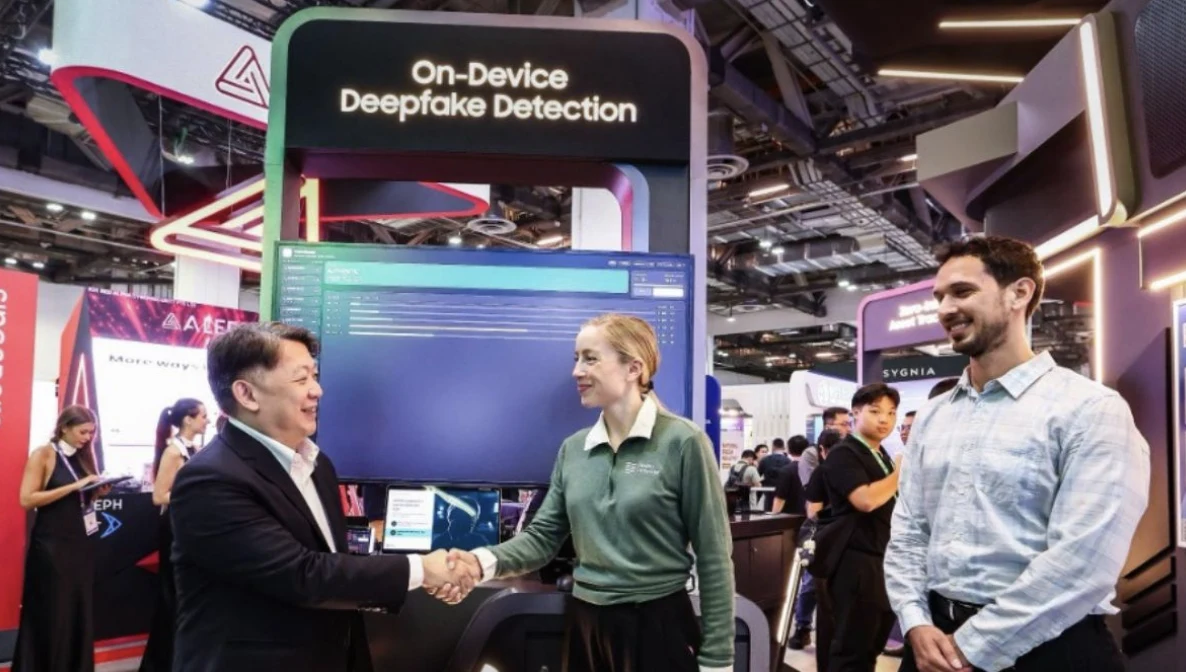
IT Home On October 16, Samsung announced a collaboration with deepfake detection company Reality Defender to develop on-device AI deepfake detection solutions for enterprise users. The solution will run directly on Samsung Galaxy devices, helping companies identify AI-generated fake voices, videos, and images, reducing impersonation scams and other related risks. It is planned to be launched in the Singapore market first.
According to IT Home, Reality Defender focuses on enterprise-level deepfake detection. It uses various AI models to analyze voice, video, and image content in real time. For example, this technology can identify synthetic voices pretending to be others during real-time calls, and it can also be used for customer identity verification and new user registration review, helping enterprises detect suspicious fake content.
Reality Defender states that with the development of generative AI technology, cases of fraud using synthetic voices and videos are receiving increasing attention. Surveys show that in 2024, 56% of companies in Singapore experienced audio deepfake fraud, while 52% of companies encountered video deepfake-related incidents.
Individual users also face economic losses caused by such scams. Data shows that in 2025, victims in Singapore affected by scams involving fake government officials lost at least 242.9 million Singapore dollars, which accounted for 26.6% of the total annual scam losses in the country.
Timothy Tan, Director and Head of the Integrated Business Department at Samsung Electronics Singapore, said that Samsung hopes through this collaboration to help enterprises detect potential threats earlier. The two parties plan to develop practical on-device deepfake detection solutions so that potential risks can be identified before the relevant data is uploaded to the cloud for processing.
A major focus of this collaboration is to carry out the detection process locally on the Galaxy device. Compared to solutions that rely on cloud-based analysis, this approach is expected to reduce the need for sensitive data to be transmitted to external servers, thereby lowering the risk of data leakage. Samsung also plans to use the Knox security platform to protect the relevant functions. Knox covers multiple security aspects from the chip’s underlying layer to the application layer.
Currently, Samsung has not announced the exact launch date for this solution, nor has it revealed which Galaxy models will be supported. At present, the project is primarily aimed at Singaporean business users, and it is expected to help local businesses avoid AI fraud risks in the future.