
By Heng Yu, from QbitAI
QbitAI | Official Account QbitAI
The world model track continues to attract the brightest minds.
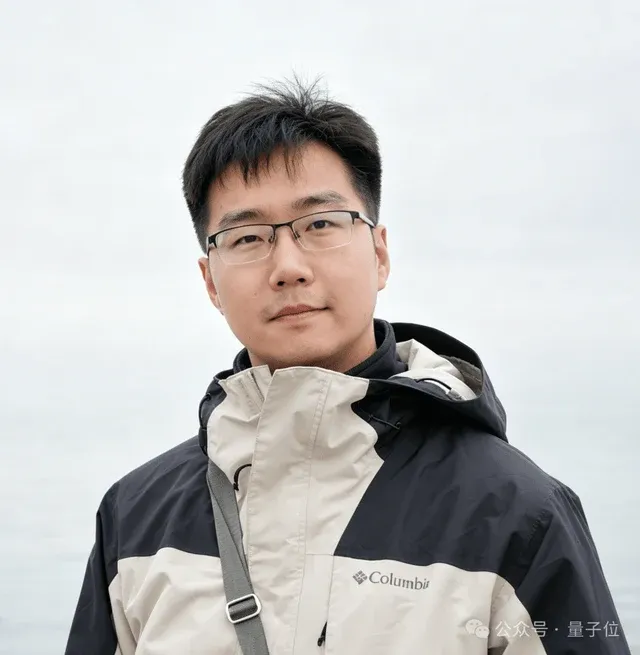
QbitAI has learned thatWu Haixu, who won the Tsinghua Special Scholarship in 2022, quietly began his world model startup this year。
The company is named Wuyuan Technology, has rapidly completed multiple rounds of financing to date, and its valuation has reached several hundred million US dollars. Among its investors are top-tier institutions such as Ant Group, Meituan, Dachen Capital, and Xinglian.

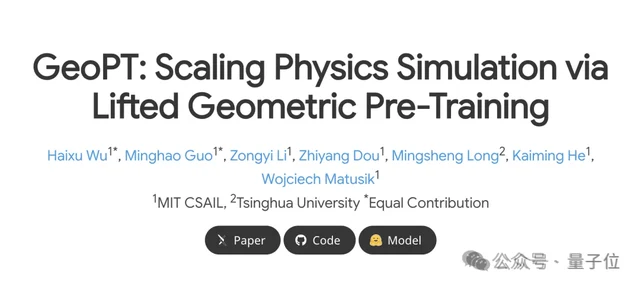
In February this year,GeoPT, a work with Wu Haixu as first author,sparked widespread discussion in the technical community.
The work proposed a brand-new dynamics-enhanced pre-training paradigm that uses Synthetic Dynamics to "lift" static geometry into dynamic space, allowing models to acquire physical intuition by learning the evolution of particle trajectories on unlabeled data.
Among the paper's co-authors are also Long Mingsheng,tenured associate professor at Tsinghua's School of Software(Wu Haixu's PhD advisor), MIT'sKaiming He, and MIT professorWojciech Matusik(advisor of the postdoc project group Wu Haixu joined), among others.
We have learned that with this venture, Wu Haixu chose to start fromworld models equipped with physical modeling capabilities.
According to insiders close to Wuyuan Technology, this approach continues the GeoPT research line to a certain extent in terms of technical thinking.
Who is Wu Haixu?
Wu Haixu entered Tsinghua University's School of Software in 2016 to study software engineering as an undergraduate, and from the following year pursued a second degree in pure and applied mathematics in Tsinghua's Department of Mathematical Sciences.
In the summer of 2019, he worked as a visiting student in Harvard University's Visual Computing Group, advised by professor Hanspeter Pfister.
After completing his undergraduate degree, he began his graduate studies at Tsinghua University's School of Software, advised by associate professor Long Mingsheng.
Long Mingsheng's research group initially focused on Transfer Learning, later shifting its focus to time-series foundation models, spatiotemporal prediction, AI for Science, multimodal world models, and more.
In 2022, Wu Haixu received Tsinghua's Special Grade Scholarship.
The prestige of the Tsinghua Special Scholarship is well known: Yang Zhilin of Moonshot AI, Chen Lijie of OpenAI, Yao Shunyu of Google (rumored to have left to found RSI), Cao Yue of Sand.ai, Liu Songming of LiberAI, and others have all received this award.
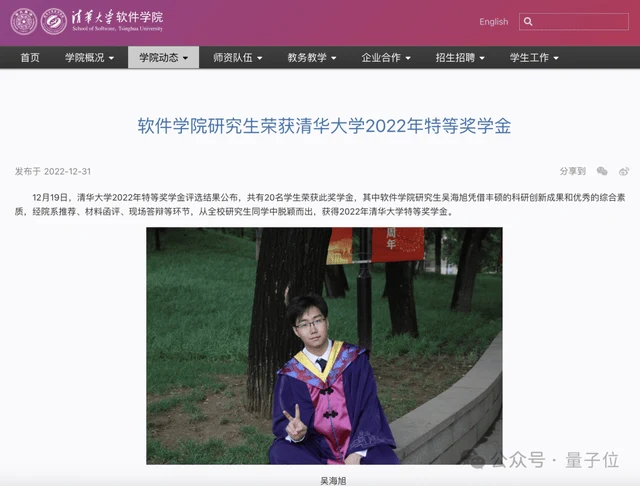
By the time of his Special Scholarship defense, Wu Haixu had already published 7 papers at CCF-A conferences/journals such as ICML, NeurIPS, and IEEE TPAMI, including 6 as first author/co-first author.
At that time, his core research achievement was Autoformer, a work that for the first time systematically and deeply integrated the idea of series decomposition with an improved attention mechanism, and is regarded as a milestone model for long-term time-series forecasting (LSTF).
After Autoformer, he published works such as PredRNN, Corrformer, Transolver, and GeoPT.
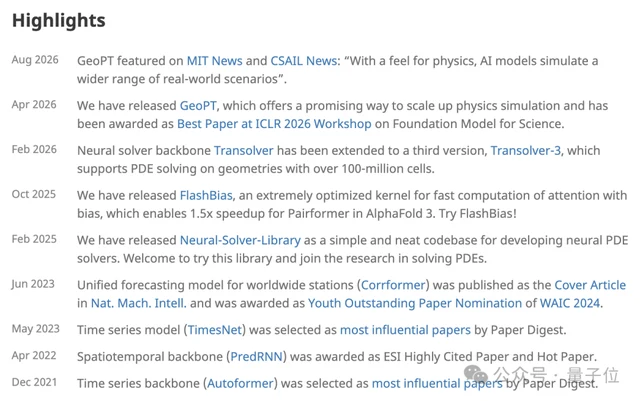
Starting in 2025, hewent to MIT CSAIL to do postdoctoral work, and GeoPT is his representative work from this period.
During this time, Haixu Wu's postdoctoral advisor Wojciech Matusik is a well-known scholar in the field of computational design and fabrication. His research spans multiple directions including computer graphics, computational fabrication, and robotics, and is dedicated to using algorithms to connect the digital world with physical manufacturing.
Haixu Wu's current personal homepage states that hisresearch focuses primarily on deep learning and scientific machine learning, with the goal of building scalable principles for physical systems。
His research centers on two major themes, physical systems and dynamical systems, and is mainly divided into the following three directions:
Physics-principle-based scalable backbone networks (Autoformer, Corrformer, Transolver)
End-to-end physical foundation models (TimesNet, Unisolver, GeoPT)
Domain-aware scientific learning systems (Flowformer, Transolver++, FlashBias)
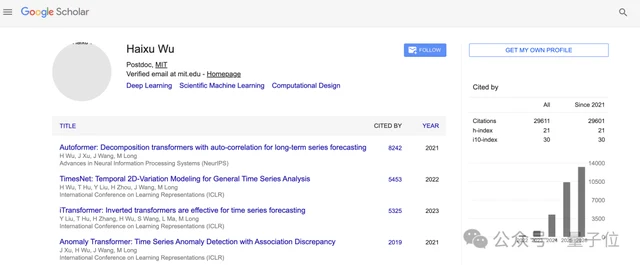
As of now, Haixu Wu'sGoogle Scholar citation count is 29611。
Reference links:
[1]
https://wuhaixu2016.github.io/
[2]
https://scholar.google.com/citations?user=oLL_x0wAAAAJ&hl=en
[3]
https://people.csail.mit.edu/wojciech/
[4]
https://www.thss.tsinghua.edu.cn/info/1023/2032.htm