
01 All three benchmarks top the list, Thinker-WM won three first places
Recently, Yibaixian Thinker-WM won first place in all three recognized world model benchmarks for embodied intelligence, improving industry performance:
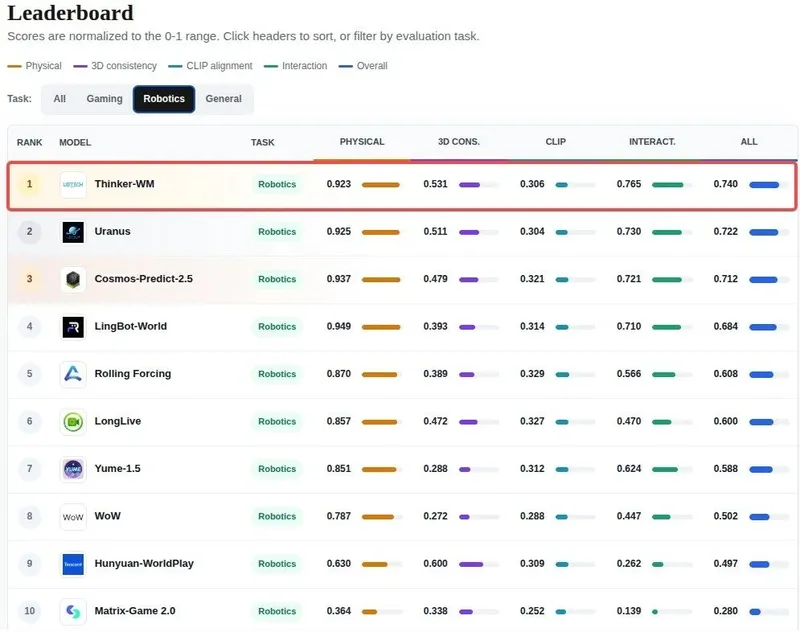
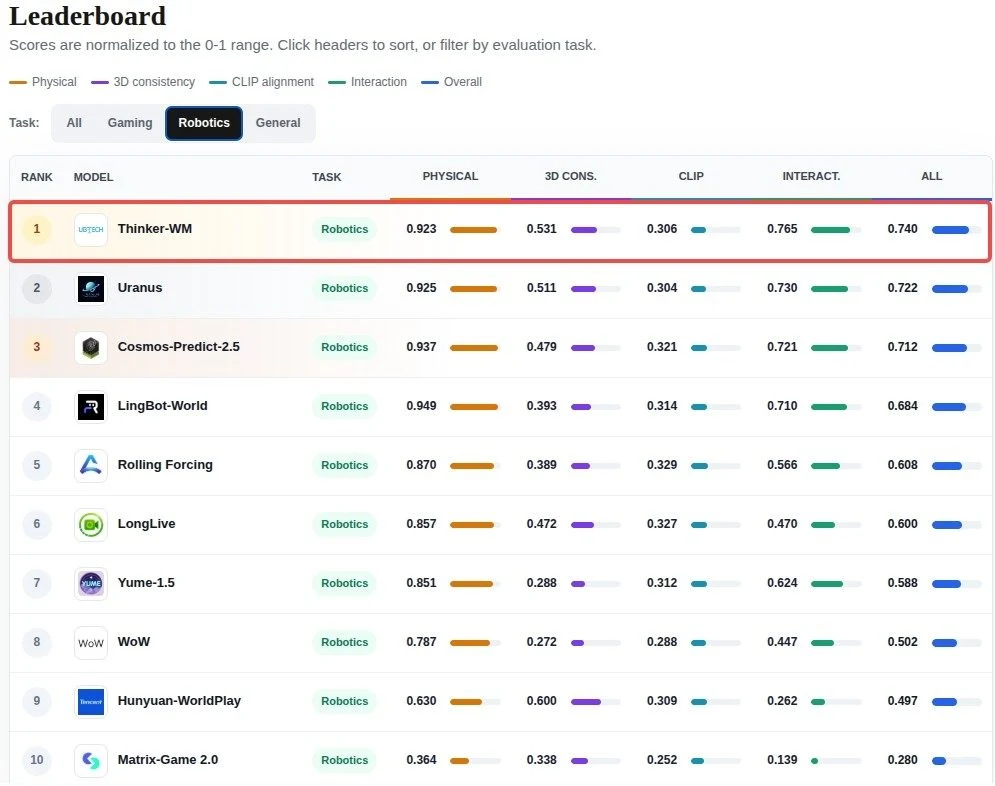
WorldOlympiad:
Thinker‑WM achieved a comprehensive score of 0.740 and ranked first. This benchmark is based on a large amount of real robot interaction data, covering more than ten different robot models and various camera configurations. It focuses on evaluating the model’s generalization ability across robot forms and perspectives. The model scored 0.531 in 3D consistency and 0.765 in interaction fidelity—both individual metrics ranked first among all evaluated models, reflecting the model’s precise modeling ability for three-dimensional geometric structures and robot interaction processes.
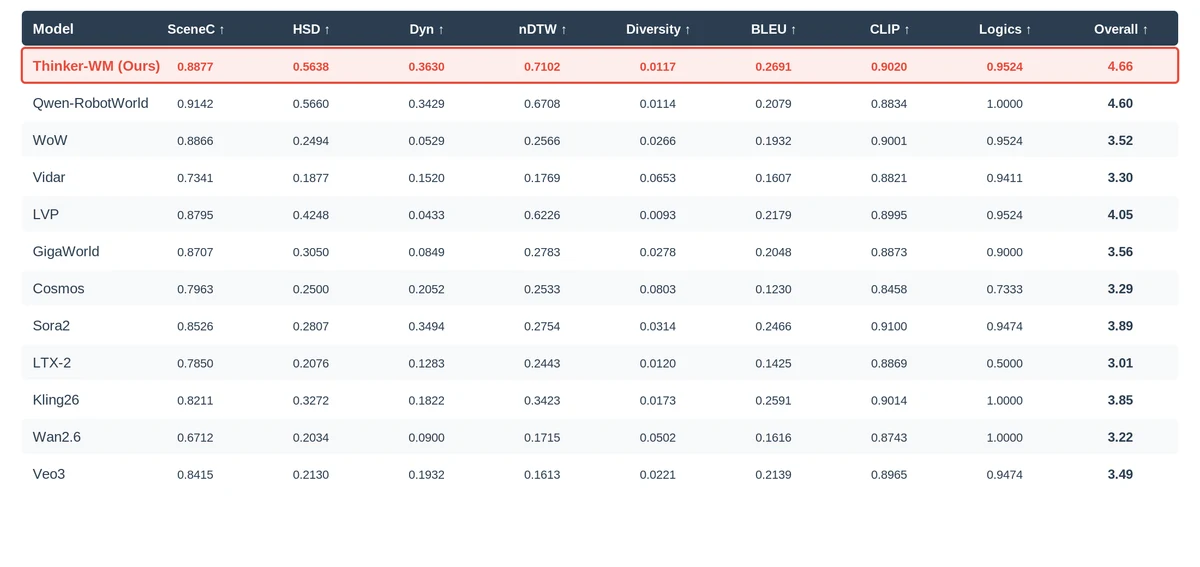
EWMBench:
Thinker‑WM achieves a total score of 4.66, surpassing mainstream models such as Qwen‑RobotWorld and Sora2. EWMBench evaluates three key capabilities: consistency in the full assessment scenario, correctness of the robot’s end-effector motion, and semantic alignment of commands. Thanks to multi-modal joint modeling at the representation level, Thinker‑WM leads in core robot motion metrics such as nDTW (normalized dynamic time adjustment) for reflecting the spatiotemporal matching of robot trajectories, and Dyn (dynamic consistency) for the reasonable representation of motion speed and acceleration.
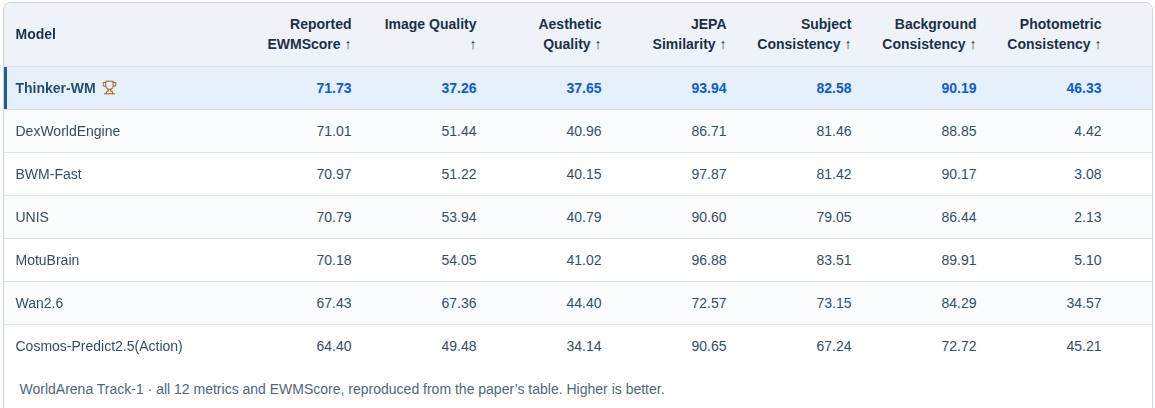
WorldArena1.0 Track-1:
In the simulation environment benchmark WorldArena Track‑1, Thinker‑WM leads overall in 12 key evaluation dimensions—visual quality, content consistency, physical plausibility, 3D geometric accuracy, and instruction compliance—while ensuring both visual generation quality and physical interaction credibility within the simulation environment. Thinker‑WM is centered around the Unified Dynamic Transformer (UDT) with unified representation layers, integrating RGB images, metric depth, and robot actions into a single shared dynamic representation evolution system. This enables combined video-action generation, world prediction, strategy reasoning, video-to-action conversion, inverse dynamics, and other capabilities, providing a new generation of foundational world model foundation for embodied intelligence.
02 Thinker-WM technological breakthrough: Achieving multi-modal unity in vision, geometry, and motion at the representation level
The most difficult task for robots to implement in the real world is not identifying objects in front of them, but predicting the next change in the environment. This is also the value and significance of the world model. In the past, world models generally used a “stitching” approach: the video generation module handles the images, the policy network handles the actions, and geometric prediction handles spatial information. The modules calculate independently, and then they are combined through interfaces to produce the final output.
But the problem with this technical model is that actions change the environment, and the environment constrains actions; the geometric structure affects both simultaneously. Signals that are physically tightly coupled are split into different modules, losing their inherent causal relationship.
For example, “a cup being pushed off the table” is a single sentence description in language, a series of joint commands in action, a sequence of object movements in video, and a set of continuously changing distance fields in depth. These four expressions refer to the same event, not four different objects. Therefore, requiring the model to generate any one of them is essentially asking about the same process.
But this overlap is also incomplete. Actions carry neither appearance nor context; the same joint commands have completely different meanings when placed on a empty table versus a messy table. Language also lacks spatial and temporal details—the sentence “the cup is pushed off the table” doesn’t specify which side to push from, how much force to use, or the speed of the push, nor does it specify the exact trajectory of the hand, how many times the cup flips, or where it ends up. The video does not carry explicit geometry and measurements; it uses a series of pixels to represent it, so neither the size nor the distance of the cup is known. Depth also lacks any appearance, naming semantics, or intention. It only indicates where the surface is, how it covers something, and how it touches, but does not tell you whether it is a cup or a tablecloth, nor why it should be pushed.
Regarding this issue, the Thinker team from U必选 offers a new solution: instead of simple merging at the interface level, multi-modal unity is achieved at the representation level. Thinker-WM (Thinker World Model), as a unified multi-modal world model developed by U必选, encodes RGB video, depth, and robot movements into the same intermediate representation space, relying on a set of shared parameters for joint evolution. Appearance, geometry, and movement are no longer three independent pipelines, but rather three forms of expression in the same world evolution process. That is to say, the underlying design logic of Thinker-WM can be summarized as follows: different modalities are different expressions of the same process; the model aligns them into a shared representation space and reasoning occurs on this shared representation, rather than making conditional combinations at the modality interfaces.
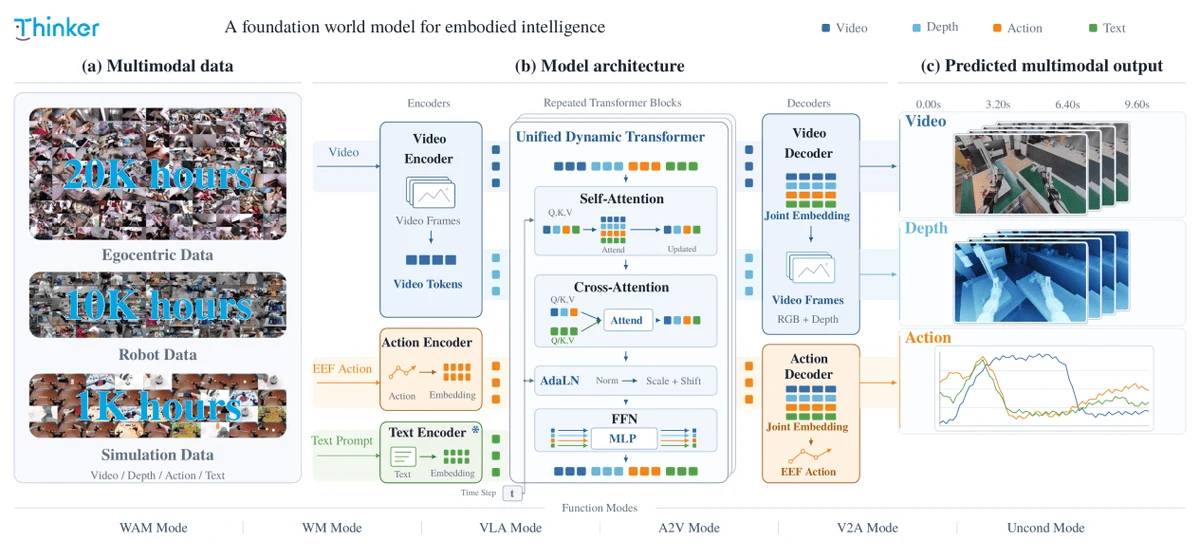
Thinker-WM: A unified modeling framework for vision, geometry, and motion
Specifically, the RGB image, depth information, and robot actions are mapped into a unified potential space by their respective encoders, and then sent to the shared Unified Dynamics Transformer (UDT) for joint temporal modeling. Finally, the respective decoders restore the output video, depth map, and robot executable actions. This means that multi-modal interaction occurs within the Transformer. Visual tokens, geometric tokens, and action tokens exchange information directly through the same attention mechanism, rather than being superficially concatenated in the input or output layers.
Geometric information is no longer just an auxiliary supervision signal. Thinker-WM uses depth as a native generation modality, sharing the same potential topology and spatio-temporal organization as video. Depth supervision directly shapes shared representations, making the physical space structure the “native language” of the world model, rather than a later supplementary module, thereby helping humanoid robots to understand the physical space more accurately. The value of unified modeling is also reflected in the actual performance of the robot. In the RoboTwin single-task ablation experiment, after introducing the depth modality, the operation success rate increased by 15 percentage points compared to the depth-free baseline, indicating that spatial geometric information not only helps the model understand the scene but also improves action generation and task execution.
03 30,000 hours of heterogeneous data, enabling a model to unlock six capabilities
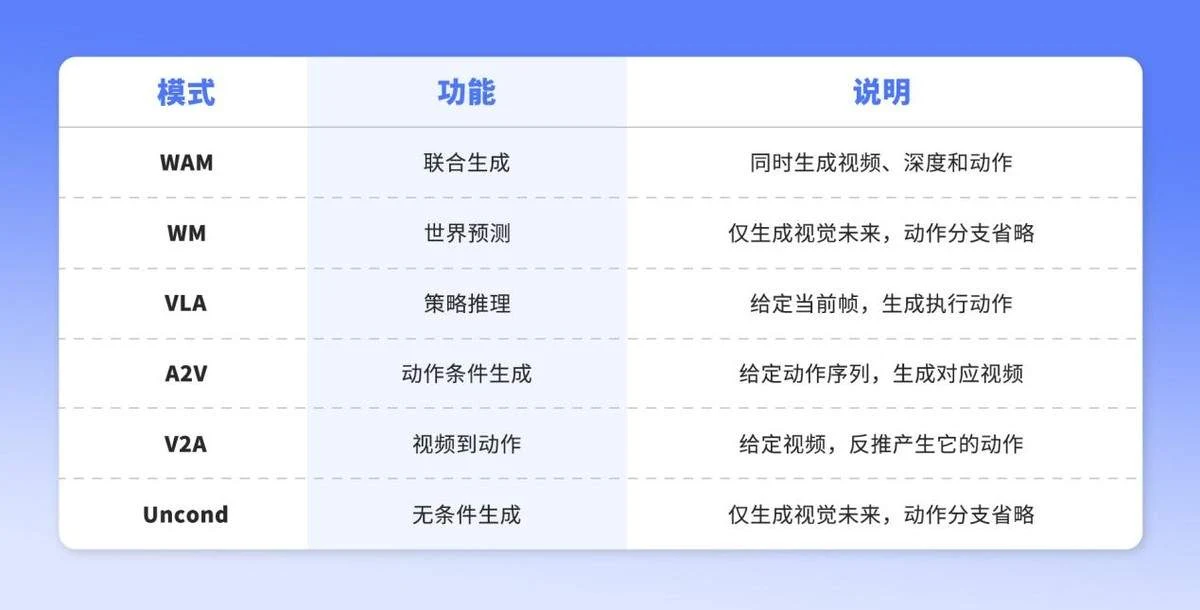
Based on multi-modal unified representation, all modalities share the same set of parameters. Thinker-WM can flexibly switch between conditional and generative modalities, supporting six capability modes.
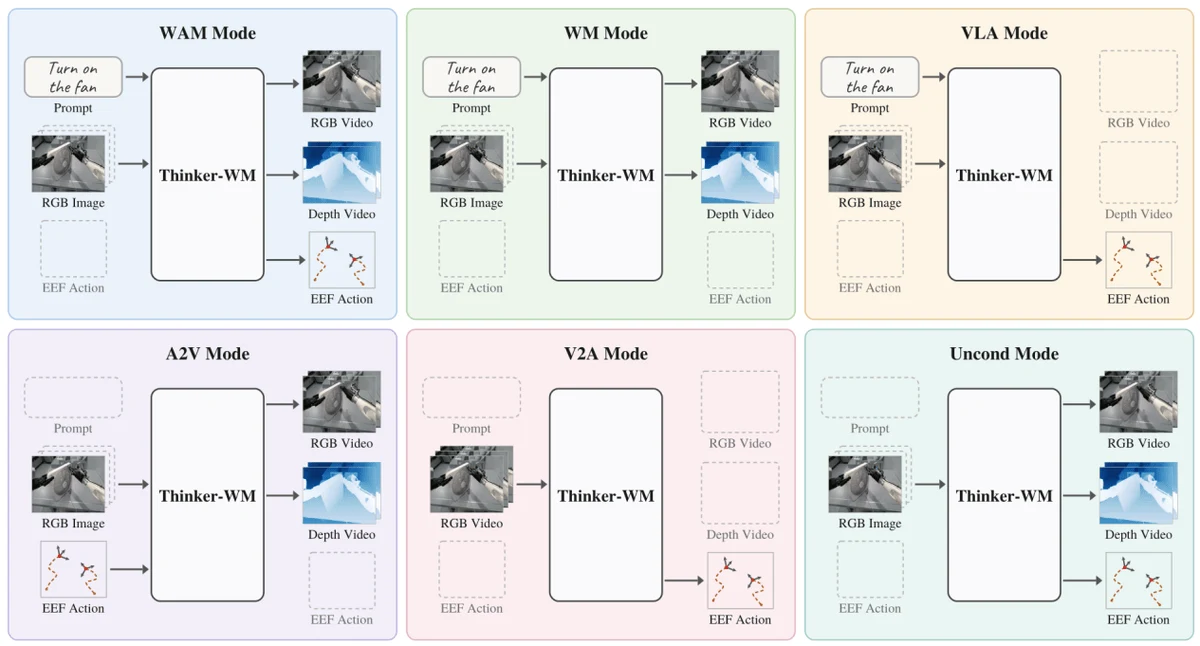
The same weight can predict and imagine future scenes, reverse-engineer the robot’s execution trajectory, and extract action information from videos. This is the core technical advantage brought by unified representation.
04 30,000 hours of heterogeneous data, supporting the foundation of the Universal World Model
Behind the unified representation capability is the support of rich-scale and diverse training data from Yobytai. The Thinker-WM training corpus has a considerable volume in the field of embodied intelligence:
- Approximately 20,000 hours of first-person human video: Covering home, commercial retail, and industrial scenarios, it addresses the diversity of tasks, objects, and environments that are difficult for robots to achieve at low cost through remote operation. It is also accompanied by approximately 1,000 hours of depth alignment data.
- Approximately 10,000 hours of real robot data: From various robot forms, providing paired supervision of visual observations and executable actions, with approximately 3,000 hours of depth annotation for alignment.
- Approximately 1,000 hours of simulation data: Provides high-precision geometric and physical supervision signals.
The action spaces, coordinate systems, and control protocols of different robots vary greatly. The unified concept of Thinker-WM is applied not only to the model framework but also to data selection. This model uses end pose representation for all robot actions, while embedding exclusive tags in tokens for each individual robot. In this way, robots of different shapes can share the same generation space, while maintaining precise body control capabilities.
05 Data Infra: Enabling massive heterogeneous data to efficiently support unified model training
To transform massive data into model capabilities, a stable and efficient data infrastructure is essential. In response to the differences in format, modality, and annotation among various robots, human video, and simulation data, the U-Bright Thinker team has established a Data Factory. This system decouples data management from training sampling, allowing multi-source data to be flexibly combined according to model requirements.
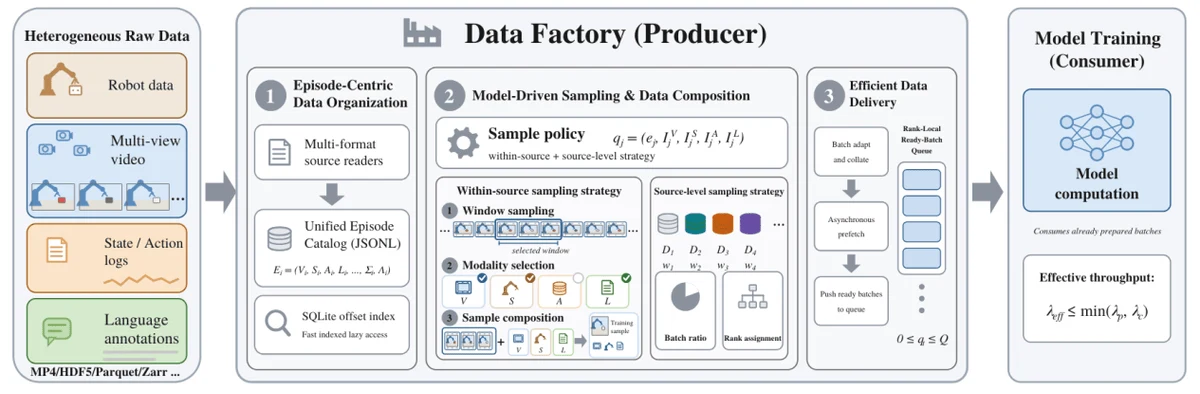
Data Factory: From heterogeneous data from multiple sources to unified model training
Data Factory supports training around three key aspects: Unified Organization of video, status, actions, and language information, generating samples required for different training modes as needed; Layer-by-layer Quality Inspection to filter out abnormal segments and verify depth alignment with the video, ensuring reliable training signals; Asynchronous Pre-fetching and Encoding Reuse to prepare training data in advance, reducing waiting time and redundant calculations.
This data infrastructure enables multi-source heterogeneous data to be reliably organized, flexibly accessed, and efficiently provided, providing engineering support for the joint training and continuous iteration of the six capability models of Thinker-WM.
06 Through the Motion Probe experimental design, lightweight experiment: verifying real coupling in cross-modal representation
On the representation level, unified multimodal features seem to be an innovative approach in architecture design. However, there is a core question: does the model actually learn the coupling relationships among vision, geometry, and motion in the shared space, or does it simply process multiple streams of information in parallel and simply combine different modalities together?
To answer this question, the U必选 Thinker team designed a lightweight Motion Probe verification experiment. The research team attached a very small motion prediction head to the frozen UDT visual representation and trained only this head, to see if the displacement of the end effector could be recovered from pure visual representations.
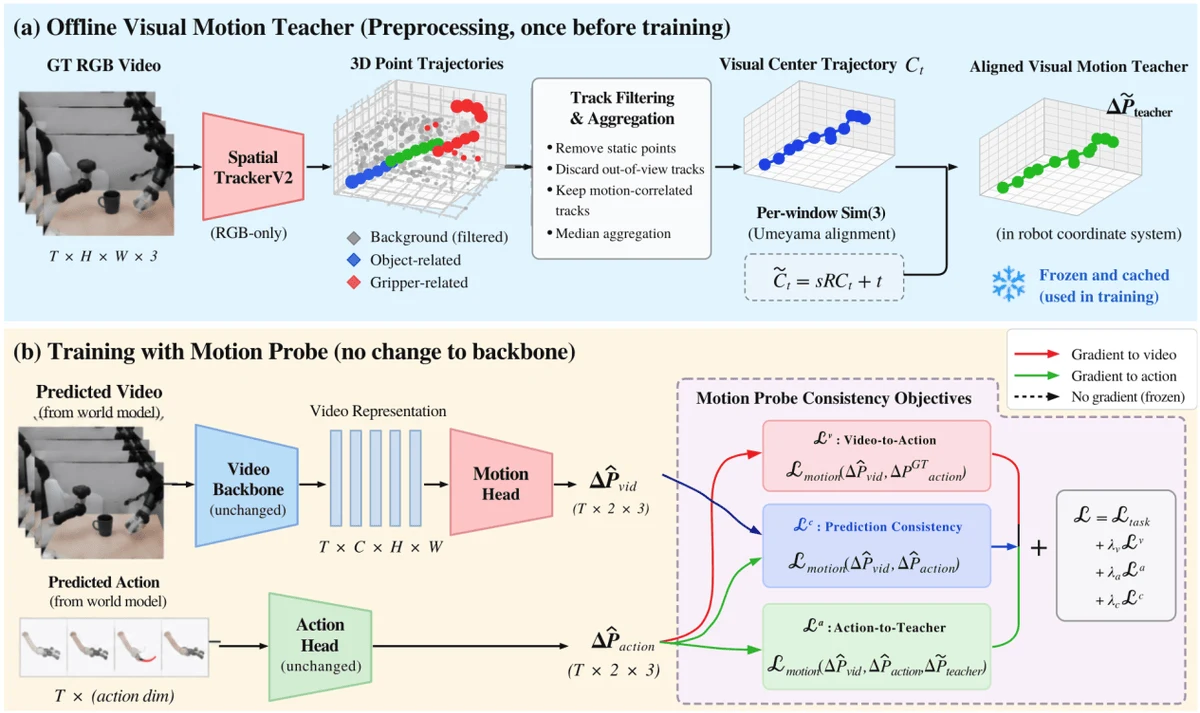
Motion Probe Diagram
The experimental results confirm the hypothesis: the probe prediction error is very low. Even without action supervision, motion information related to actions is already encoded in the visual representations. This result directly proves that multi-modal unity at the representation level actually works effectively. Visual perception and action planning are not two independent pathways, but rather achieve deep coupling in a shared potential space.
07 What Does This Mean
This also further shows that the technological breakthrough of Thinker-WM is worth far more than just achieving a top ranking. It indicates a new underlying paradigm for the embodied world model:
The world model of embodied intelligence should not be a simple combination of “video generator + strategy head”, but a complete and unified generation process—visual observation, spatial structure, and action planning are different expressions of the same physical world process.
When a robot can synchronize the changes in the display, spatial structure, and motion trajectory within the same representation space, its understanding of the causal logic of the physical world advances significantly. This is also the key leap that enables a robot to move from “performing tasks” to “understanding the real world”.
Thinker-WM has now completed the deployment verification on the U-Bite robot platform. The related technology will continue to empower the next generation of embodied intelligent systems.
The Thinker-WM exploration will not be limited to this release of results. The model technology report and subsequent iteration versions will continue to be updated on the U-Boot Robot official embodied intelligence developer community, Thinker Cosmos; the world model secondary development capability open plan and the technical interpretation live broadcast announcements will also be announced to developers immediately. Welcome to join Thinker Cosmos (https://thinkercosmos.ubtrobot.com/) and jointly build an embodied intelligence ecosystem.
Project link
Paper link: https://arxiv.org/abs/2610.18447
Project address: https://thinkercosmos.ubtrobot.com/thinker-wm
Github: https://github.com/UBTECH-Robot/Thinker-WM
Huggingface: https://huggingface.co/UBTECH-Robotics/Thinker-WM
This article is provided by U-Bite, and Qbit has been authorized to reproduce it. The views belong to the original author.