
Yunzhong, reporting from Aofeisi
Quantum Bit | Official Account QbitAI
Wow, even a former Boston Dynamics executive has been completely captivated by a Chinese robot.
Recently, a post went viral in the robotics community.
The poster, Marc Theermann, is no ordinary figure — he spent nearly six years at Boston Dynamics, rising to Chief Strategy Officer, during which he helped drive the large-scale commercial rollout of the Spot quadruped robot and went through the entire journey of the Stretch handling robot from launch to commercial sale, making him a top-level operator in robot commercialization.
The somewhat "special" robot he liked comes from ZheJiangshen Chenkai Technology Co., Ltd.。
Founded in March 2025 in Shaoxing, Zhejiang, by a company listed on the A-share marketDaqian EcologywithDr. Xuan Dongwas co-initiated by the leading research team. Xuan Dong formerly served as a tenured professor at Ohio State University in the United States.
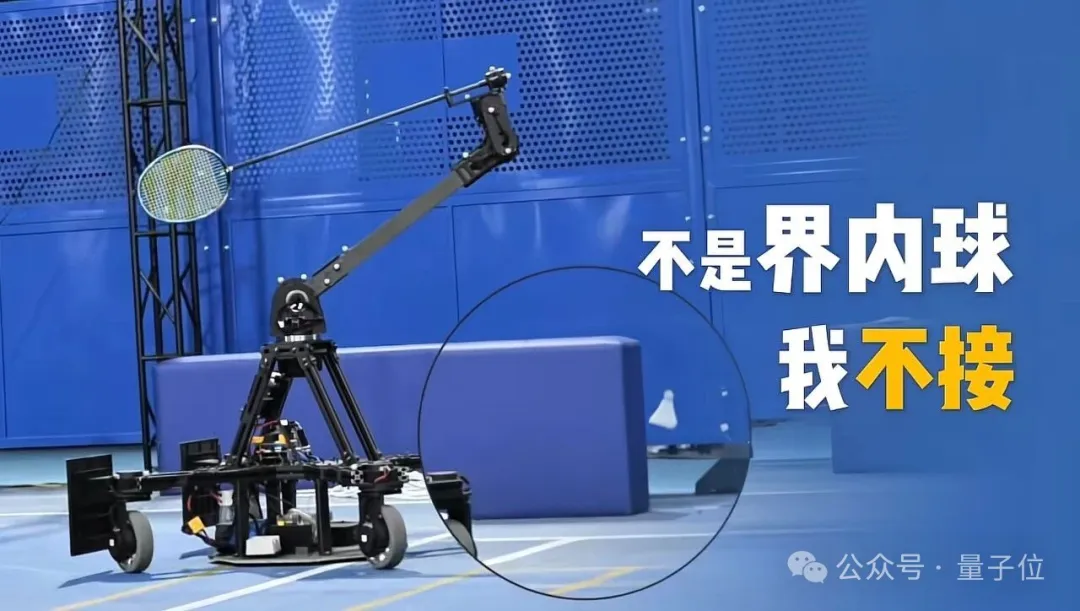
So, how could a robot earn explicit praise from a former Boston Dynamics executive? What kind of technology lies behind this post?
What does this post actually say
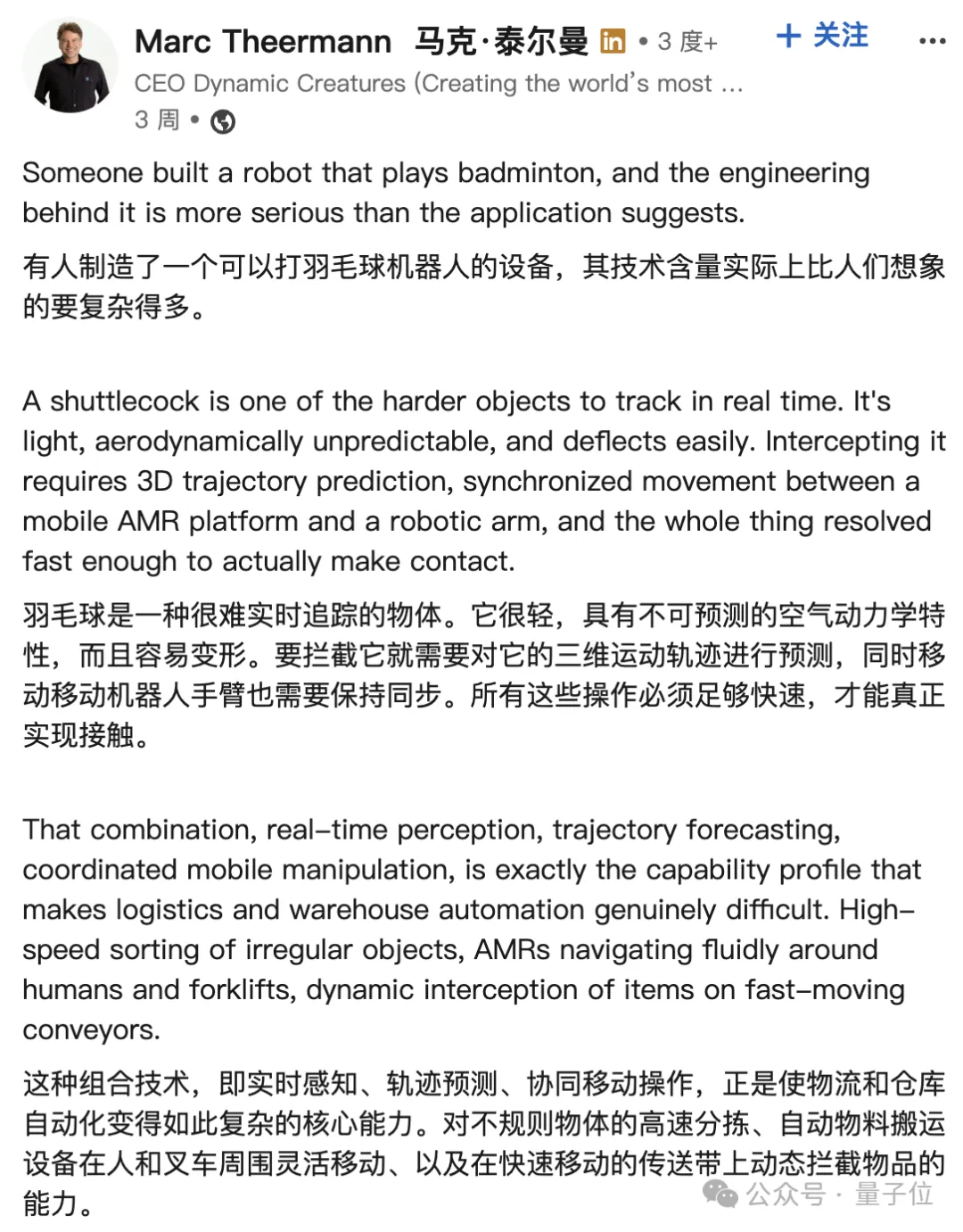
Theermann's review was less of a compliment than a professional teardown.
He wrote in the original text as follows:
Badminton shuttlecocks are a type of object that is very difficult to track in real time. They are extremely light, their aerodynamic trajectories are hard to predict, and they are prone to deflection.
To successfully intercept a badminton shuttlecock, you need to3D trajectory prediction enables the mobile AMR platform and the robotic arm to move in sync, while it must also complete the entire set of calculations and control fast enough to actually hit the shuttlecock.
In his view, this combination of capabilities — real-time perception, trajectory prediction, and coordinated operation between mobile platforms and robotic arms — is precisely where the true difficulty of logistics and warehouse automation lies.
For example, high-speed sorting of irregularly shaped objects; enabling AMRs to move flexibly among people and forklifts; and dynamically intercepting items on high-speed conveyor belts.
In other words, in his eyes, being able to play badminton is an outward manifestation of a set of hardcore engineering capabilities.
Starting from badminton, building a general-purpose physics motion platform
Shencheng Kaidong set out to build a brain for sports robots—the original intention was not to make a piece of sports equipment, but toBuilding a general-purpose physical motion platform oriented toward the real physical world.
ThisThe core members of the team have long been deeply engaged inRobot motion control, machine vision, and reinforcement learningdirection; the underlying approach is as follows:
The badminton robot is a technical carrier for high-difficulty embodied intelligence, so the team wanted to use the dynamic scenario of badminton to hone the most core capabilities of general-purpose robots.
Ultimately, they hope that this general-purpose physical motion platform, combined with their self-developed robot brain, can achieve a full-chain closed loop of perception, prediction, decision-making, and coordinated execution in a physical world full of disturbances and uncertainties, thereby supporting the development and iteration of motion robots of different forms.
It is worth mentioning that this badminton robot is not a specialized machine built solely for playing badminton, but ratheran application built on top of a general-purpose physical motion platform.。
This platform consists of two parts:
- the hardware layeris a reusable mobile chassis, joint motor drives, and a multi-degree-of-freedom racket arm;
- the software layeris Shenchekaidong's self-developed robot brain — responsible for real-time perception, trajectory prediction, motion decision-making, and whole-body control.
Badminton is simply the platform's most eye-catching real-world application at present.
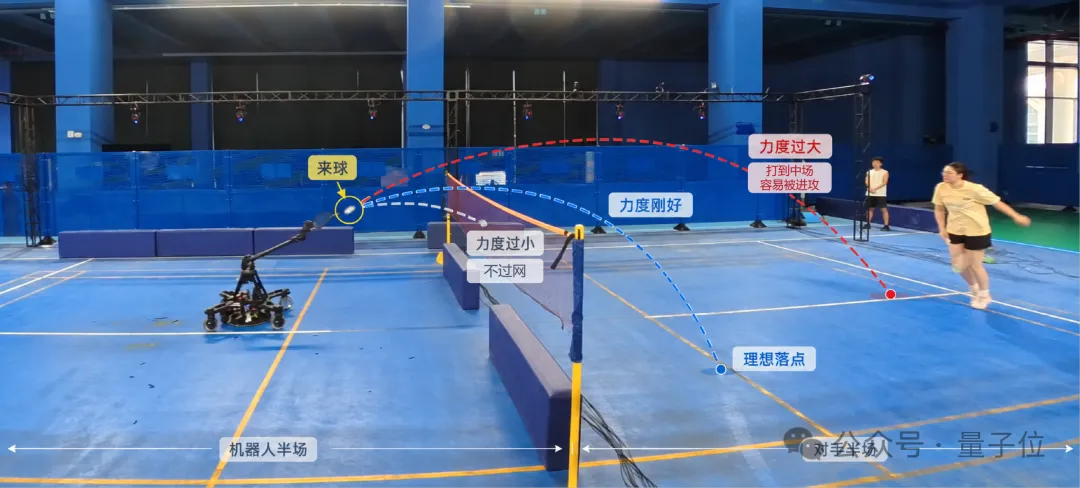 △ Experimental scene of the Shenchekaidong badminton robot rallying with a real person
According to public reports, this robot can identify an incoming shuttlecock in about 0.5 milliseconds, with a swing speed of up to 30 meters per second and a smash speed exceeding 250 kilometers per hour; from the robot body and motion control to visual perception and AI algorithms, the team claims to have achieved full-stack independent development and holds more than 100 domestic and international patents.
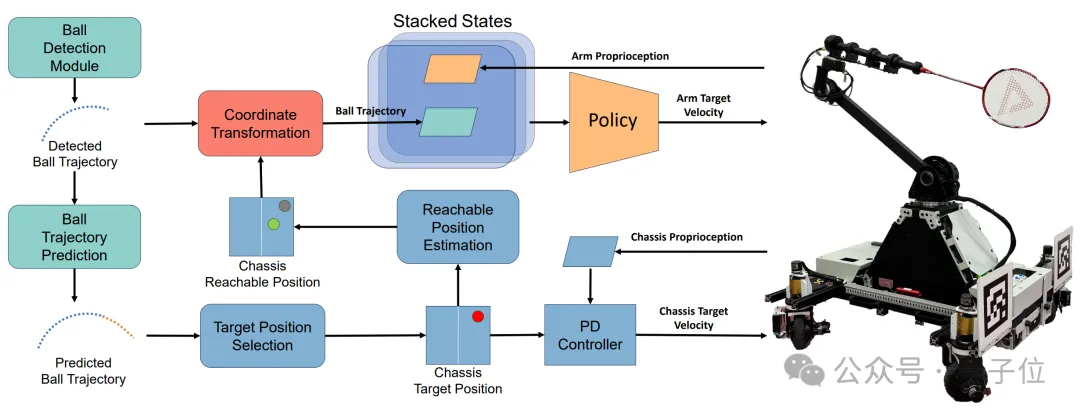 △ System architecture and control flow of the badminton robot
As early as 2022, the same team published the VaRSM system at ICCPS, the flagship conference in the field of cyber-physical systems. It is reportedly the world's first autonomous robot capable of playing three racket sports simultaneously: table tennis, tennis, and badminton.
In 2025, its related whole-body control results were presented at ICRA, the top robotics conference, achieving a 94.5% success rate at returning balls from a ball machine and a 90.7% success rate in continuous rallies with real humans.
A Guinness record: 1452 claps
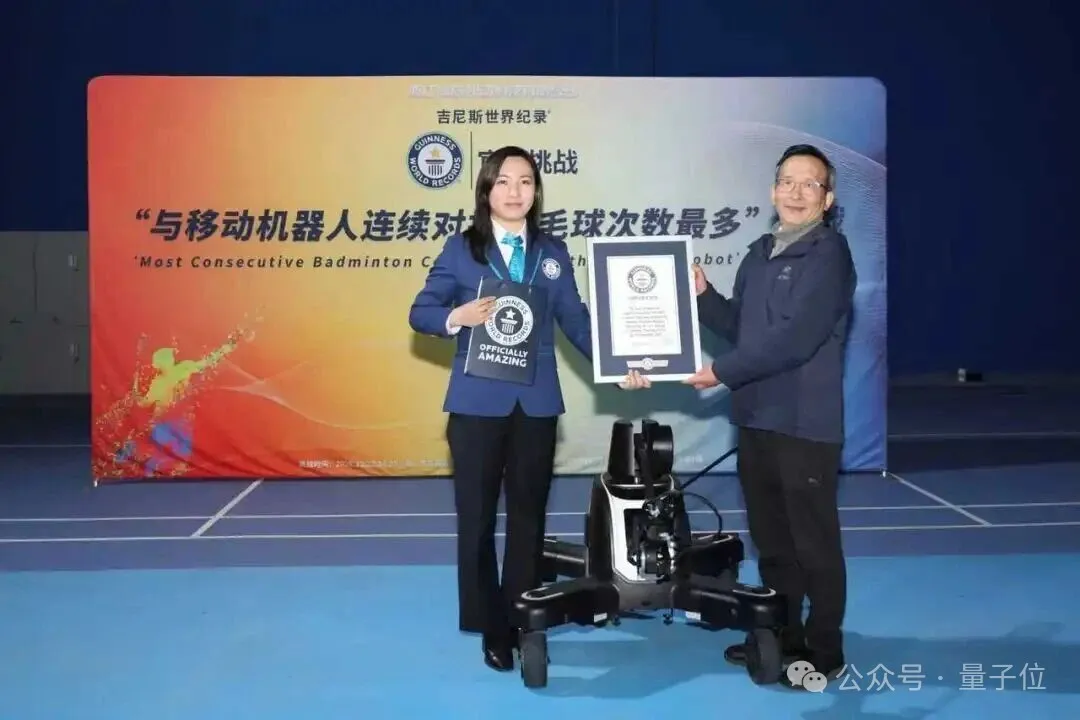
On December 22, 2025, at the Shaoxing Hangzhou Bay Joint Innovation Center, the badminton robot developed by Shencheng Kaidong completed a continuous rally with a human player — 1452 shots.
This achievement was certified by Guinness World Records, with the project namedMost consecutive badminton counter hits with a mobile robot(Most consecutive badminton counter hits with a mobile robot), and 1452 hits have also become the current Guinness World Record for this category.
Judging from public reports, this robot is at a critical juncture of moving from a laboratory prototype to a market product.
The significance of the Guinness record lies not just in the number itself, but in a public verification of the system's stability under long-duration, high-intensity, real-human confrontation.
Landing and Application Scenarios
In sports scenarios, the most direct value of this robot is to serve as a tireless training partner.
In professional badminton training, multi-shuttle training is a core method for improving reaction and stroke stability, but the combination of coaches and serving machines is costly and monotonous in rhythm.
A robot that can rally continuously and adjust its intensity means athletes can get training volume close to real confrontation at any time; for badminton enthusiasts and the youth training market, it can also be a highly interactive experiential entry point.
But what Shencheng Kaidong really wants to do is not just a badminton-specific device.
The significance of a general-purpose physical motion platform is that the hardware chassis, joint drives, and the robot brain can be reused in other scenarios requiring high-speed dynamic manipulation—badminton is merely the first stage for validating this platform.
Industrial shockwaves beyond the racket
Theermann pointed out in his post the true imaginative space of this robot.
Following his judgment, many people see this badminton robot as a cool tech exhibit.
But its real core value has long surpassed sports entertainment itself, validating a deployable, engineering-ready, and scalable general technical path for the entire sports robotics industry.
For a long time, many robotics technologies could only operate stably in static, structured, and controlled laboratory environments; once entering the real world, facing dynamic changes, random disturbances, and unpredictable environments, problems such as delayed decision-making, inaccurate movements, and poor adaptability easily arise.
Relying on its self-developed robot brain and general-purpose physical motion platform, Shencheng Kaidong has to a certain extent achievedengineering implementation of robot motion control:
enabling robots to adapt to real, dynamic, and uncertainty-filled physical environments and deliver effective movements with high precision, high stability, and high timeliness, breaking down the barrier between laboratory technology and industrial implementation.
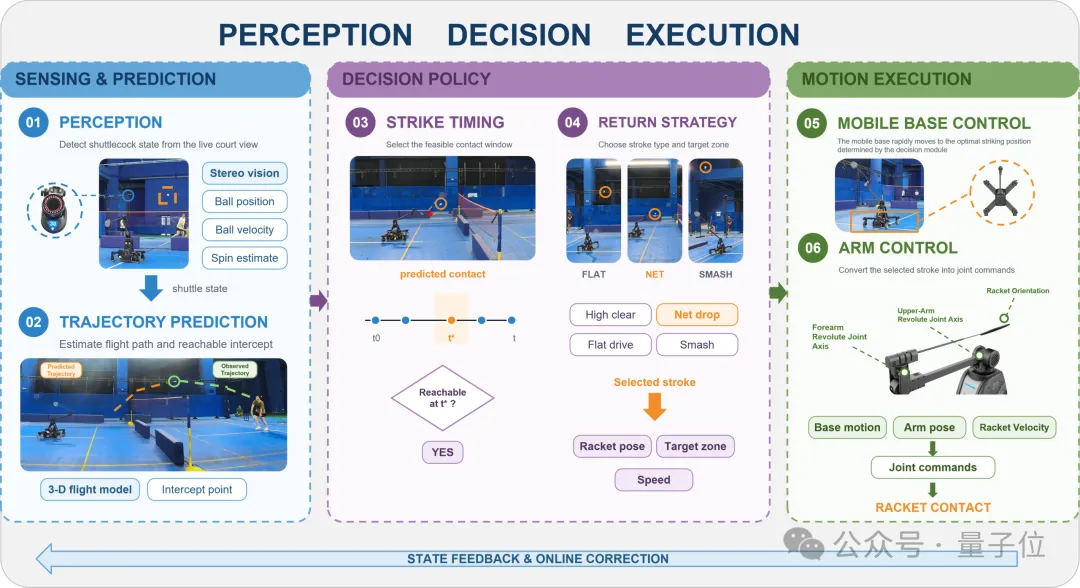
Essentially, making a robot play badminton precisely and making robots autonomously do housework, drive intelligently, perform flexible factory operations, or conduct outdoor intelligent inspections followthe same set of general intelligence logic。
Embodied intelligence scenarios actually all depend on one core closed-loop chain: precisely perceiving complex environments, millisecond-level intelligent decision-making, and high-precision coordinated execution of actions. The breakthrough of the badminton robot is precisely the ultimate validation and refinement of this core chain.
The reason the team chose badminton as the technical testing ground is precisely thatit places high demands on a robot's dynamic perception, trajectory prediction, motion control, and anti-interference capabilities.

A badminton shuttlecock is extremely light, its flight trajectory is easily affected by airflow, and the pace of attack and defense is very fast; against a real human, the direction, speed, and landing point of incoming shots keep changing.
This means the robot must complete perception, prediction, decision-making, and execution within an extremely short time, a high-intensity test of the real-time performance and coordination of the entire system.
Therefore, badminton is more like a high-difficulty validation ground. At the very least, it shows that this system has completed a relatively complete closed-loop validation in real tasks that are high-speed, dynamic, and full of disturbances, and it also provides a technical foundation for later expansion into other dynamic manipulation tasks. For example:
- in the logistics field, achieving high-speed dynamic sorting, unordered parcel grasping, and intelligent material handling in human-machine mixed environments;
- In the field of mobile robots, it can adapt to autonomous driving on complex road conditions, dynamic obstacle avoidance, and flexible operations;
- At the same time, it can broadly empower various terminal products such as home service robots, industrial flexible robotic arms, and special inspection robots.
From this perspective, a human-machine badminton rally may seem like a fun tech demonstration, but what it validates behind the scenes is the robot's entire set of real-time closed-loop capabilities.
It proves that robots can already break free from a strong dependence on fixed scripts and static environments in some high-speed dynamic scenarios, and begin moving toward more complex, more open real-world tasks.
Founding team and shareholder background
The technological foundation of Shenzhen Chenkai Dong comes from a team spanning academia and industry.
ChairmanProfessor Xuan Dong, Bachelor's and Master's degrees in Electronic Engineering from Shanghai Jiao Tong University, Ph.D. in Computer Engineering from Texas A&M University in the United States, IEEE Fellow, Changjiang Chair Professor of the Ministry of Education, and Zhejiang Top Talent.
He taught for more than 20 years in the Department of Computer Science and Engineering at The Ohio State University in the United States, and has been a tenured full professor in that department since 2013.
To date, Professor Xuan Dong has published more than 160 high-level academic papers covering networks, sensing, robotics, computer vision and other directions, with results published at top industry conferences such as ICCPS, NeurIPS and ICCV. He has long been engaged in research on networks and systems and robot intelligence, and is the anchor of the team's academic height and systems vision.
CEOBai Xiaole, Bachelor's degree in Electronic Engineering from Southeast University, Ph.D. in Computer Engineering from The Ohio State University in the United States, has long been deeply engaged in the fields of artificial intelligence, big data, machine learning and digital transformation, has published more than 40 high-level papers, and previously served as CEO of a China Top 500 private enterprise.
CTOYang Fan, Bachelor's and Master's degrees from the Department of Electronic Engineering at Shanghai Jiao Tong University, Ph.D. in Computer Engineering from The Ohio State University in the United States, is a core author of the two papers VaRSM (ICCPS 2022) and Hamlet (ICRA 2025), and was one of the core technical leads who took these two generations of racket-sport robots from concept to reality.
In terms of capital, the company is jointly owned by the A-share listed company Daqian Ecology and the technical team. Zhang Yuan, the actual controller of Daqian Ecology, is a veteran of the BBK group and currently a director of OPPO and a non-executive director of J&T Express; the chairman of Daqian Ecology is Duan Liping. The company was registered in March 2025 with a registered capital of approximately 24.75 million yuan and is based in Zhejiang.
From the world's first three-in-one racket robot in 2022, to the 90.7% success rate against real human opponents in the ICRA paper in 2025, and then to winning a Guinness World Record in the same year, this team has spent years step by step pushing an academic concept toward a real system that can be demonstrated, can rally against humans, and can be commercialized.
Closing words
The robotics industry has never lacked impressive videos; what is lacking is the patience to build hardcore capabilities and put them into real scenarios to be tested.
A shuttlecock takes only a few hundred milliseconds to fly over, but a team spent years polishing those few hundred milliseconds.
When Boston Dynamics' former Chief Strategy Officer wrote his evaluation of this Chinese robot — 'it may look like just playing badminton, but the engineering difficulty behind it far exceeds imagination' — what he was truly seeing was a transformation taking place:
Chinese robotics teams have begun to demonstrate hardcore capabilities recognized by peers worldwide in the most difficult dynamic adversarial scenarios.
The court is only the starting point; the complex battlefields of the real world are the true destination this set of capabilities is meant to reach.
*This article is published by QbitAI with authorization; the views are those of the original author alone.