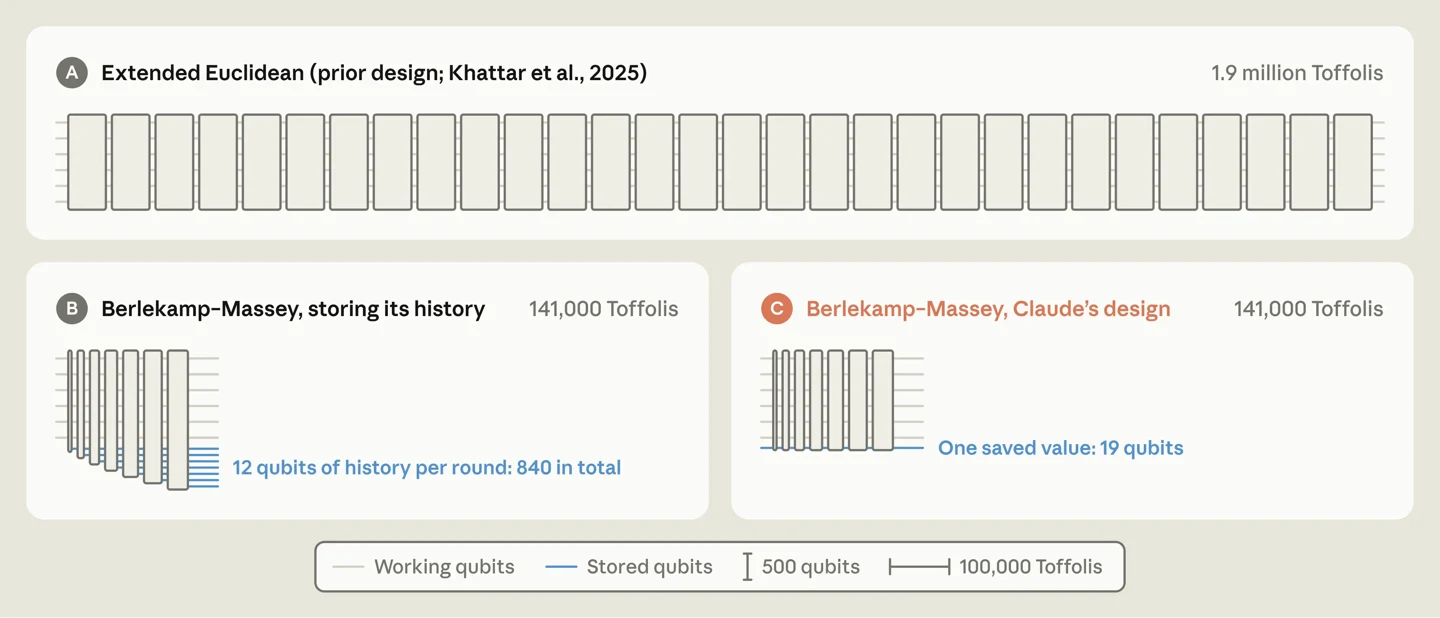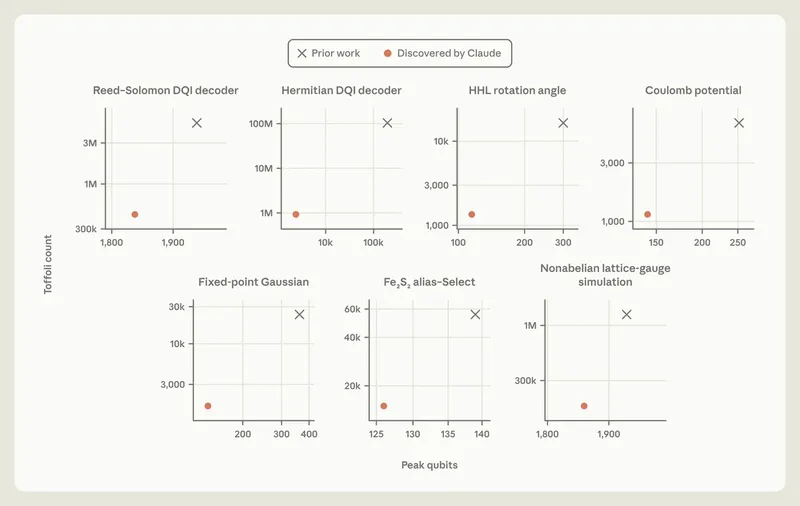
IT之家 News on October 17: Anthropic released research on October 16 stating thatits AI model Claude, with almost no human intervention, designed more efficient solutions than the best published circuits for 8 types of quantum computing tasks.
Citing the blog post, IT之家 reports that quantum computers rely on qubits to operate, but current devices typically have only hundreds to thousands of qubits and are extremely sensitive to environmental noise such as heat and vibration. Both qubits and runtime are scarce resources, so the key to making quantum computing practical is reducing the number of qubits and quantum gates a circuit requires.
A qubit is the "information unit" of quantum computing: classical computers use bits to represent 0 or 1, while qubits can exist in a superposition of 0 and 1, that is, carrying "probability amplitudes" of both states simultaneously. However, qubits are very fragile. Heat, vibration, electromagnetic noise and other factors cause decoherence and computational errors, so current quantum devices typically have only hundreds to thousands of qubits and require extremely low temperatures, isolation, and error-correction mechanisms.
A quantum gate is a unitary transformation applied to one or more qubits, equivalent to the quantum version of classical logic gates (such as AND, NOT), but operating on superposition and entanglement states. A quantum circuit is a set of quantum gates arranged in chronological order, plus steps such as initialization and measurement.
The "cost" of a quantum circuit is usually measured by two metrics: how many qubits are needed, and how many quantum gates are needed. The fewer the qubits and gates, the lower the hardware strain, runtime, and noise accumulation generally are.
The Anthropic research team described 8 tasks from fields including chemistry, optimization, physics simulation, number theory, and numerical computation to Claude in plain language, and set up an automated evaluation procedure.
This procedure checks whether the circuits Claude proposes are correct and scores them by "number of qubits × number of quantum gates"; Claude then iteratively improves based on the feedback, forming a closed-loop design process.
The results show that the new designs Claude discovered not only reduce the number of qubits and quantum gates, but are not minor tweaks to existing solutions—they propose new mathematical and structural ideas.
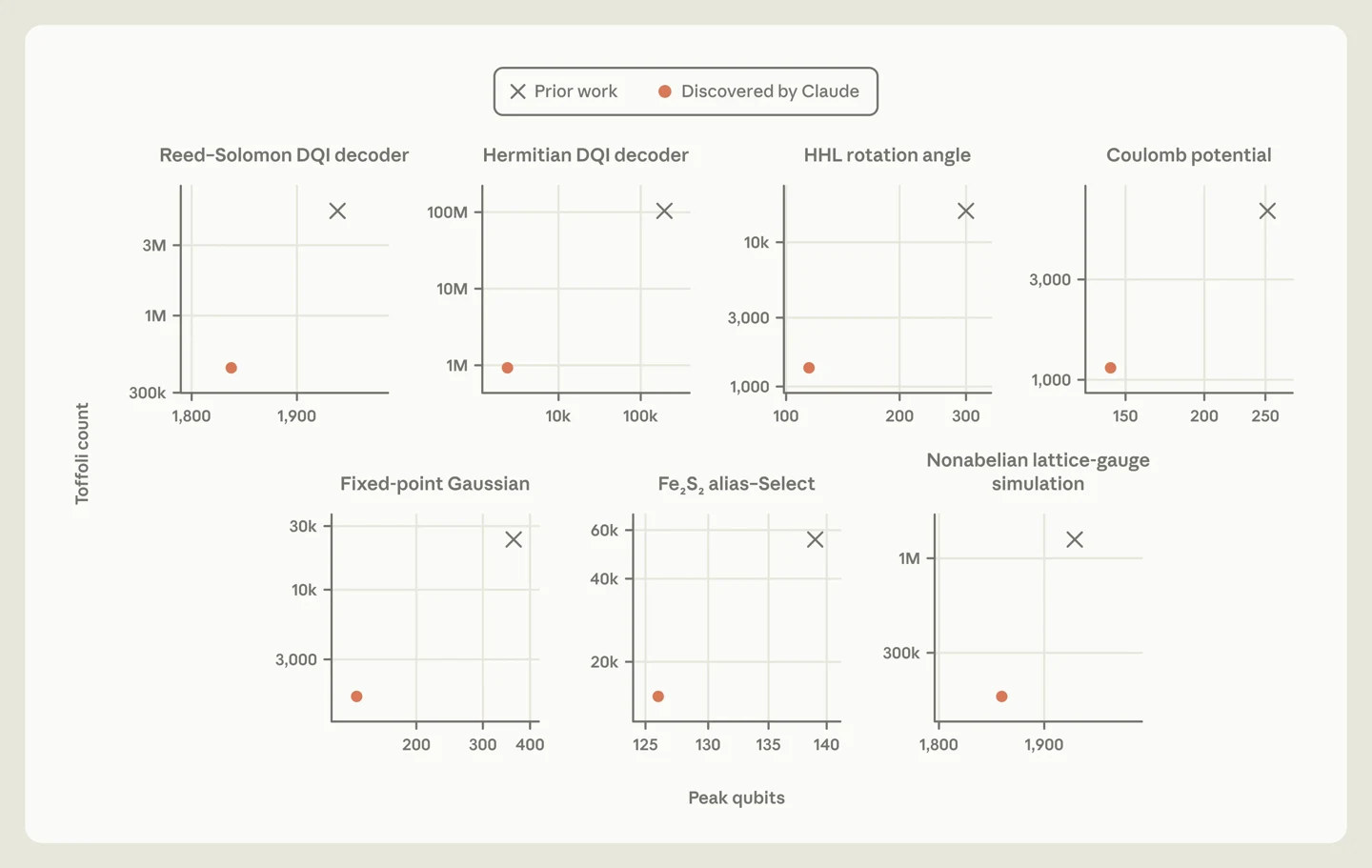
For example, when simulating an iron sulfide molecule, Claude exploited the molecule's symmetry and repeating structure to compute some results once and reuse them; in the decoding step of a quantum optimization algorithm, it reduced the cost of the most expensive step to one 12th.
One representative achievement involves elliptic curve point addition. After about 53 hours of autonomous exploration, Claude proposed a reversible algorithm that can run in reverse without storing the full branch history, and produced a series of new designs that strike different balances between qubit count and runtime.
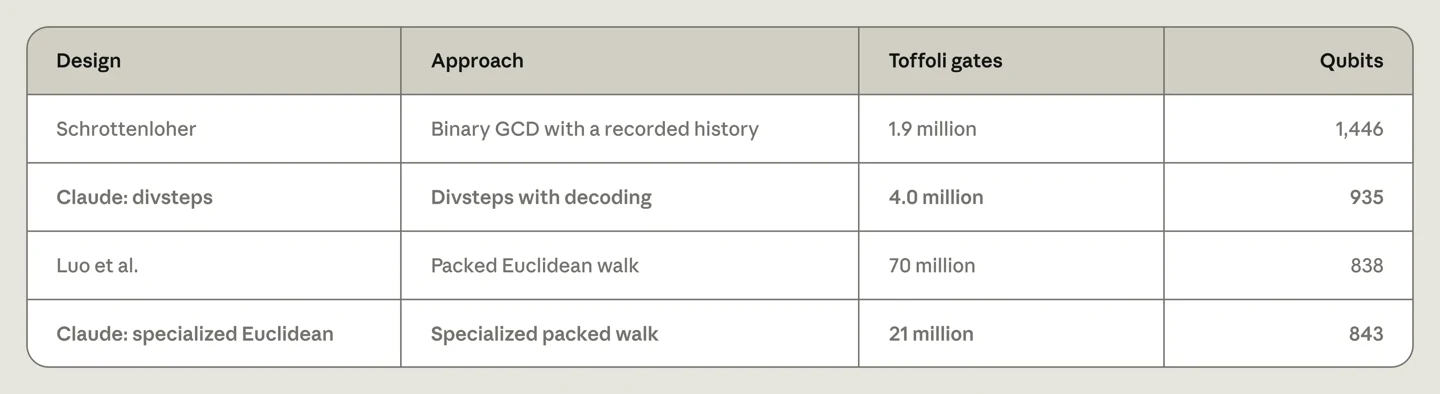
The researchers believe such advances could lower the hardware scale requirements for practical quantum applications, allowing quantum computing solutions for problems such as new drug design, efficient batteries, novel catalysts, and cleaner fertilizer production to arrive sooner. However, the research also notes that quantum circuit design is only one part of building a fault-tolerant quantum computer; issues such as error correction and hardware control still require coordinated breakthroughs.