
Mengyao, from Ao Fei Temple
Quantum Bit | Public Account QbitAI
Tsinghua recently launched a open-source intelligent agent operating system, designed to solve various persistent problems that occur when AI agents are working?!
This system named PilotDeck 2.0 was jointly launched by the THUNLP Laboratory at Tsinghua University, along with teams from Face Wall Intelligence and OpenBMB.
The problem it solves is, coincidentally, highly relevant to the most painful aspects of working with an AI Agent—
For example… when there are too many projects, files, memories, and tasks all get mixed up together, it’s really confusing… (laugh)
It’s very complex; Tokens are generated rapidly. As soon as people leave the computer, the AI gets stuck halfway, waiting for instructions*1000……
And PilotDeck 2.0 targets precisely those troublesome old bugs—memory management, task execution, and model invocation costs.
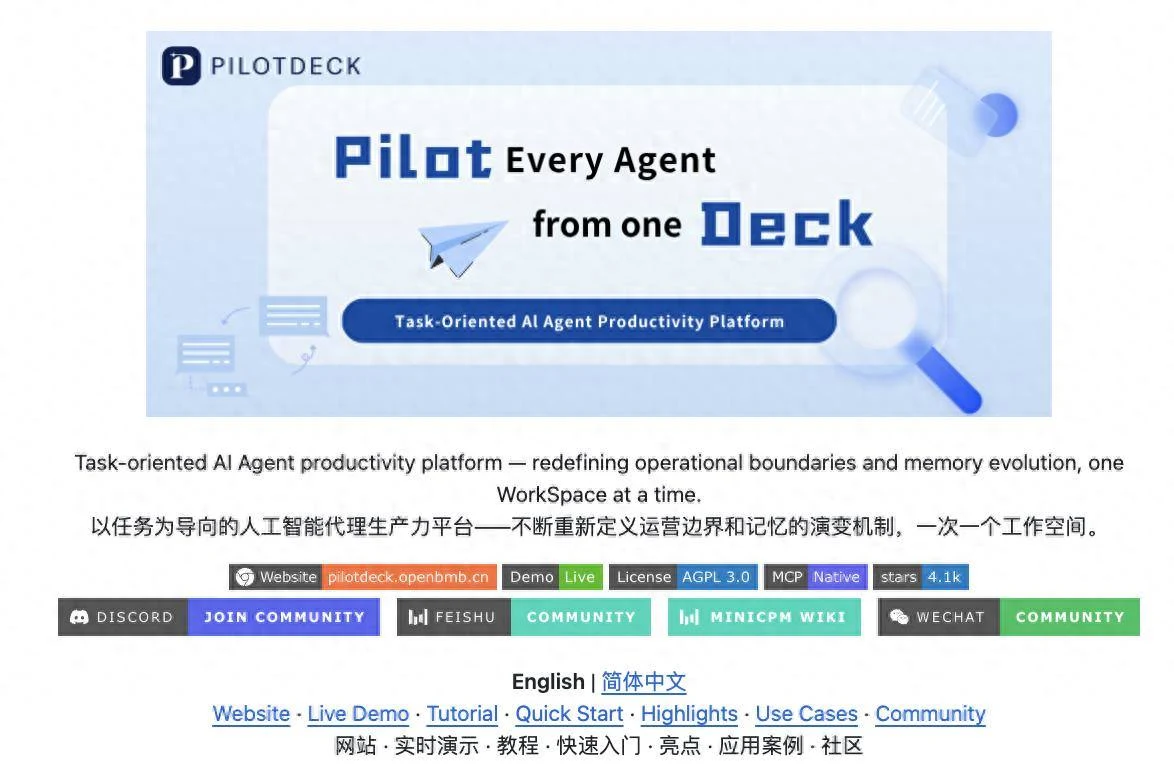
The considerate me also briefly summarized for everyone what this thing can help us with, and what daily troubles it can solve—
- Project management: Handle multiple projects simultaneously, isolate files, memories, and tasks, reducing confusion and overlapping work.
- Long-term memory: Remember the project context, user preferences, and progress, allow viewing and modification, and avoid repeated explanations.
- Backend execution: Supports running long-term tasks and checking actionable items in the background, allowing AI to continue working even when users are away.
- Smart Routing: Select the appropriate model based on task difficulty. Use a strong model for complex tasks and a low-cost model for simple tasks, thereby reducing unnecessary expenses.
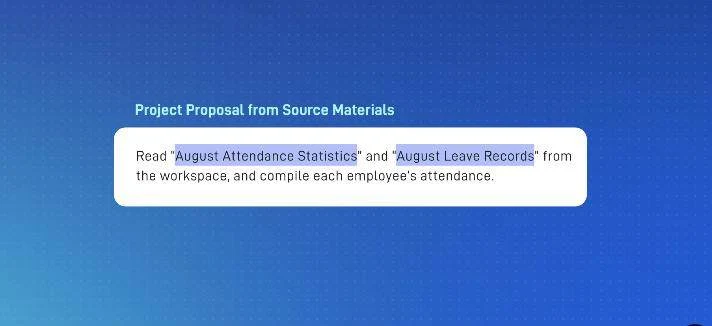
In terms of performance on Workbuddy Bench evaluations, PilotDeck achieved a score of 79.1 with Qwen3.6-35B-A3B, which is also better than Claude Code (77.3).
Moreover, by letting strong models make decisions and small models handle routine tasks, it is possible to cut the cost of complex long tasks by nearly five-sixths??
It sounds like it’s quite practical, huh??
The AI has its own working chamber, and it can manage memory, files, and tasks.
Everyone might have this feeling...
One of the things we’re most afraid of when using various AI tools in daily life is “context pollution”.
For example, just now it asked the AI to write a technical architecture article in a serious academic style, and then asked it to write a Xiaohongshu post, but what it says is still about architectural decoupling... (laughs)
And behind this “charm” thing is mainly related to the black box problem with the memory of most existing Agents.
In other words, what exactly does AI remember, when it remembers, and where it stores it—we on the other side of the screen have no idea.
If I accidentally make a mistake in some key business logic during the process, it will be extremely difficult to find where the problem lies. In the end, I have no choice but to discard the entire conversation and start over!!!

And the core underlying architecture of PilotDeck is based on the WorkSpace as the basic unit.
We can think of it as providing AI with separate physical workstations, where each project has its own dedicated file system, memory database, and skill set.
Specific examples provided by the official side –
Working on audio and video editing in Workbench A, and on iOS mini-games in Workbench B. The memory and retrieval spaces on both sides are completely physically isolated, and they will no longer interfere with each other.
In this way, even when handling several tasks simultaneously, each task can maintain its own context, reducing the trouble of memory confusion and misaligned tasks.
What’s even more problematic is that PilotDeck completely turns memory into a “white-box” format.
For example, AI suddenly said that I remember you previously preferred this style of writing. You probably have no idea where it came up with that conclusion, or whether it made a mistake!!
White-box memory solves this problem by directly giving users the opportunity to “flip through the notebook” at any time.
From the generation, extraction, storage of memory to its final invocation, the entire chain is completely visible to the user.
For example, during the work process, AI records certain preferences and facts. By opening the panel, you can view them one by one.
If it is found that it has miswritten a key parameter, there is no need to write a long string of Prompt to try to make it forget the error message.
Directly modify or delete manually, and you can even fix important information with a single click~
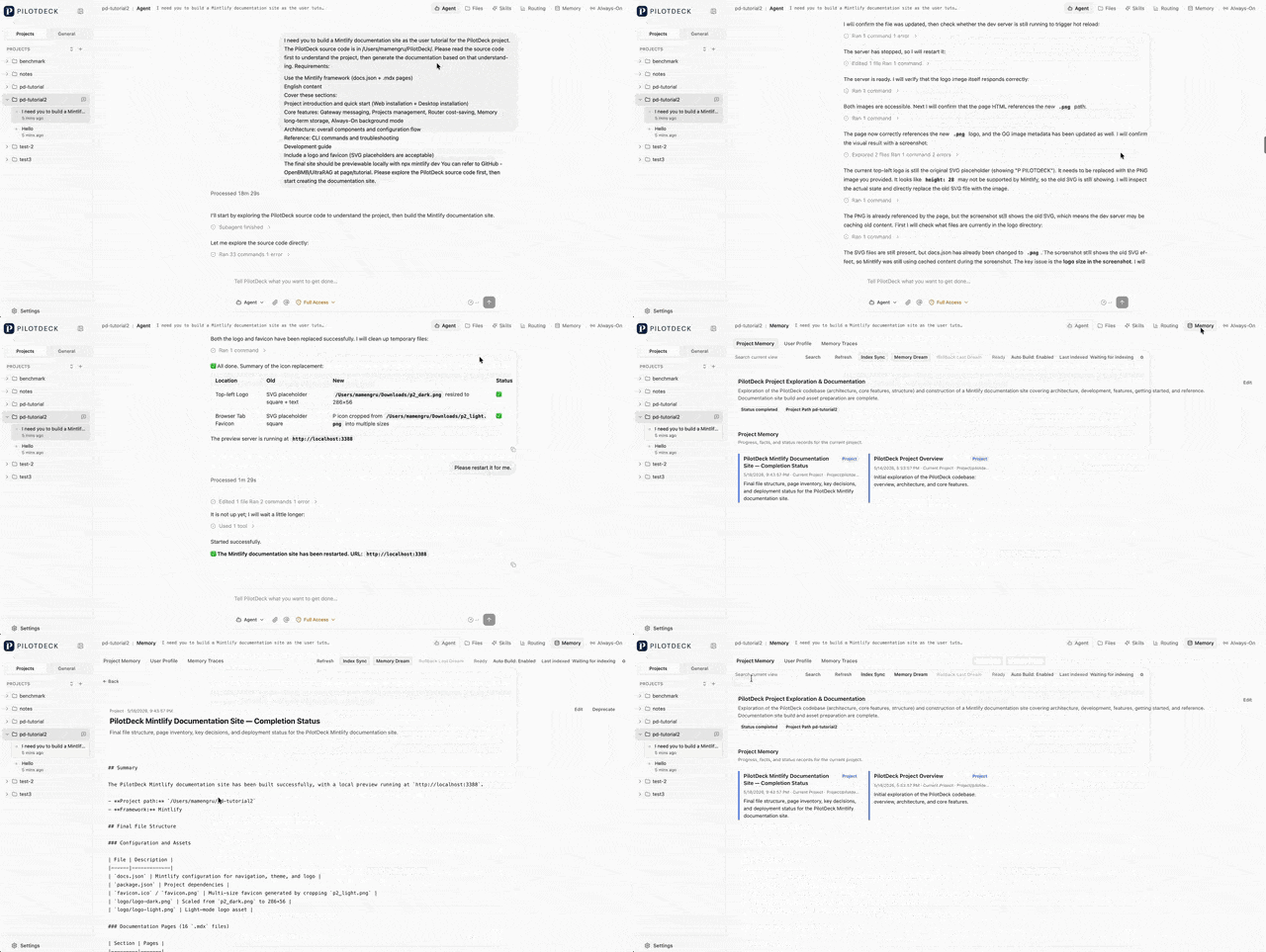
In addition, it also has a mechanism called “Dream Mode” built-in.
When AI is in a idle state, the system automatically summarizes, refines, and removes duplicates from scattered interactions in the background.
If important details are lost during organizing, you can revert them with just one click, instantly returning to the state before organizing, so there’s no need to worry that the mess will get worse as you continue organizing.
Moreover, PilotDeck also introduces an Always-on mode.
Even if the chat window is closed and the computer is turned off, the Agent will still continue to carry out long-term monitoring and task execution in the background.
It can complete the assigned task, actively identify potential additional tasks during execution, and after everything is finished, turn the results into local files along with a complete progress and summary report.
It is worth mentioning that the entire system natively supports MCP.
Whether operating in a web interface, a command-line CLI, or an IM ecosystem like Enterprise WeChat and Feishu, the backend logic and behavior are exactly the same.
For developers, this means they can expand tools and skills around existing workflows.
For friends who use AI for long-term use, it also presents an opportunity to reduce the time spent repeatedly explaining the background and manually connecting steps together~
“Strong Master, Weak Child” intelligent routing: spend 1/6 of the money to destroy the top-tier model...
Using the Agent to run long tasks, and the wallet being unable to handle it, is often the biggest reason for giving up.
Many times the tasks aren’t difficult; it might just be arranging a few paragraphs of text or applying a template for multilingual translations.
But well, due to the simple system architecture, it always runs at full speed on the most expensive flagship model, and the Token consumption is often quite excessive...
It is worth mentioning that PilotDeck also offers Smart Routing.
It has built-in task difficulty recognition at the underlying level. The tasks in different stages are broken down and distributed to models of different levels, enabling a set of end-cloud collaboration and hierarchical scheduling.
Complex planning decisions are left to the top-tier large model, while low-level execution, polishing, and formatting tasks are downgraded to lightweight models.
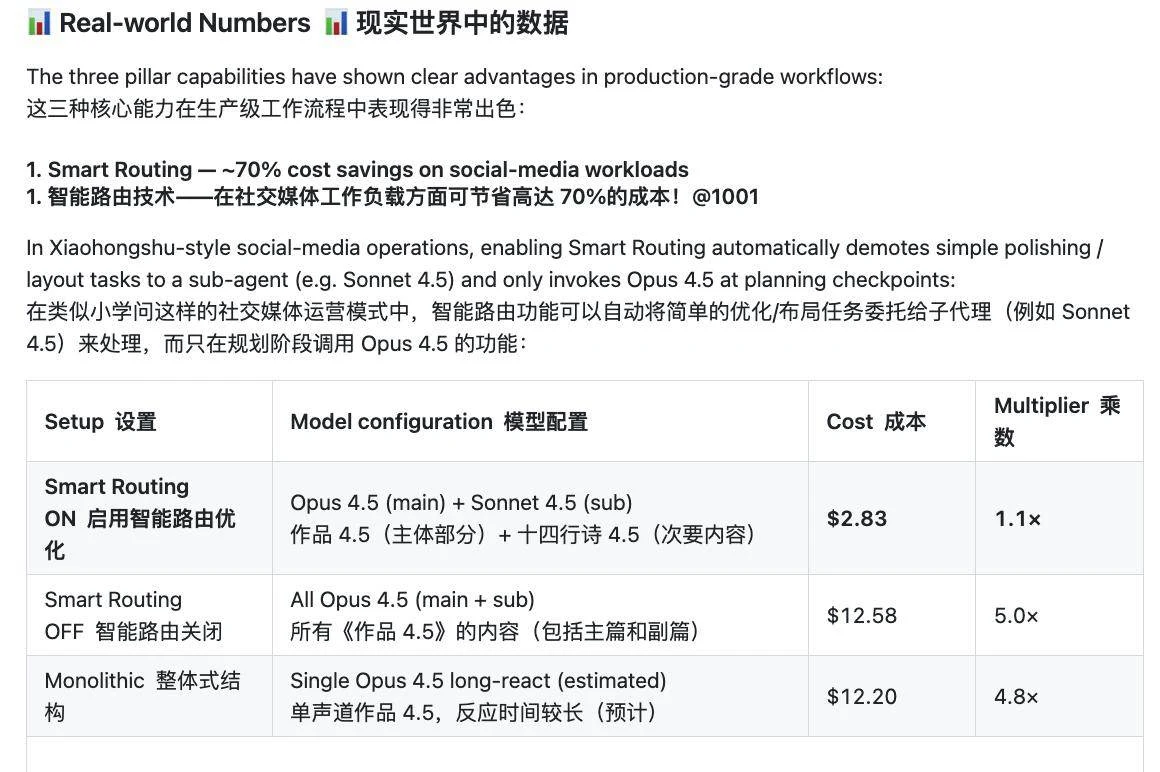
In actual testing in the social media operation scenario, if no cost-saving routing is used and the entire process runs Claude Opus 4.5, the single cost can reach $12.58.
After the intelligent routing is enabled, the main Agent is responsible for top-level planning using Opus 4.5, while the sub-Agent is responsible for text polishing and downgrading to Sonnet 4.5.
The cost is reduced to $2.83, which means a savings of almost 70% on costs, like:
Moreover, in more hardcore complex task tests, is this gap even more significant??
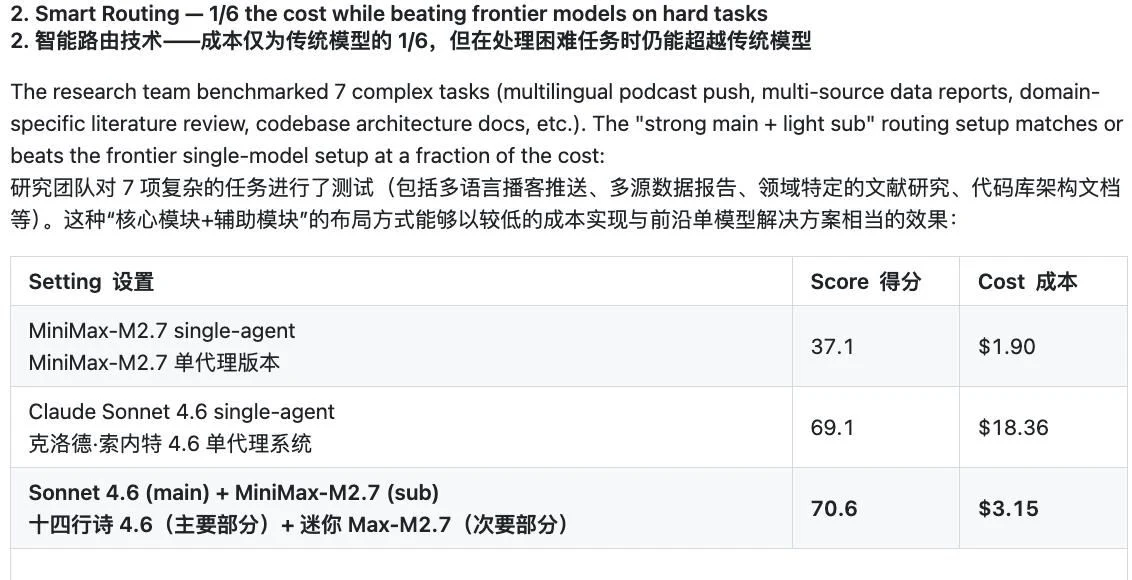
The research team compared horizontally 7 highly complex tasks such as multilingual podcast pushes, multi-source data reports, domain paper reviews, and code library architecture documents.
Single MiniMax-M2.7 runs down, the cost is quite low at $1.90, but the score is only 37.1, so it’s unusable, so it’s passed directly...
The single Claude Sonnet 4.6 version ran down to a score of 69.1, but one test costs $18.36.
Under the routing arrangement in PilotDeck, using the main Sonnet 4.6+ sub-MiniMax-M2.7 main strong-weak architecture, the overall score soars to 70.6, with a cost of only $3.15.
The performance is better than that of a pure top-tier single model, yet the cost is only about one-sixth of the top-tier model’s cost.
By the way, PilotDeck uses the AGPL-3.0 open-source license, supports macOS, Linux, and Windows, and offers a Docker deployment method as well.
If you're interested, you can give it a try. The GitHub link is below!
Reference link:
[1]
https://github.com/OpenBMB/PilotDeck
[2]
https://x.com/OpenBMB/status/2110364065822646570