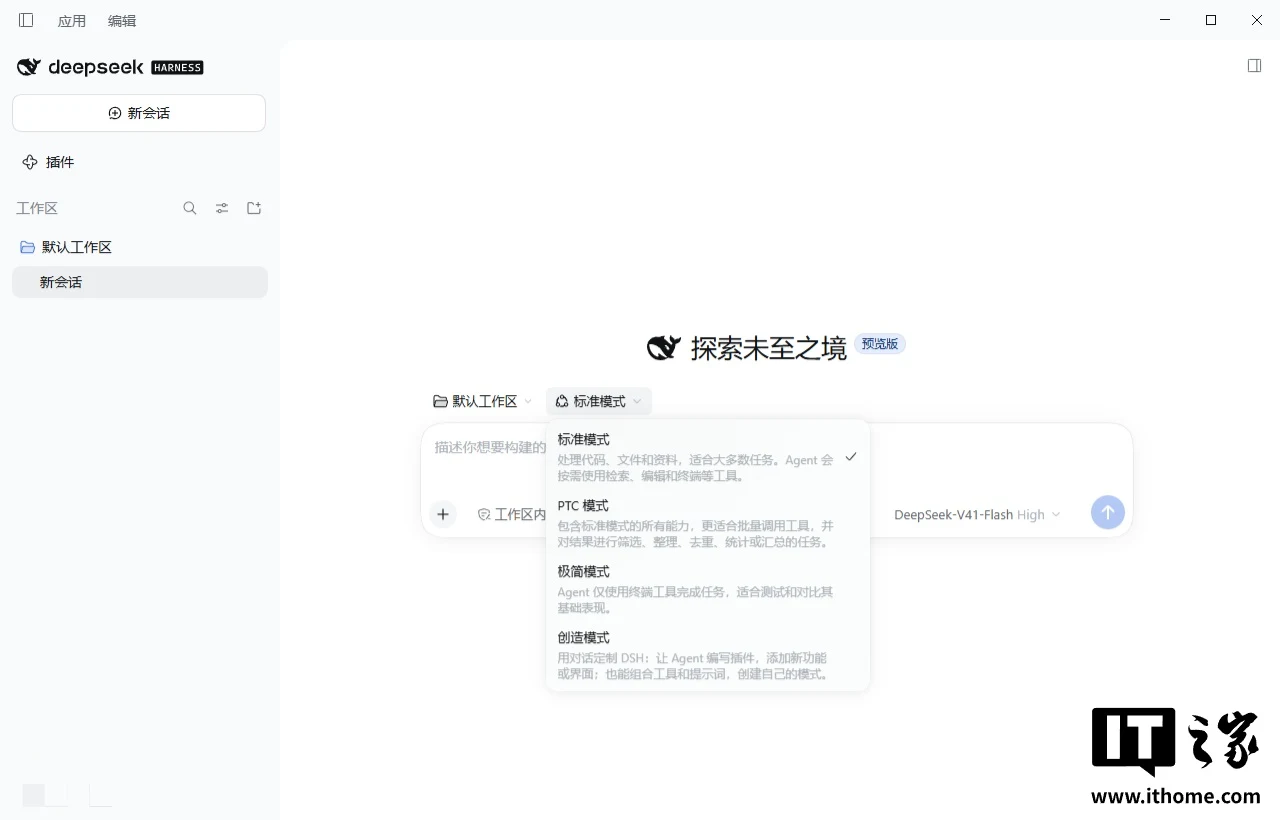
IT Home On October 19, a report was released by CIT Securities’ research official account. It is believed that Harness will become a key component in DeepSeek’s transition from model supply to platform ecosystem. This will transform the open-source and engineering advantages into a user base, ecological influence, and commercial capabilities.
The report mentions that as the competition among agents shifts from model capabilities to delivering stable, easy-to-use, and low-cost tasks, DeepSeek expands its user base and task coverage through pluginization, scenario presetting, and cross-agent collaboration, and extends Infra’s advantages from software and hardware synergy to full task execution.
The report believes that its long-term value lies in the demand for ecological expansion, the enhancement of product stickiness through configuration and process accumulation, the support provided by a backward-looking capability for secure governance, and the creation of conditions for continuous use and enterprise deployment. Based on official model calls, the company can also explore platform services and ecological transactions, transforming ecological accumulation into more diverse revenue sources, and supporting further investment in products and the ecosystem.
CITIC Securities also mentioned in the report that it is optimistic about the continuous rise of domestic large models, as well as DeepSeek’s potential to improve its ecosystem and commercialization loop through Harness. As the capabilities of domestic models continue to improve, combined with cost efficiency and an open-source ecosystem advantage, they are expected to drive AI applications into broader knowledge-based work and business scenarios.
IT Home note: DeepSeek Harness (abbreviated as dsh) is an agent runtime framework open-sourced by DeepSeek AI in August 2026. It is licensed under the MIT license and written in TypeScript.
The most prominent feature of DeepSeek Harness is “everything is a plugin”, including models, tools, skills, sessions, sandboxes, storage, agent loops, scheduling, and UI. All Agent capabilities are provided in the form of plugins through the underlying plugin system Cordis.