
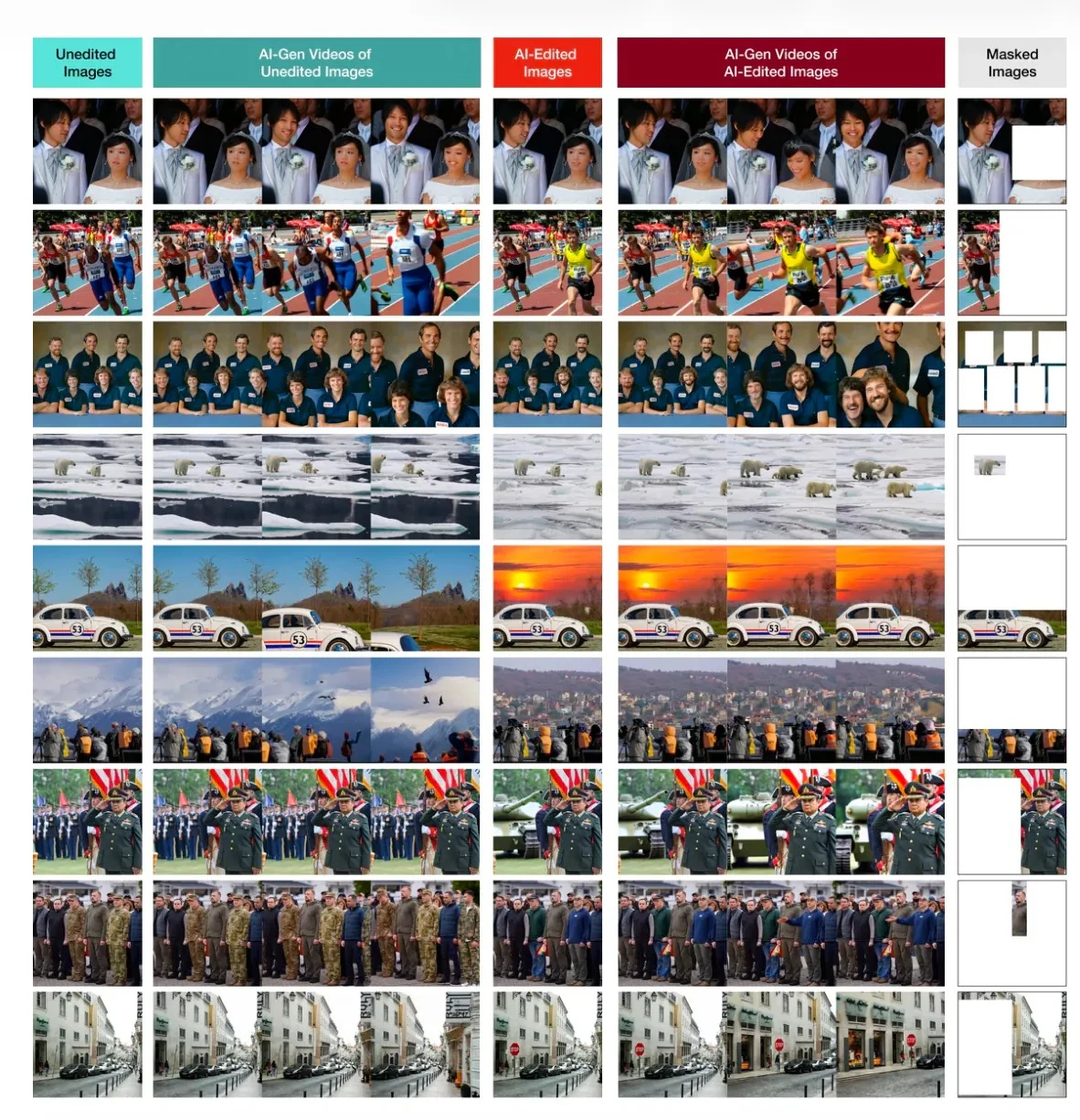
IT Home On October 19, according to a report by the Washington Post, research has found that AI can manipulate human memories. In this experiment, 24 ordinary photos were prepared in advance: weddings, city streets, and racing scenes. Pattie Maes, a professor at the Media Lab at MIT, and her colleagues showed these photos to 200 subjects.
After a short break, some people saw the original image again; others saw a version modified by AI — with changed facial expressions, new military figures in the scene, or added scenes related to climate change.
Then the researchers conducted a memory test.
When seeing the results, Meis was shocked: Among the subjects who watched the AI alter images, the probability of having false memories increased significantly. What’s more serious is that she said they felt even more confident in these false memories.
Mees said, “Basically, I think everything is very dangerous.”
So far, public concerns have mostly focused on what some researchers call “cognitive abandonment”: as machines take on more and more thinking-related tasks, people will become less willing and less able to examine the information provided by the machines. However, there is another possibility that receives much less attention: AI may be changing our memories themselves.
A group of new studies focused on political events, crimes, and even the perception of new movies have shown that images and dialogues generated by AI can implant false details into people’s minds, making them believe that certain things that never happened actually existed.
Memory is not just about retaining the past. It provides knowledge and experience that help us understand the present, predict the future, shape our self-perception, maintain interpersonal relationships, and guide individuals and groups in making decisions.
However, memory itself is also a major weakness of the human mind: we can only remember a small part of what has happened. The details disappear, the memories become vague, and the memory itself changes each time it is recalled.
AI seems to be able to compensate for these flaws: it can store massive amounts of information, retrieve data in seconds, and bring back details that humans might have lost forever. However, these features also carry potential risks. AI systems not only store the past; they also interpret, summarize, and reconstruct past information, and sometimes make mistakes.
The consequences are far more than just forgetting a photo or a conversation. From car accidents to sexual assault cases, court trials often rely on witness memories, although decades of research have shown that eyewitness memory is highly susceptible to distortion. And history itself depends on the choices individuals and society make regarding what to preserve, forget, and ultimately decide to believe about the past.
Humans have inherent flaws in memory
Maez was a pioneer in the field of artificial intelligence. In the early stages of her over 35-year career, she participated in developing some algorithms that laid the foundation for early internet technology. However, over time, she became more interested in another possibility of AI: not replacing human intelligence with machines, but expanding human intelligence.
For Meis, this issue carries personal emotions. As she gets older, her mother begins to forget the details of daily life.
“My mother will forget who came yesterday and what others told her,” Meis said. She could only write a note herself: “‘Daughter says she will come in two weeks.’”
Mees began to imagine a tool much more powerful than a notebook: a memory assistant that could silently record a person's life journey.
For patients with Alzheimer’s disease and other forms of dementia, this issue is particularly urgent. These diseases are characterized by memory loss, and they deprive patients of the ability to live independently.
Mees’ research team has developed several generations of external memory systems. Memoro and MemPal rely on AI, combined with wearable or portable devices, to collect everyday life snippets for easy retrieval later. Forgetting what someone said in a conversation? You can query the system. Not remembering where you put your keys? The system might be able to locate them.
This approach does not ask the aging brain to try hard to improve memory, but instead connects it to another memory database.
The early test results for elderly people are promising. Meis said her 96-year-old mother has severe cognitive decline and cannot benefit from this technology. However, the scientist is very optimistic that such systems will help a large number of people in the future to maintain independent living as their biological memory declines. Some commercial products of this kind have already appeared on the market: such as interactive memory tools that record personal life stories, and personalized smart glasses that assist with daily activities like brushing teeth.
But what if the machine becomes an extension of our memory, and what happens to the memory we form ourselves?
Increasingly dependent on AI
Mae’s other study provides clear evidence for this issue.
In an experiment released last year and currently under peer review, 54 subjects were asked to write SAT-style essays on topics such as the meaning of happiness. One group did not use any online tools; another group could use Google search, but was not allowed to use AI to generate answers; a third group could use ChatGPT.
During the writing process, the scalp electrodes recorded brain electrical activity, and the differences were very obvious: among subjects who wrote independently, the neural connections between different brain regions were the strongest and most widespread; among those using Google, the results were average; among those using ChatGPT, the brain connections were the weakest.
Later, the participants were asked to repeat the essay they had just written. People who relied on ChatGPT found it difficult to recall the words they had written.
According to IT Home, memory is not simply about storing information in the brain. Attention, subjective effort, information retrieval, and establishing connections—all these processes together reinforce memory. Generative AI will eliminate some of this mental work.
Gideon Nave, an associate professor of marketing at the Wharton School of the University of Pennsylvania, and Steven Shaw, an assistant professor at King’s College London, study the impact of AI on human cognition and raise deeper concerns. Nave is not too worried about Hollywood-style nightmares—such as super AI taking control of humanity—but rather about a more subtle risk: humans may gradually stop exercising those abilities that machines can perform.
“It is more likely that human abilities will decline, rather than AI taking over the world,” he added, worrying that in the future “thinking will become an optional choice.”
Signs that researchers call “skill degradation” have appeared. Shaw mentioned several studies: people who rely on AI to assist with their work (such as doctors using AI to diagnose cancer) experience a decline in performance once they lose access to this auxiliary tool.
A study published in The Lancet: Gastroenterology and Hepatology in 2025 revealed such potential effects. The researchers examined the evaluations of 19 experienced doctors on nearly 1,500 colonoscopies and found that after doctors routinely used AI, their ability to independently detect precancerous lesions decreased by approximately 20%.
“They no longer exercise this mental workout like they did before,” he said, “using it until it wears out.”
For children, he is worried about a more fundamental issue: they might assign mental tasks to AI before their core cognitive abilities are fully developed. “They may not be able to develop key critical thinking skills from the start.”
Of course, this does not mean that using AI tools like ChatGPT will necessarily reduce human abilities. Current recent studies have not shown that regular use of AI will inevitably lead to cognitive decline or permanent memory damage. Related research is still in its early stages. Humans have been relying on tools to offload memory and thinking for a long time: abacuses, clocks, dictionaries, and calculators are all examples of this.
But generative AI brings new variables. We rely more and more on it to interpret the information retrieved, and people are easily persuaded by what the AI offers. In Naf and Shaw’s experiment, subjects still followed the AI’s advice at a high proportion even when they received incorrect information.
What happens when AI makes a mistake?
This week, researchers in the fields of AI ethics and society held an annual conference in Malmö, Sweden. Many focused on a single question: What are the consequences when artificial intelligence begins to interfere with human memory?
More and more studies show that generative AI interferes with memory in a remarkable persistent manner: distorting memories, blurring the boundaries between one’s own thoughts and machine-generated content, and even implanting memories of events that never occurred.
In one study, researchers had participants watch a criminal video and then have it discussed with a generative AI chatbot. The number of false memories created by the participants was three times that of the control group. In another experiment, participants brainstormed ideas with and without AI assistance. A week later, they had difficulty distinguishing which ideas came from the machine and which were their own.
Other experiments show that AI-generated false information can make people remember things that never existed. In one experiment, nearly half of the subjects falsely remembered versions of movies that were never filmed, including “The Matrix” starring Will Smith. In another experiment, AI-generated videos made people believe they remembered political scandals that never occurred. However, researchers point out that deepfake videos are not more effective than plain text in creating false memories.
Recent research evidence shows that this problem is more difficult to solve than researchers expected.
Both businesses and government agencies are competing to deploy AI: the police try using AI to summarize video records from law enforcement devices, and hospitals use AI to organize medical documents. Mattea Sim, an assistant researcher at the Georgetown University Institute of Mass Data, said that the most common security measure is to retain human intervention, allowing people to check for machine errors.
But the premise of this approach is that humans can independently verify machines. Sim’s research indicates that the impact may be reversed: AI will change the judgments and memories people use to identify AI errors, causing the human oversight layer to fail fundamentally.
In a recent experiment, Sim recruited 331 people to watch a short animated video of a car hitting a pedestrian. One or two days later, the participants read an AI-generated accident summary. Some of them received a summary that accurately described the traffic signs in the video; others received a summary that confidently reported incorrect signs.
Among the participants who received an accurate summary, nearly 84% could correctly remember the identifier; among those who received a misleading summary, the correct rate was only about 45%. Even if the participants were informed in advance that this summary was generated by AI, it still couldn’t prevent them from being influenced by it.
“Everyone generally knows that AI makes mistakes,” Sim said, but research shows that “manual supervision may not be a good way to solve this problem.”