All AI News
Browse AI developments, their sources and dates.
1281 updatesLatest update 2026-10-05 09:10 UTC+8
Latest updates
1281 updates · UTC+82026-09-22
13 updates
NVIDIA Launches DSX Ready to Qualify Power and Cooling Products for AI Factories
Every AI factory needs power and cooling that fit its computing architecture. As AI infrastructure expands, power, cooling, water, site and grid constraints are shaping what builders can deploy. Choosing products that fit the complete factory design helps builders turn computing capacity into useful AI output. To help builders make those decisions, NVIDIA is introducing […]
Why Deploying Physical AI at Scale Demands Safety at Every Layer
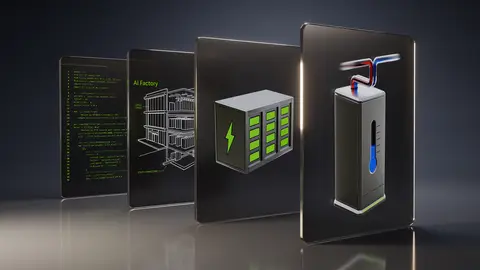
Physical AI is moving rapidly from research to large-scale deployment. By 2035, ABI Research projects an installed base of 49 million level 3-5 autonomous vehicles (AVs), while Omdia estimates that roughly 60 million industrial robots will be deployed between 2026 and 2035. As these machines enter roads, factories, warehouses and other environments shared with people, […]

From Enablement to Execution, Egypt’s AI Ecosystem Reaches Production Scale
Today, Egypt’s AI builders gathered in the Grand Egyptian Museum for a reception that highlighted the nation’s rapidly growing AI ecosystem — spanning AI natives, developers, researchers, startups and enterprises — building applications across industries. The event included a keynote from Paolo Guglielmini, vice president of EMEA at NVIDIA. Ahmed Mostafa, regional AI adoption lead […]

When large-model reinforcement learning goes to scale, what's different about Batch Size Scaling?
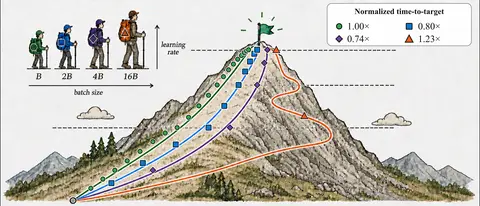
A larger batch lets each update process more sequences, thereby making use of more parallel computing resources; but with a fixed sample budget, the number of times the model can be updated also decreases. In reinforcement learning, when does increasing the batch actually shorten the wall-clock time needed to reach a target performance? For large language models, we must also consider that training rollouts need to be generated online, and that generation and training have different computational resource demands. We build an analytical framework that links the number of samples required to reach the target with end-to-end throughput: only when the throughput gain exceeds the extra sample cost can a larger batch accelerate training. This also yields a practical tuning order: first find the range in which learning outcomes remain approximately unchanged as batch size varies, then optimize throughput within that range. GRPO and PPO experiments show that, after re-tuning the learning rate, learning curves for different batches roughly align when compared by cumulative samples within a certain range. On fixed hardware, increasing the batch improves generation throughput by up to 2.29x; our best measured GRPO configuration reduces the time needed to reach the same validation target by 29% without adding GPUs.

The Situation Report
A rare strain of Ebola, with no confirmed vaccine, is spreading through the east of the Democratic Republic of Congo. World health organizations are using Claude to move as fast as possible to combat it.

Introducing Claude Opus 5.5
Opus 5.5 performs at the level of Claude Fable 5.1 on most work and costs 40% less to run than Opus 5.

2026-09-21
10 updatesImproving synthesis prediction of small molecules at scale with RetroChimera
Custom-made molecules are advancing medicine, materials, and agriculture, but producing them is slow and expensive. A new Nature paper highlights RetroChimera, a predictive model that helps accelerate chemical synthesis, helping researchers explore a wide range of molecules. The post Improving synthesis prediction of small molecules at scale with RetroChimera appeared first on Microsoft Research .

AI Security Is an Engineering Problem — How to Solve It at Every Layer of the Agent Stack
AI security is an engineering problem. That means defined security requirements, enforceable controls, named owners and evidence that protections work. As AI becomes more capable, the industry must accelerate security engineering, broaden access to defensive tools and share what works faster. Technology Changes, Security Fundamentals Endure The internet and cloud computing changed how software operates, […]

Advisory Group on Mathematics and Artificial Intelligence
OpenAI is working with an independent Advisory Group on Mathematics and Artificial Intelligence to guide the review and communication of emerging AI results.

Higgsfield AI ships new video features in a day with GPT-6 Astra
With GPT-6 Astra, Higgsfield AI makes video ad creation easier for small businesses and brings new creative tools to market faster.
5 Companies Using NVIDIA AI for Clean Energy
Clean energy isn’t hard to come by, but the pace of large-scale adoption has historically been slow due to bottlenecks — including out-of-date infrastructure, elongated research and development timelines, and upfront cost barriers. At New York Climate Week, NVIDIA is highlighting five companies pioneering clean energy projects with AI baked into their foundation, accelerating research-to-inception […]

Building standards for the next phase of AI
OpenAI outlines a path to shared global AI standards, calling for coordinated evaluation, reporting, and governance to improve safety.

Expanding OpenAI Academy with new learning paths
Explore new OpenAI Academy learning paths for employees, developers, leaders, educators, and students to build and demonstrate practical AI skills.

V7 cuts costs 78% while boosting accuracy with GPT-5.6 Luna
Using GPT-5.6, V7 turns scattered company files into context agents can use to complete complex, source-linked work.
2026-09-20
1 updatesQwen-Image-2.1: A Small Model with Strong Power, Unifying Creation and Editing
We are pleased to open-source Qwen-Image-2.1, the open-source image model in the Qwen image series that currently balances generation quality, inference efficiency, and usage cost. Qwen-Image-2.1 integrates text-to-image generation and image editing into a single model, with the visual generation portion containing only 7B parameters, and natively supports the generation and editing of transparent images. The main highlights of this update include four aspects: A small model with strong power, exceptional cost-effectiveness: A lightweight model architecture and inference optimizations strike a balance between generation quality and computational cost.