
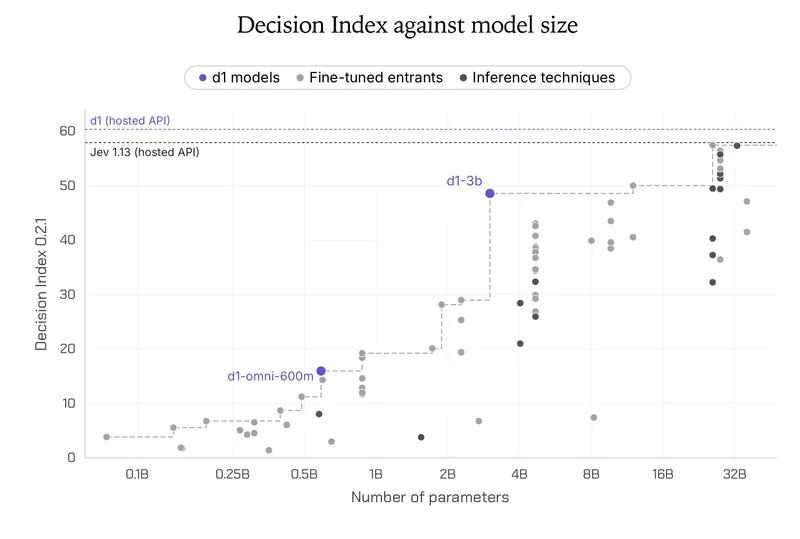
今天,我们在我们的 d1决策模型家族: d1-3B 和 d1-omni-600M (实验性)中发布两个开源决策模型。
- Decision Index 0.2.1上10B以下的最佳决策模型: d1-3B得分为48.57,领先所有4B和9B模型,也领先Decider 35B-A3B(47.11)。
- 多模态: d1-3B支持文本和图像,而d1-omni-600M支持文本和图像或文本和音频
- 快速: d1-3B在NVIDIA Jetson AGX Thor上16 ms即可回答一个问题,在Jetson AGX Orin上为26 ms,在Jetson Orin Nano上为50ms
我们如何构建面向边缘的决策模型
这些开源d1决策模型构建于我们的Liquid Foundation Models(LFMs)之上。与我们的生成式模型不同,决策模型不生成token,而是在单次前向传播中给出答案。
d1-3B和d1-omni-600M从两个截然不同的骨干网络训练而来:
- d1-3B 从 LFM2.5-VL-3B训练而来,这是我们最新的VLM,采用decoder-only架构。它接受文本和图像作为输入。
- d1-omni-600M 从 LFM2.5-Encoder-350M训练而来,这是一个双向编码器。它添加了视觉和音频编码器以处理全部三种模态。它接受文本和图像,或文本和音频作为输入。该模型目前处于早期研究发布阶段,正在进一步开发中。
基准测试结果
我们在七个公开数据集上对d1-3B和d1-omni-600M进行了基准测试,涵盖阅读理解、毒性检测、意图分类、医疗问答和跨语言理解。d1-3B的平均得分为82.9,是表中最高的,高于Decider 4B。d1-omni-600M得分为78.4,仅用四分之一的参数量就超过了Decider 2B(77.1)。
| 基准 | d1-omni-600M | d1-3B | Decider 2B | Decider 4B |
|---|---|---|---|---|
| SQuAD 2.0 | 74.0 | 83.3 | 67.7 | 76.0 |
| Civil Comments | 95.8 | 93.3 | 93.6 | 92.8 |
| MASSIVE intent | 86.1 | 86.9 | 81.1 | 88.3 |
| PubMedQA | 61.3 | 68.3 | 65.7 | 63.3 |
| BoolQ | 77.7 | 86.3 | 87.3 | 89.0 |
| XNLI | 74.7 | 85.6 | 85.0 | 88.6 |
| PAWS-X | 79.5 | 76.4 | 59.5 | 69.8 |
| 平均值 | 78.4 | 82.9 | 77.1 | 81.1 |
我们验证了 d1-3B 在标准视觉基准上保留了其 LFM2.5-VL-3B 骨干模型的视觉能力,并且 d1-omni-600M 能够处理全部三种模态。我们没有报告任何视觉或音频基准结果,因为 Decision Index v0.3 仅包含一个私有的视觉子集,而音频决策基准目前仍是一个未解决的开放问题。
速度
我们与 NVIDIA 合作,在 NVIDIA 技术栈上对 d1-3B 进行了评估,涵盖 NVIDIA GeForce RTX 4090、NVIDIA Jetson AGX Thor、Jetson AGX Orin 64 GB 和 Jetson Orin Nano。由于 d1-omni-600M 是早期研究版本,我们在本版本中未报告其任何速度数据。
边缘推理。 d1-3B 在所有受测设备上回答单个问题的时间均在 50 ms 以内。回答三个问题仅需单个问题的 1.3 倍时间,其中 AGX Thor 从 16 ms 增加到 20 ms。
| 单个问题 | 3 个问题 | 3.4K-token 状态 | 384px 图像 | 64 个状态,已打包 | |
|---|---|---|---|---|---|
| Apple M5 Pro | 30 ms | 41 ms | 640 ms | 62 ms | 78 / s |
| Jetson AGX Thor | 16 ms | 20 ms | 220 ms | 35 ms | 262 / s |
| Jetson AGX Orin 64 GB | 26 ms | 35 ms | 560 ms | 83 ms | 110 / s |
| Jetson Orin Nano | 50 ms | 73 ms | 1,640 ms | 202 ms | 38 / s |
GPU 推理。 在 GPU 上,d1-3B 在两个平台上回答一个问题均不超过 10 ms,处理一张 384px 图像均不超过 18 ms。
| 一个问题 | 3 个问题 | 3.4K-token 状态 | 384px 图像 | 64个状态,已打包 | |
|---|---|---|---|---|---|
| NVIDIA RTX 4090 | 8 毫秒 | 21 毫秒 | 102 毫秒 | 17毫秒 | 475 / s |
| AMD MI325X | 9 毫秒 | 14 毫秒 | 44 毫秒 | 18 毫秒 | 1,106 / 秒 |
如何使用开放 D1 决策模型
当您需要快速、结构化的决策(包括多模态输入)时,请选择 d1 决策模型。d1-3B 在其尺寸级别提供了最高的决策质量,而 d1-omni-600M 则适用于对体积有要求的场景。
安装依赖(需要 transformers>=5.14):
pip install "transformers>=5.14" torch torchvision pillow
这些模型自带代码,因此请使用以下方式加载: trust_remote_code=True:
import io
import urllib.request

import torch
from PIL import Image
from transformers import AutoModel

device = "cuda" if torch.cuda.is_available() else "mps" if torch.backends.mps.is_available() else "cpu"
model = AutoModel.from_pretrained("LiquidAI/d1-3B", trust_remote_code=True,
                                  dtype=torch.float32 if device == "cpu" else torch.bfloat16).to(device)

# Several named questions over one text state, answered in one pass
questions = {
    "refund": {"type": "noul", "instructions": "Is the customer asking for a refund?"},
    "team": {"type": "choice", "instructions": "Which team should handle this?",
             "criteria": {"billing": "Charges, refunds, invoices", "technical": "App or site faults",
                          "fraud": "Suspected unauthorised use"}},
    "urgency": {"type": "score", "instructions": "How urgent is this?",
                "criteria": ["Can wait", "Today", "Blocking the customer now"]},
}
print(model.system_one("I was charged twice this month, please refund one of them.", questions))

# An image as the whole state
url = "http://images.cocodataset.org/val2017/000000039769.jpg"  # two cats on a sofa
photo = Image.open(io.BytesIO(urllib.request.urlopen(url).read()))
print(model.system_one(None, {"cats": {"type": "choice", "instructions": "How many cats are there?",
                                       "criteria": {"one": "One", "two": "Two", "more": "Three or more"}}},
                       images=[photo]))

# Many requests, packed together with no padding
tickets = ["Where is my parcel? It was due Monday.", "The app crashes when I open settings."]
print(model.system_one_batch([(t, {"team": questions["team"]}) for t in tickets]))
为简洁起见,我们只提供 d1-3B 的示例。有关运行说明,请参阅 d1-omni-600M 模型卡片 了解如何运行它。
开始使用开放 d1 决策模型
这两个决策模型均为开放权重模型,现已可在 Hugging Face 上获取:
- 下载: d1-3B 和 d1-omni-600M (在 Hugging Face 上)。
- 试用: 在我们的 System One Arcade Hugging Face Space 中运行演示。
我们迫不及待想看到您构建的作品。
引用
如果您使用本作品,请引用发布博客:
@article{liquidAI2026opend1,
  author  = {Liquid AI},
  title   = {Open d1: Edge decision models for text, vision, and audio},
  journal = {Liquid AI Blog},
  year    = {2026},
  note    = {www.liquid.ai/blog/open-d1},
}