
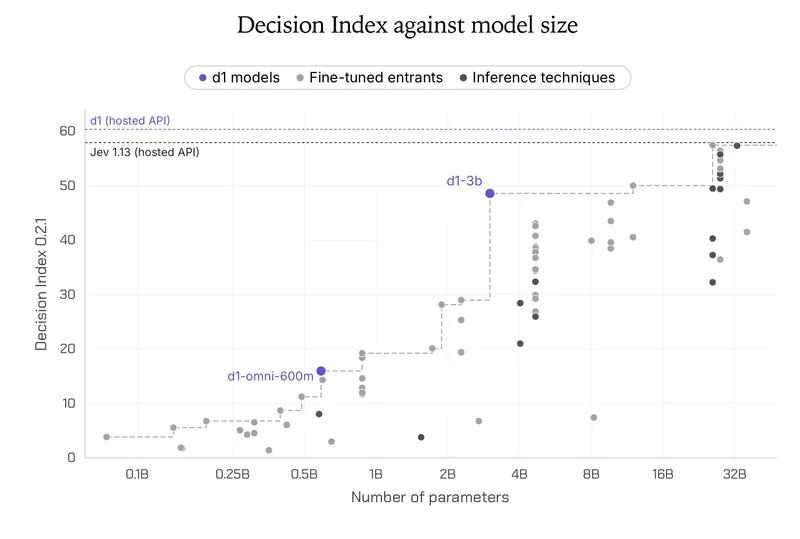
本日、私たちは2つのオープンな決定モデルをリリースします。対象は私たちの d1 決定モデルファミリー: d1-3B と d1-omni-600M (実験的)です。
- Decision Index 0.2.1 における 10B 未満で最高の決定モデル: d1-3B は 48.57 を記録し、すべての 4B および 9B モデル、そして Decider 35B-A3B(47.11)を上回りました。
- マルチモーダル: d1-3B はテキストと画像に対応し、d1-omni-600M はテキストと画像、またはテキストと音声に対応します
- 高速: d1-3B は NVIDIA Jetson AGX Thor 上で 16 ms、Jetson AGX Orin 上で 26 ms、Jetson Orin Nano 上で 50ms で質問に回答します
エッジ向け決定モデルの構築方法
これらのオープンな d1 決定モデルは、私たちの Liquid Foundation Models(LFMs)を基盤として構築されています。生成モデルとは異なり、決定モデルはトークンを生成せず、単一のフォワードパスで回答します。
d1-3B と d1-omni-600M は、まったく異なる2つのバックボーンから学習されています:
- d1-3B は、私たちの最新の VLM である LFM2.5-VL-3Bから学習されており、これは decoder-only で、テキストと画像を入力として受け付けます。
- d1-omni-600M は、双方向エンコーダである LFM2.5-Encoder-350Mから学習されています。これはビジョンおよびオーディオエンコーダを追加し、3つのすべてのモダリティに対応します。入力としてはテキストと画像、またはテキストと音声のいずれかを受け付けます。このモデルは現在、初期の研究リリース段階にあり、さらなる開発が進行中です。
ベンチマーク結果
私たちは、読解、毒性検出、意図分類、医療 QA、およびクロスリンガル理解にわたる7つの公開データセットで d1-3B と d1-omni-600M をベンチマークしました。d1-3B は平均スコア 82.9 を達成し、表の中で最高となり、Decider 4B を上回りました。d1-omni-600M は 78.4 を記録し、パラメータ数が4分の1だけで Decider 2B(77.1)を超えました。
| ベンチマーク | d1-omni-600M | d1-3B | Decider 2B | Decider 4B |
|---|---|---|---|---|
| SQuAD 2.0 | 74.0 | 83.3 | 67.7 | 76.0 |
| Civil Comments | 95.8 | 93.3 | 93.6 | 92.8 |
| MASSIVE intent | 86.1 | 86.9 | 81.1 | 88.3 |
| PubMedQA | 61.3 | 68.3 | 65.7 | 63.3 |
| BoolQ | 77.7 | 86.3 | 87.3 | 89.0 |
| XNLI | 74.7 | 85.6 | 85.0 | 88.6 |
| PAWS-X | 79.5 | 76.4 | 59.5 | 69.8 |
| 平均 | 78.4 | 82.9 | 77.1 | 81.1 |
我々は、d1-3B が標準的なビジョンベンチマークにおいて LFM2.5-VL-3B バックボーンの視覚能力を保持していること、また d1-omni-600M が3つのモダリティすべてを処理できることを検証しました。Decision Index v0.3 にはプライベートなビジョン分割のみが含まれ、音声意思決定ベンチマークは現在未解決の課題であるため、ビジョンや音声のベンチマーク結果は報告していません。
速度
NVIDIA との協力のもと、d1-3B を NVIDIA GeForce RTX 4090、NVIDIA Jetson AGX Thor、Jetson AGX Orin 64 GB、Jetson Orin Nano の NVIDIA スタック上で評価しました。d1-omni-600M は初期の研究リリースであるため、今回のリリースではその速度数値は報告していません。
エッジ推論。 d1-3B は、測定したすべてのデバイスで1つの質問に50 ms 未満で回答します。3つの質問でも所要時間は1問のわずか1.3倍で、AGX Thor では16 ms から20 ms へと増えるだけです。
| 1つの質問 | 3つの質問 | 3.4Kトークンの状態 | 384px画像 | 64状態、パック済み | |
|---|---|---|---|---|---|
| Apple M5 Pro | 30 ms | 41 ms | 640 ms | 62 ms | 78 / s |
| Jetson AGX Thor | 16 ms | 20 ms | 220 ms | 35 ms | 262 / s |
| Jetson AGX Orin 64 GB | 26 ms | 35 ms | 560 ms | 83 ms | 110 / s |
| Jetson Orin Nano | 50 ms | 73 ms | 1,640 ms | 202 ms | 38 / s |
GPU推論。 GPU上では、d1-3Bは質問に10 ms未満で回答し、両プラットフォームで384pxの画像を18 ms未満で処理します。
| 質問1件 | 質問3件 | 3.4Kトークンの状態 | 384px 画像 | 64の州、ぎっしりと詰まった | |
|---|---|---|---|---|---|
| NVIDIA RTX 4090 | 8 ms | 21ミリ秒 | 102 ms | 17ミリ秒 | 475 / s |
| AMD MI325X | 9 ms | 14 ms | 44 ms | 18 ms | 1,106 / 秒 |
オープンな d1 意思決定モデルの使い方
高速で構造化された意思決定、マルチモーダル入力を含む判断が必要なときには、d1 デシジョンモデルを選択してください。d1-3B はそのサイズにおいて最高の決定品質を提供し、d1-omni-600M はフットプリントが重要な場面に適しています。
依存関係をインストールします(必要 transformers>=5.14):
pip install "transformers>=5.14" torch torchvision pillow
これらのモデルは独自のコードを同梱しているため、次のようにして読み込みます。 trust_remote_code=True:
import io
import urllib.request

import torch
from PIL import Image
from transformers import AutoModel

device = "cuda" if torch.cuda.is_available() else "mps" if torch.backends.mps.is_available() else "cpu"
model = AutoModel.from_pretrained("LiquidAI/d1-3B", trust_remote_code=True,
                                  dtype=torch.float32 if device == "cpu" else torch.bfloat16).to(device)

# Several named questions over one text state, answered in one pass
questions = {
    "refund": {"type": "noul", "instructions": "Is the customer asking for a refund?"},
    "team": {"type": "choice", "instructions": "Which team should handle this?",
             "criteria": {"billing": "Charges, refunds, invoices", "technical": "App or site faults",
                          "fraud": "Suspected unauthorised use"}},
    "urgency": {"type": "score", "instructions": "How urgent is this?",
                "criteria": ["Can wait", "Today", "Blocking the customer now"]},
}
print(model.system_one("I was charged twice this month, please refund one of them.", questions))

# An image as the whole state
url = "http://images.cocodataset.org/val2017/000000039769.jpg"  # two cats on a sofa
photo = Image.open(io.BytesIO(urllib.request.urlopen(url).read()))
print(model.system_one(None, {"cats": {"type": "choice", "instructions": "How many cats are there?",
                                       "criteria": {"one": "One", "two": "Two", "more": "Three or more"}}},
                       images=[photo]))

# Many requests, packed together with no padding
tickets = ["Where is my parcel? It was due Monday.", "The app crashes when I open settings."]
print(model.system_one_batch([(t, {"team": questions["team"]}) for t in tickets]))
簡潔にするため、ここでは d1-3B の例のみを示します。 d1-omni-600Mモデルカード 実行方法については、手順をご確認ください。
open d1 意思決定モデルを始めよう
両方の決定モデルはオープンウェイトで、本日Hugging Face上で利用可能です:
- ダウンロード: d1-3B および d1-omni-600M Hugging Face上で。
- 試してみてください: 当社のデモを以下で実行する システムワン アーケード Hugging Face Space。
皆さんが何を開発されるのか、楽しみでたまりません。
引用
この作品を利用する場合は、リリースブログを引用してください:
@article{liquidAI2026opend1,
  author  = {Liquid AI},
  title   = {Open d1: Edge decision models for text, vision, and audio},
  journal = {Liquid AI Blog},
  year    = {2026},
  note    = {www.liquid.ai/blog/open-d1},
}